


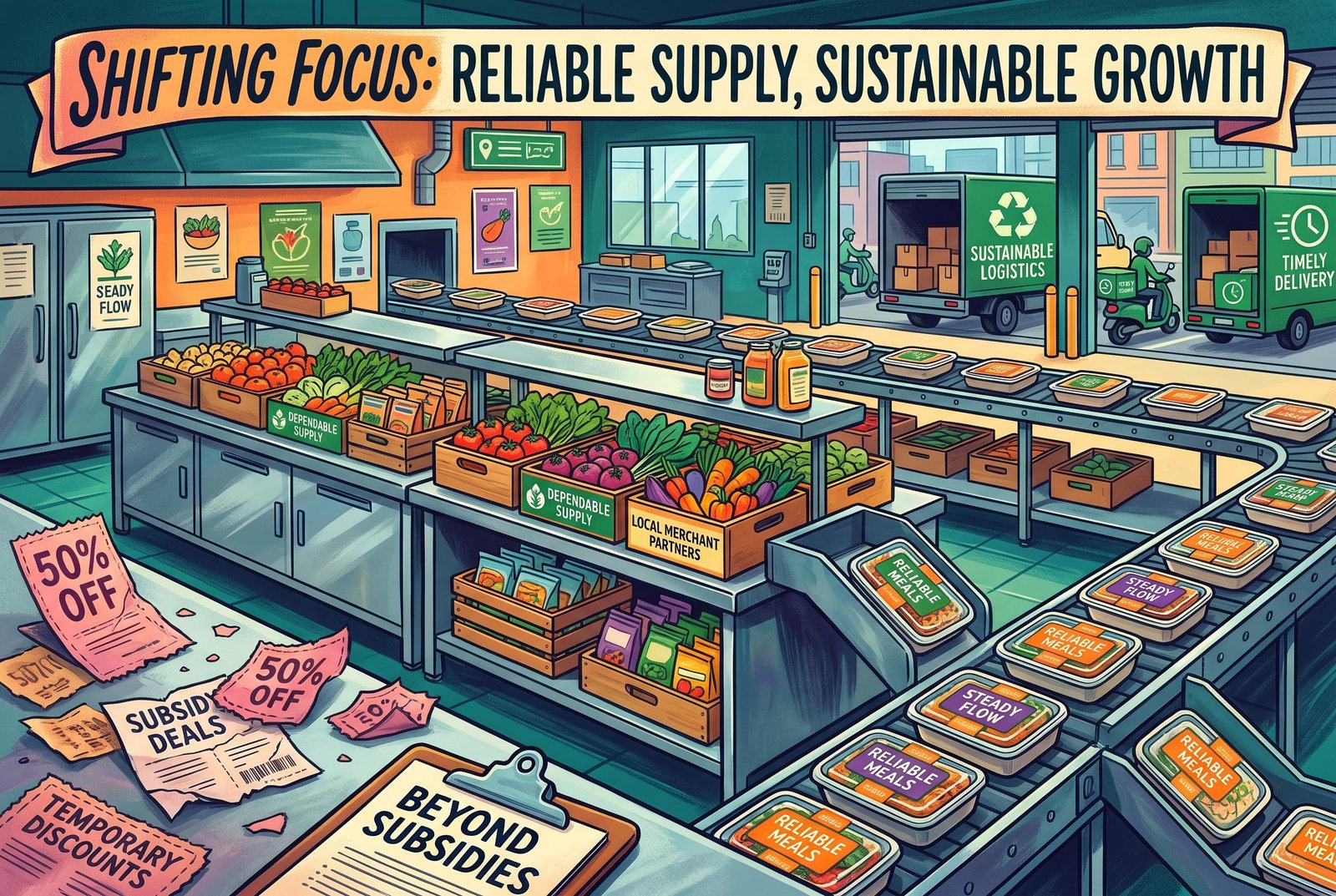
Guo Qing’s reported departure from JD.com marks a possible change in direction for its food-delivery business, after a rapid expansion driven by subsidies and recruitment. The strategic question is no longer only how many orders JD can attract, but whether it can build a supply and fulfilment model that works without continuous promotional spending.
First Financial reported on 4 November that Guo, who led JD’s local-services division, had recently left for personal reasons....
Continue Reading This Article
Enjoy this article as well as all of our content, including reports, news, tips and more.

By registering or signing into your SRM Today account, you agree to SRM Today's Terms of Use and consent to the processing of your personal information as described in our Privacy Policy.
TMTPost, citing people close to JD, reported that the incoming leadership team had extensive supply-chain experience and that the business was entering a new phase centred on supply innovation. That account has not been confirmed by JD, but it fits a broader shift in the company’s public emphasis: away from buying demand through discounts and towards changing how meals are prepared, supplied and delivered.
Guo was recruited to help JD establish itself in local services. Under his leadership, the business built a merchant base, expanded its delivery network and sought to position itself around food quality and worker protections. Fastdata’s industry report says JD exceeded 25 million daily orders in the second quarter of 2025, had more than 1.5 million participating merchants and employed over 150,000 full-time riders. Those figures capture the scale of the expansion at that point; they do not establish that the growth was sustained or that JD secured a lasting share of the market.
The early push drew on a familiar platform strategy: promotions can attract customers and merchants quickly, while a large workforce helps establish coverage. But food delivery presents a different operational challenge from selling standardised goods. A retailer can exercise considerable control over products moving through warehouses and established distribution networks. Restaurant orders involve independent kitchens, variable preparation times and a wide range of dishes, making consistency and delivery coordination harder to impose.
Order density is central to the economics. When many orders cluster in a small area, riders can complete more deliveries with less unproductive travel. A less dense network may require more time and distance per order, increasing the cost of fulfilment. TMTPost’s analysis of JD’s next stage focuses on improving efficiency and the economics of individual transactions, rather than pursuing expansion at any cost. It also describes a reported move towards clearer, market-based accounting between delivery and logistics operations. Such a separation may make costs more visible, but it cannot by itself remove them.
JD is also testing a more direct role in food production through Seven Fresh Kitchen. Jiemian News describes the operation as a partnership in which brands and chefs contribute recipes and menu development, while JD manages ingredients, premises, staffing and daily operations, with the partners sharing the commercial outcome. The outlets are designed primarily for delivery and collection, rather than conventional restaurant dining.
The model brings several parts of the supply chain under tighter control. Ingredients can be processed centrally, packaged and moved to outlets through cold-chain logistics; cooking machines are intended to make preparation more consistent. JD’s approach is more hands-on than a shared-kitchen model in which merchants retain responsibility for their own food businesses. But centralised preparation and automation do not guarantee customer acceptance. Jiemian notes unresolved questions around scale, taste, food safety, affordability and the possibility that JD’s own kitchens could compete with partner restaurants.
This experiment reflects a larger shift in the contest. Instead of relying chiefly on discounts to persuade customers to place orders, platforms are exploring ways to shape the supply available to them. JD is investing in standardised kitchens and logistics; Meituan is associated with a broad network of independent merchants and shared facilities; Alibaba’s Taobao Flash Sale has been expanding its instant-commerce activity, including warehouse-based fulfilment. These approaches are not mutually exclusive, and each depends on whether the operating model can balance convenience, quality and cost.
The subsidy battle has also attracted closer regulatory attention. China’s State Administration for Market Regulation published a draft set of ten rules on platform subsidies in June 2026, inviting comments until 17 July. The regulator said it was responding to concerns that platforms could use financial resources to capture market share, pressure merchants into promotions or shift the cost of discounts on to them. The proposals would restrict practices including forcing merchants to join promotions or pay subsidy costs, and would require greater disclosure around campaigns. They were put forward for consultation, not announced as rules already in force.
That distinction matters as the industry assesses the costs of the recent competition. The debate is often framed as a contest with no winners, given the sums spent by JD, Meituan and Alibaba. But the period has also brought previously contested issues into sharper view: what merchants pay, who bears the cost of promotions and what protections delivery workers receive. JD’s stated focus on full-time riders and lower merchant commissions helped it distinguish its offer, while also adding costs that can make the economics of delivery more demanding.
The company’s broader ambition has been described as extending beyond food delivery. JD chairman Richard Liu has linked the service to the group’s supply-chain capabilities, but evidence that restaurant customers will become regular shoppers across JD’s retail platform remains uncertain. Growth in delivery and growth in online retail do not, by themselves, prove that one is driving the other. A claim that delivery users also buy other goods may indicate an acquisition opportunity, but it does not show how many would have made those purchases anyway or whether the resulting revenue covers delivery costs.
The same caution applies to market-share claims. Fastdata’s account documents a sharp rise in JD’s operating scale during 2025, while the underlying reports offer differing measures of its position and do not demonstrate a durable outcome. A promotional surge can produce impressive order totals without establishing a profitable business once discounts recede.
Guo’s exit therefore signals a leadership change, but it does not, on its own, confirm a settled new strategy. The more consequential development may be the industry’s turn towards building and organising supply: kitchens, cold chains, merchant networks and fulfilment infrastructure. JD’s retail and logistics experience could give it useful capabilities in that contest, though its ability to translate them into reliable meals at a sustainable cost remains unproven. The next phase will be judged less by the peak reached during a subsidy drive than by whether each platform can make its version of local supply work at scale.
Source: Noah Wire Services
Subscribe to Industry Updates
Get the latest news and updates directly to your inbox.

