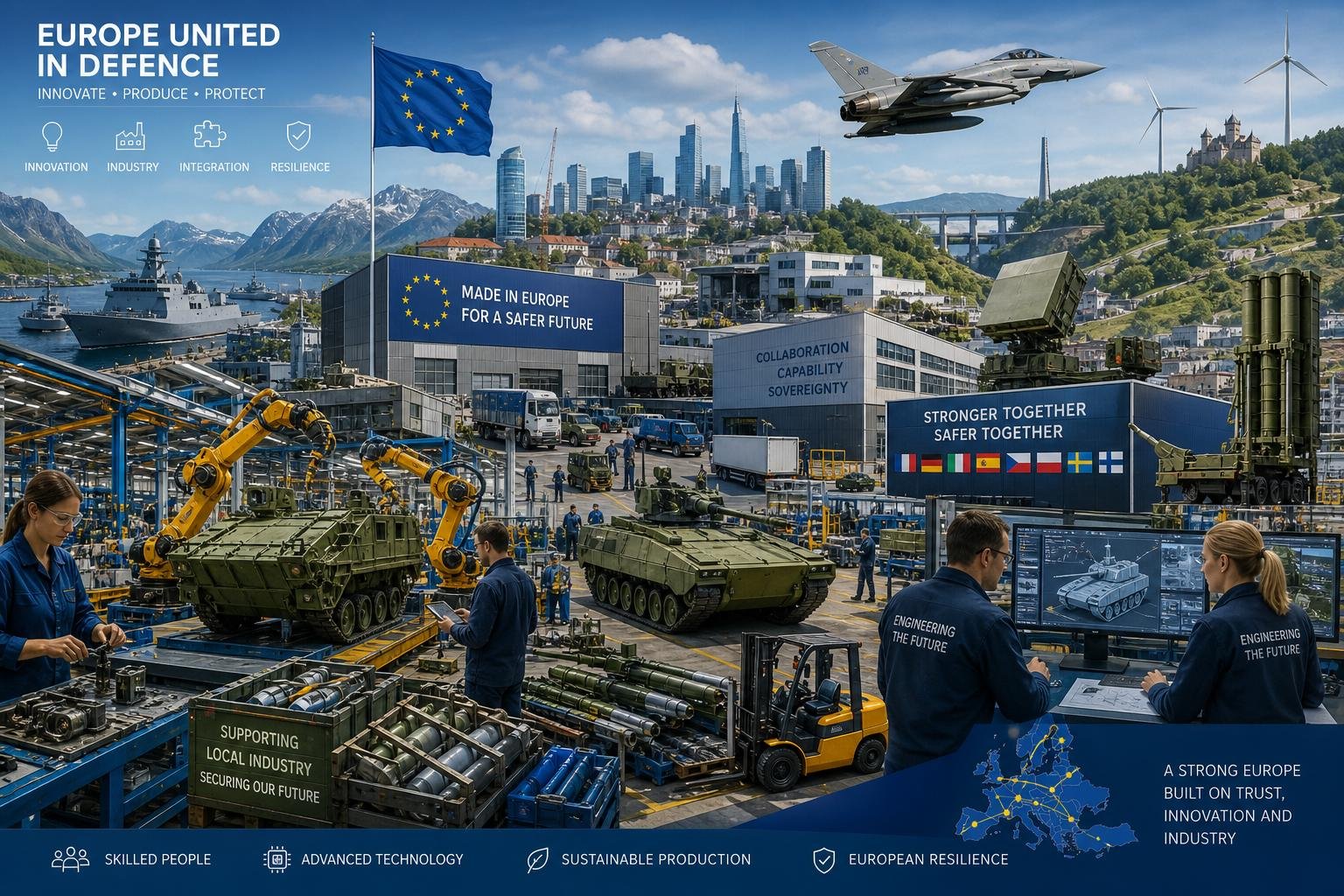
Europe’s defence market is being reshaped by a rare combination of geopolitical pressure, regulatory change and a new willingness in Brussels to treat security as an industrial policy priority.
According to the Council of the European Union, the Security Action for Europe, or SAFE, was adopted on 27 May 2025 as a €150 billion lending instrument to help member states finance joint defence procurement. The European Commission says the programme will provide long-duration, com...
Continue Reading This Article
Enjoy this article as well as all of our content, including reports, news, tips and more.
By registering or signing into your SRM Today account, you agree to SRM Today's Terms of Use and consent to the processing of your personal information as described in our Privacy Policy.
petitively priced loans and is intended to strengthen the bloc’s defence industrial base, close capability gaps and expand production capacity. The Council has also said Ukraine can be associated with the scheme from the outset.
That shift sits alongside a broader policy reset. The European Commission’s defence readiness package is designed to speed up investment and output by clarifying how environmental, social and governance rules apply to defence work, simplifying rules for dual-use technologies, fast-tracking permits for readiness projects and making it easier to move defence products across borders. Brussels has also signalled a more flexible stance on merger control, antitrust and state aid in the sector.
The underlying logic is clear: Europe wants to spend faster, buy more collectively and rely less on outside suppliers. Yet the practical shape of a genuinely European defence industry remains unsettled. France and Germany, among others, have outlined plans for new naval and radar capabilities, but duplication across national programmes could waste capital if the equipment is not interoperable or exportable across the bloc.
For companies hoping to benefit, the market opportunity is considerable, but so are the governance questions. EU procurement rules increasingly favour firms established in the EU, or in closely associated territories, and Brussels has made clear that control by entities outside those areas can limit access. That means boards may need to review ownership structures, executive decision-making and supply chains if they want to compete for public contracts tied to the new spending wave.
The strategic case for this tightening is also political. Relations between Washington and Brussels have remained strained over trade, speech regulation and climate policy, while U.S. criticism of the EU’s regulatory model has sharpened. That has accelerated the bloc’s desire to build resilience at home, but it has also exposed fault lines inside the EU itself, where eurosceptic governments could complicate future action.
To reduce the risk of a veto, the Commission has already shown it is prepared to use treaty mechanisms that allow certain defence measures to move ahead without the usual parliamentary path. That suggests faster, more centralised decision-making may become a feature of the next phase of European security policy.
The result is a defence market that is no longer defined only by military demand. It is increasingly shaped by borrowing, procurement rules, industrial coordination and legal design. For investors and suppliers, the message from Brussels is straightforward: Europe wants a stronger defence base, but access will depend on how closely firms align with the bloc’s political and regulatory priorities.
Source: Noah Wire Services