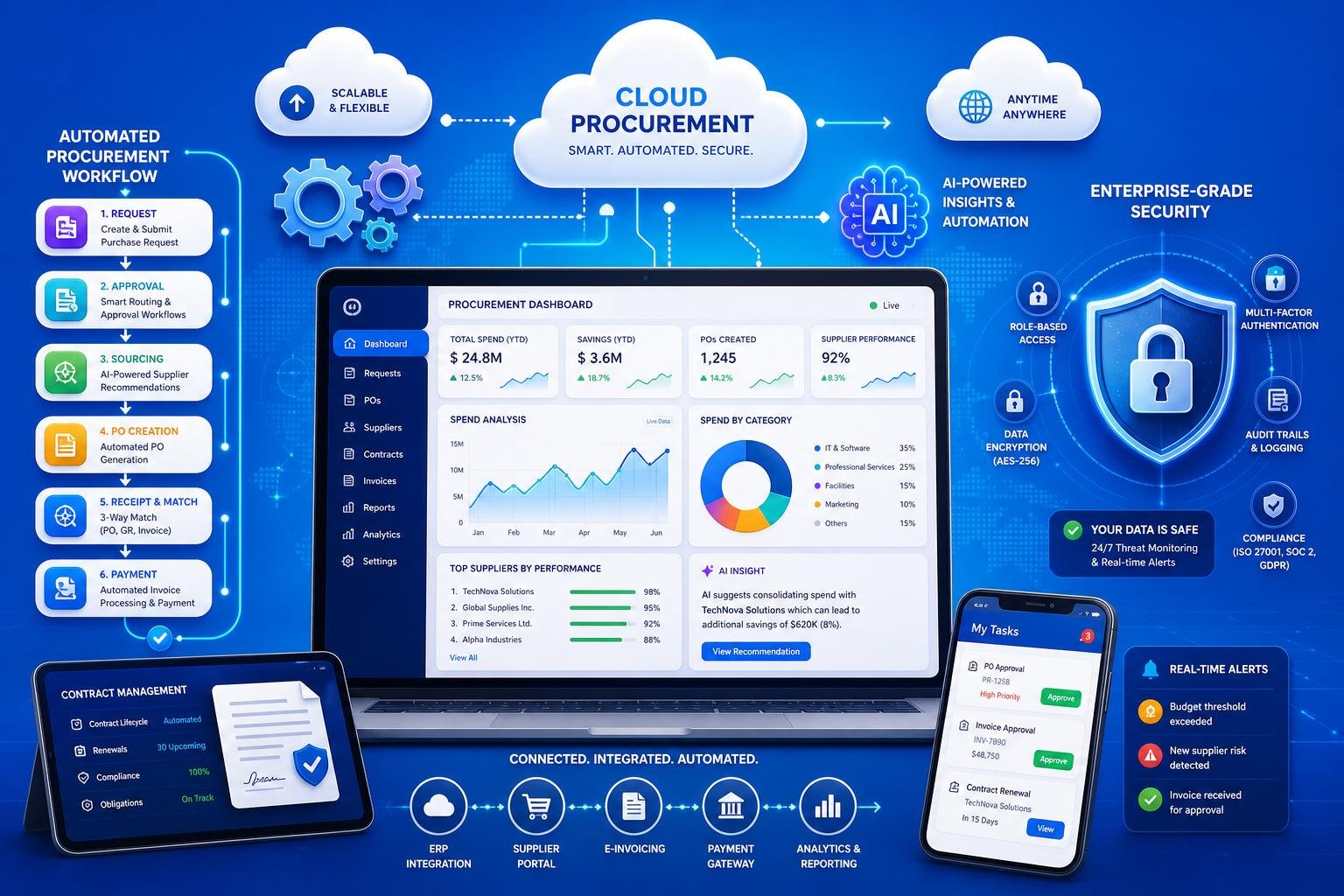
Cloud-based procurement is moving from a back-office efficiency play to a core part of how companies manage spending, supplier relationships and finance operations. As Procurement Magazine notes, organisations are increasingly turning away from legacy systems that rely on manual approvals, spreadsheets and fragmented communication, in favour of software that can centralise purchasing and improve visibility across the whole process.
The appeal is straightforward. Cloud procureme...
Continue Reading This Article
Enjoy this article as well as all of our content, including reports, news, tips and more.
By registering or signing into your SRM Today account, you agree to SRM Today's Terms of Use and consent to the processing of your personal information as described in our Privacy Policy.
nt platforms can reduce administrative friction, allow teams to work from different locations and give managers a clearer view of what is being bought, from whom and at what cost. Fraxion says the main advantages include better accessibility, lower IT overhead, real-time collaboration, stronger security and the ability to scale as businesses expand. That combination has made cloud systems attractive not only to large enterprises but also to smaller firms looking to modernise without investing heavily in infrastructure.
At their simplest, cloud procurement systems move the purchasing workflow onto a secure web-based platform. An employee raises a request, the system routes it through the appropriate approval chain, a purchase order is issued and the transaction can then be tracked through delivery, invoicing and payment. Ivalua describes this as a way to unify procurement activity, enforce policy more consistently and support faster decisions with live data rather than static reports.
CloudBlue defines cloud procurement as the acquisition and management of goods, services and software through online platforms, and says one of its biggest advantages is the ability to control spending in real time while integrating more easily with ERP and finance tools. That integration is important because procurement rarely operates in isolation. Finance teams need invoice visibility, managers need budget oversight and suppliers need timely communication.
Accounts payable is one area where the shift can be particularly noticeable. Automated invoice capture, matching and approval routing can cut down on repetitive manual work and reduce the risk of duplicate payments or delayed processing. Cloud-based AP automation also improves audit readiness, since records are stored digitally and can be retrieved quickly for compliance checks or reporting.
The same logic applies to purchase orders. A cloud purchase order system can standardise order creation, limit unauthorised buying and give organisations a clearer view of approval status, shipment progress and invoice reconciliation. UST says cloud procurement tools are also increasingly incorporating artificial intelligence and machine learning, which may help automate routine tasks and improve responsiveness as business needs change.
Security remains a concern for some organisations, but vendors argue that modern cloud platforms often offer stronger protections than older on-premises setups. Fraxion points to features such as data security, while Cflow highlights the burden cloud software can remove from internal IT teams by handling updates and patches centrally. Common safeguards include role-based access, encryption, backup systems and audit trails.
Adoption is being driven across sectors. Manufacturing companies use cloud procurement to coordinate materials and supplier planning, retailers to manage replenishment across multiple sites, technology firms to speed up software and hardware sourcing, and healthcare organisations to improve compliance around sensitive purchases. The underlying reason is the same: businesses want procurement to be faster, more transparent and easier to control.
The transition is not always smooth. Companies may face resistance from staff, difficulties moving data from old systems or integration challenges with existing finance software. Even so, the direction of travel is clear. As Procurement Magazine and other industry commentators note, cloud procurement is increasingly seen not as an optional upgrade but as part of the wider push to make procurement more strategic, data-driven and resilient.
As AI-enabled automation, predictive analytics and mobile workflows mature, cloud procurement is likely to become even more embedded in day-to-day business operations. For many organisations, the question is no longer whether to move away from manual procurement, but how quickly they can do so without disrupting the rest of the business.
Source: Noah Wire Services