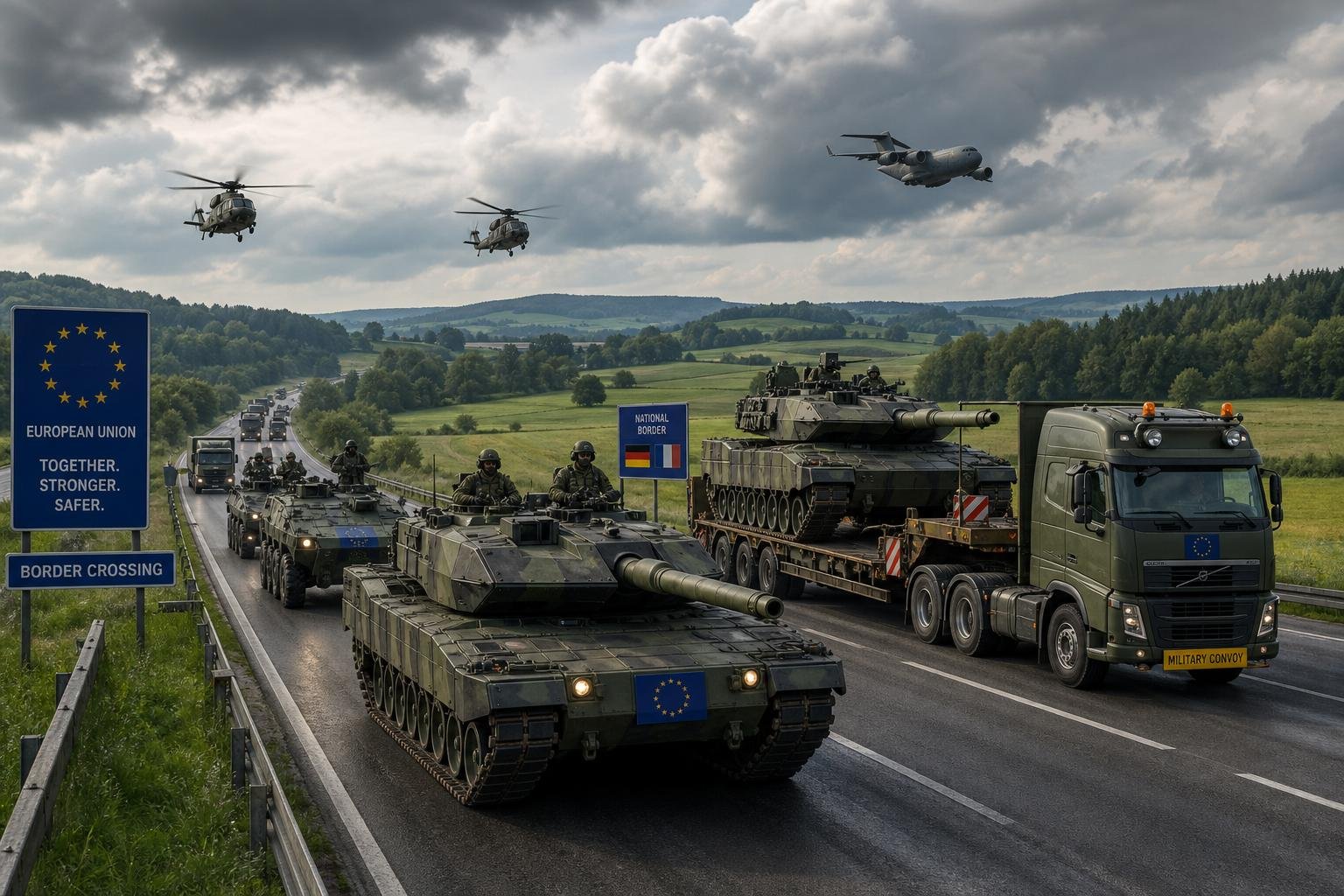
The European Union’s defence policy has shifted decisively since Russia’s full-scale invasion of Ukraine in 2022, with member states raising military spending and the bloc itself building a far more active industrial role. In a recent Birmingham Law School blog post, Professor Martin Trybus argues that this is no longer a purely national rearmament effort: it is increasingly shaped by EU instruments designed to speed procurement, expand production and deepen cooperation across bor...
Continue Reading This Article
Enjoy this article as well as all of our content, including reports, news, tips and more.
By registering or signing into your SRM Today account, you agree to SRM Today's Terms of Use and consent to the processing of your personal information as described in our Privacy Policy.
ders. (
blog.bham.ac.uk)
The scale of the spending push has been significant. According to the European Defence Agency, EU member states reached a record €240 billion in defence expenditure in 2022, with €58 billion devoted to investment in new equipment. The Commission has also been using emergency-style funding to bolster production, allocating €500 million under the Act in Support of Ammunition Production to help raise annual ammunition output to 2 million shells by the end of 2025. (defence-industry-space.ec.europa.eu)
That industrial turn now sits within the EU’s broader “Readiness 2030” agenda. The European External Action Service says the initiative is meant to strengthen military capabilities, reinforce the European defence industry, simplify procurement and increase support for Ukraine. It includes the Security Action for Europe, or SAFE, which provides up to €150 billion in loans for joint defence purchases, while the Commission has also said the European Investment Bank should play a wider role in defence and security lending. (eeas.europa.eu)
Professor Trybus notes that most rearmament remains national, even in states making the largest commitments. Germany’s expansion, he writes, is emblematic, while the Netherlands, Sweden, Finland and Poland have also stepped up more markedly than some southern member states. Against that background, the EU has tried to create a more integrated defence market through long-standing procurement and transfer rules dating back to 2009. (blog.bham.ac.uk)
Those rules are now being overhauled. The Commission’s 2025 Defence Readiness Omnibus proposes amending the 2009 procurement and transfers directives, with changes intended to reduce red tape, widen the scope for simpler procedures, extend framework agreements and make cross-border collaborative purchasing easier. The Commission has also recently launched a public consultation on further simplification of defence and sensitive security procurement, with an impact assessment due to follow. (blog.bham.ac.uk)
Support for the defence industry has meanwhile moved from short-term emergency measures towards a more settled funding architecture. In March 2024, the Commission said the combined budgets of ASAP, EDIRPA and the European Defence Fund amounted to almost €2 billion. In December 2025, the Council gave final approval to the European Defence Industry Programme, which provides €1.5 billion in grants for 2025-2027, including €300 million for a Ukraine Support Instrument. The Commission had earlier described EDIP as the bridge between emergency measures and a longer-term industrial readiness framework. (defence-industry-space.ec.europa.eu)
Still, Trybus warns that the legal reform may not go far enough. He argues that the current directive framework covers only a relatively small share of defence contracts, and that crisis conditions have made security of supply, confidentiality and domestic industrial capacity more important than ever. The Commission itself acknowledged in 2016 that much strategic, high-value defence spending still sat outside the regime, even though it judged the directive broadly fit for purpose. (blog.bham.ac.uk)
His broader point is that Europe’s defence market is being pulled in two directions at once: towards more common rules, common procurement and common industrial policy, but also towards national exemptions, domestic resilience and protection of supply chains. Unless the 2026 reform addresses that tension more boldly, he suggests, the effort may improve procedures at the margins without fully matching the strategic realities of Europe’s post-2022 security environment. (blog.bham.ac.uk)
Source: Noah Wire Services