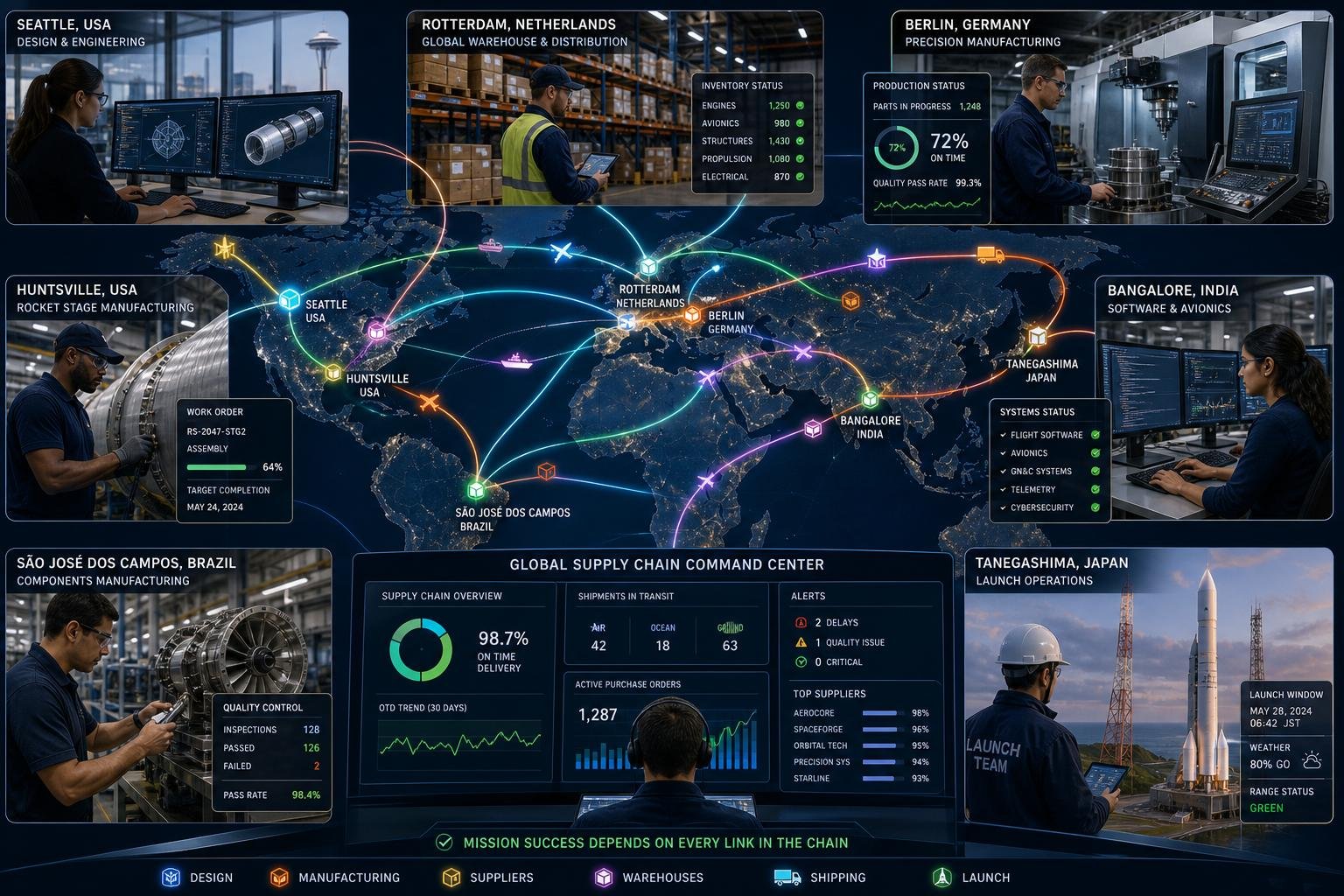
NASA’s Artemis II mission has drawn attention for its role in returning humans to the Moon, but its deeper significance may lie in what it reveals about modern supply chains.
According to the SpaceNews opinion piece, the programme depends on a vast supplier network spread across multiple tiers, with many organisations far removed from one another and often lacking a clear line of sight to where every part begins. That complexity matters because Artemis II is not just a high-p...
Continue Reading This Article
Enjoy this article as well as all of our content, including reports, news, tips and more.
By registering or signing into your SRM Today account, you agree to SRM Today's Terms of Use and consent to the processing of your personal information as described in our Privacy Policy.
rofile launch; it is a test of whether aerospace supply chains can operate at scale without losing control of traceability, quality and timing.
Industry groups have highlighted just how large that network is. ASCM said Artemis II draws on the expertise of more than 2,700 suppliers, while Supply Chain Digital described a similarly wide supplier base supporting the mission’s many technical demands. The point is not only the number of firms involved, but the way they are connected: components, sub-assemblies and data move through layers of contractors and sub-suppliers that are often invisible to the programme’s prime integrators.
That is where the real risk sits. The SpaceNews article argues that supply chain oversight is usually strongest at the top of the chain and thins out quickly below Tier 1, precisely where disruptions can become hardest to detect. A part may appear straightforward at the point of integration, yet still depend on a web of upstream suppliers, inconsistent data formats and fragmented systems. When a problem emerges, teams can struggle to answer basic questions about origin, usage and replacement options.
ASCM noted that one of Artemis’s key tools is its digital thread, a continuous record linking design, engineering, manufacturing, testing and integration. That kind of traceability is increasingly central to aerospace programmes because it shifts supply chain management from a back-office compliance function to an operational necessity. In the event of a failure, leaders need to know quickly where a component came from, how it was made, where else it is used and what alternatives are approved.
The weakest links are often the least visible ones. Lower-tier suppliers may produce specialised parts with long production cycles and few substitutes. In some cases, they may not even realise they are supporting a space programme. The SpaceNews commentary points to the danger of finding out too late that a supplier has changed process, run into quality issues or left the market altogether.
That challenge is not unique to space. Roland Berger and the German Aerospace Industries Association have warned that aerospace supply chains still face severe disruption, with 62 per cent of respondents in one survey saying the problem remains serious. The Aviation Supply Chain Integrity Coalition has also called for stronger document traceability, vendor accreditation and verification to reduce the risk of unapproved parts entering the aviation system.
The article also warns against assuming artificial intelligence can fix these problems on its own. AI can help map dependencies and speed decisions, but only if it is built on clean, standardised and connected data. Without that foundation, automation can amplify confusion rather than reduce it. The harder task, the piece argues, is establishing common product identification standards and treating product data as shared infrastructure rather than something recreated by every supplier or site.
That is a broader shift from linear supply chains to coordinated ecosystems. In a linear model, information is handed off from one organisation to another and often degrades along the way. In a coordinated model, participants work from the same current data, which makes it easier to respond when disruption hits. For Artemis II and the missions that follow, that distinction may prove as important as propulsion or materials science.
As commercial space activity expands, the lesson is likely to become more urgent. More missions, more partners and more pressure on cost and schedule will only increase the burden on supply networks. The organisations that succeed will be those that build shared standards, extend visibility deeper into lower tiers and invest in systems that allow coordinated action, not just observation.
The technology needed to reach the Moon already exists. The harder challenge is making sure the supply chains behind it can keep pace.
Source: Noah Wire Services