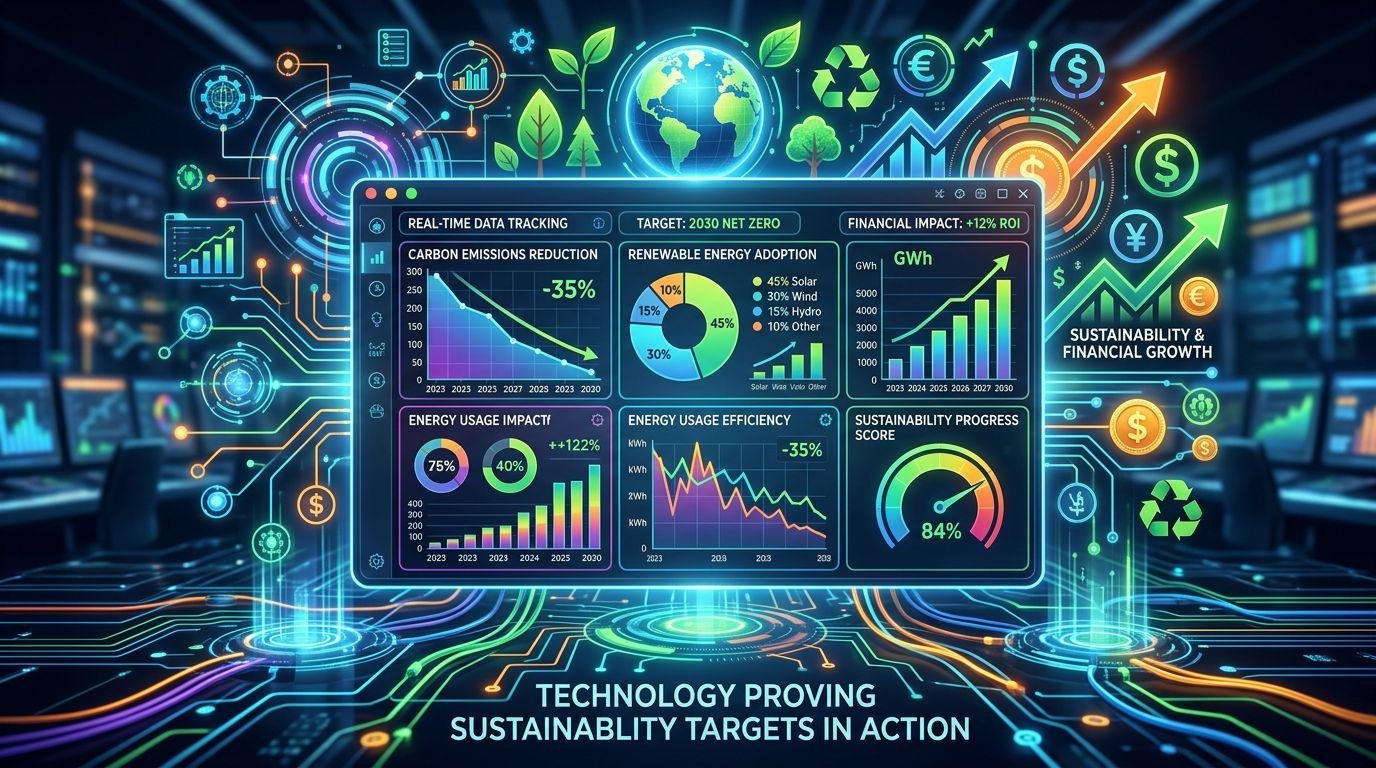
The gap between ambition and evidence has become one of the defining tests of corporate credibility. As scrutiny of greenwashing intensifies and pressure from customers, investors and regulators continues to build, companies are finding that it is no longer enough to announce sustainability targets. They are expected to show, in measurable terms, that those commitments are delivering real-world change.
That shift is changing the role of technology inside businesses. Once judged...
Continue Reading This Article
Enjoy this article as well as all of our content, including reports, news, tips and more.
By registering or signing into your SRM Today account, you agree to SRM Today's Terms of Use and consent to the processing of your personal information as described in our Privacy Policy.
mainly on its ability to cut costs, lift productivity or drive growth, digital investment is now increasingly being assessed on a broader basis: whether it can help organisations reduce waste, track emissions, improve resource use and prove that sustainability promises are more than branding exercises. Without that capability, even the most carefully designed strategy risks remaining an intention rather than an outcome.
This is why the debate has moved beyond whether a company has a sustainability strategy at all. The harder question is whether it can demonstrate that the strategy works. According to research highlighted by Thomson Reuters, businesses are under growing pressure to connect environmental, social and governance initiatives to financial performance, with methodologies such as Return on Sustainability Investment, or ROSI, developed at New York University’s Stern Centre for Sustainable Business, designed to do precisely that. The aim is to show that sustainability is not only a moral or regulatory obligation, but a source of measurable value.
The logic behind that argument is straightforward. A sustainability plan that cannot be tested, tracked and refined is difficult to manage. In practice, companies now need systems that can capture data, monitor performance and translate operational changes into evidence. That is where technology has become central. Sensors, internet-connected devices, live monitoring tools and automated analytics can reveal where energy is being lost, where waste is accumulating and where processes can be improved before problems become expensive or irreversible.
The World Economic Forum has said sustainability is increasingly seen as a core part of corporate strategy, pointing out that while nine in 10 executives consider it important, far fewer organisations have fully embedded sustainability plans. That mismatch helps explain why so many companies still struggle to turn good intentions into consistent delivery. Strategy, in other words, is no longer the main challenge; execution is.
The implications are not limited to manufacturing or heavy industry. In healthcare, electronic health records, remote consultations and data analysis tools can streamline services and improve access to information. In the public sector, digital systems can reduce bureaucracy, improve transparency and make institutions easier to navigate. Across all of these areas, the same principle applies: technology matters most when it turns abstract goals into observable results.
Business schools have long argued that sustainability should not sit apart from commercial strategy. Harvard Business School has noted that sustainability, in a corporate context, is about the impact companies have on people and the planet, and that integrating those concerns into core decision-making can support long-term resilience. The Institute for Management Development has likewise argued that companies commit more seriously to sustainability when there is a clear business case for doing so, because that makes it easier to scale initiatives and embed them into everyday operations.
That business case is becoming more compelling as sustainability, efficiency and competitiveness converge. Cutting energy use, reducing waste and improving process control can all lower operating costs. More transparent systems can strengthen trust with stakeholders. Simpler digital services can improve the experience of customers and citizens alike. In that sense, sustainability is no longer a separate agenda item; it is increasingly intertwined with performance.
Technology strategists are making a similar point. As TechTarget has argued, environmental sustainability is not merely a reputational exercise, but one that can deliver direct returns through savings, risk reduction and stronger competitive positioning. Other analysts, including those focused on ESG technology, say the most advanced tools are shifting corporate sustainability away from retrospective reporting and towards live management, allowing companies to ask not only what happened, but what should happen next.
For business leaders, that means the task has evolved. The challenge is not simply to add digital tools to an existing sustainability plan, but to design both together from the outset. Measurement, validation and continuous improvement need to be built into the model, not bolted on afterwards.
That is because a target without a way to track progress is difficult to govern. And a commitment without evidence of delivery will increasingly struggle to stand apart from a slogan.
Technology will not make a company sustainable on its own. But without the ability to measure what is changing, analyse what is working and adapt operations accordingly, it becomes far harder to move from aspiration to impact. In an era when stakeholders want proof rather than promises, that transition may prove decisive.
Source: Noah Wire Services