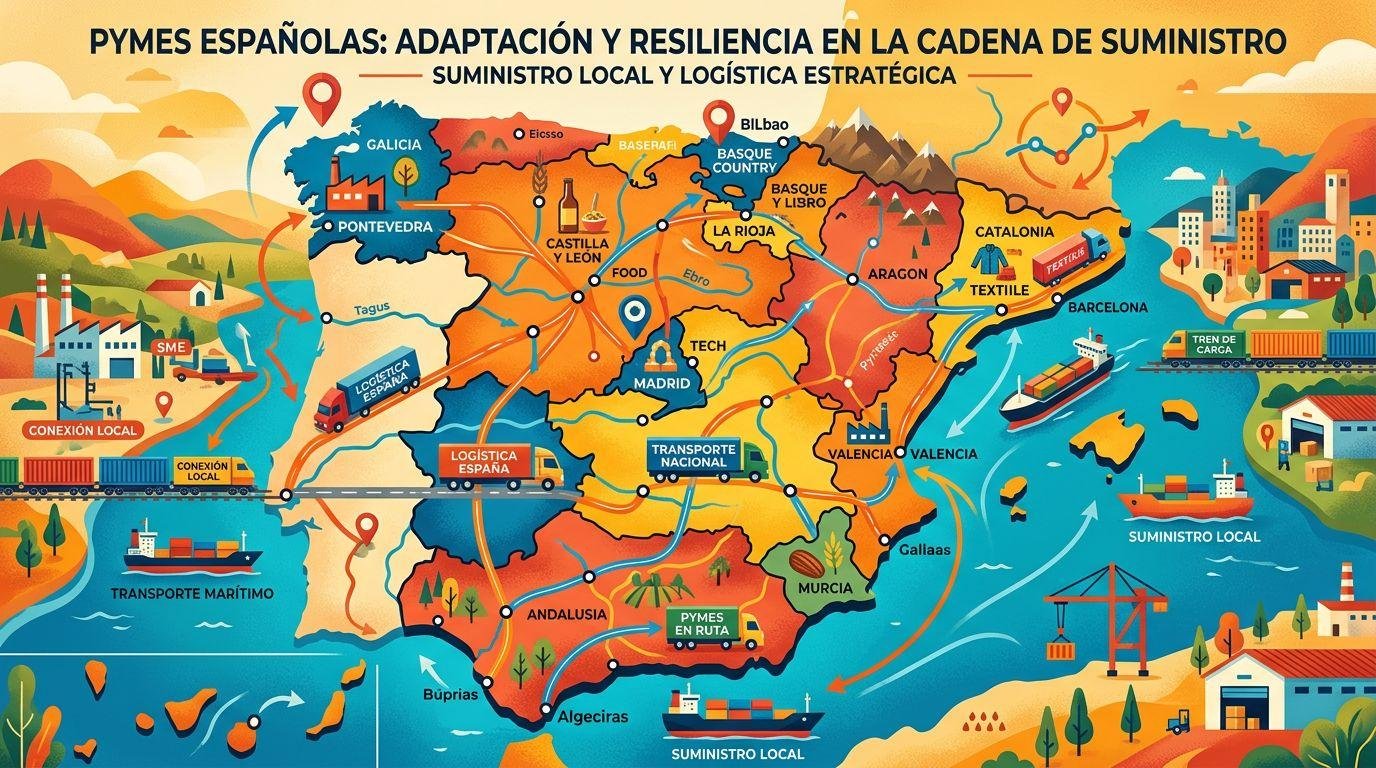
Spanish small and medium-sized enterprises are steadily reshaping the way they buy, source and receive goods, moving towards supply chains that are more mixed, more selective and, above all, closer to home. The latest edition of Geopost’s 2B Recipient Barometer suggests that this shift is being driven by a combination of geopolitical uncertainty, persistent cost pressure and a growing desire for greater control over deliveries.
Compared with the first edition of the study in ...
Continue Reading This Article
Enjoy this article as well as all of our content, including reports, news, tips and more.
By registering or signing into your SRM Today account, you agree to SRM Today's Terms of Use and consent to the processing of your personal information as described in our Privacy Policy.
2024, Spanish SMEs now rely on a broader blend of channels when looking for suppliers. Digital tools, including the internet and artificial intelligence, are becoming more relevant, but personal relationships and traditional commercial networks still carry particular weight in Spain. Across Europe, Geopost says 15% of SMEs now use AI tools to research suppliers, illustrating how quickly procurement habits are changing, even as face-to-face contact and word-of-mouth remain important parts of the process.
One of the clearest changes is the rise of local sourcing. In Spain, 80% of SMEs now source domestically, a rise of 12 percentage points from the previous survey. That still does not mean stepping away from international supply chains altogether. Another 80% of Spanish firms buy within the European Union, above the European average of 72%, with Italy, Germany and France among the leading markets. Beyond Europe, sourcing remains more limited, but China and the United States continue to feature in procurement strategies.
The broader European picture points in the same direction. Geopost says 84% of SMEs across the continent now source domestically, up eight points from 2024, while 20% have cut back on international deliveries amid geopolitical instability. Taken together, the figures point to a more hybrid model in which businesses are trying to balance resilience with efficiency rather than relying on a single procurement route.
That recalibration is also making logistics more central to commercial decision-making. Delivery performance is no longer treated as a back-office concern but as part of supplier selection itself. In Spain, 23% of SMEs now see the parcel carrier as a key criterion when choosing a supplier, a sign that transport capability has become entwined with business continuity.
The stakes are high. Among Spanish SMEs, delays disrupt operations for 50%, stock shortages affect 48% and missed deadlines hit 47%. Those pressures explain why 65% would like to choose their own carrier, compared with 56% across Europe, reflecting a wish to exert more control over the final stage of the supply chain. Security, speed and reliability remain central expectations: 77% say safe handling is essential, 70% want quick resolution of problems and 63% regard punctual delivery as non-negotiable.
Previsability is emerging as the next priority. Businesses want clearer information about when orders will arrive so they can plan labour, manage stock and avoid interruptions. Better real-time tracking, faster service and more transparent communication are all being seen as part of what an ideal delivery experience should look like. SEUR’s Santiago Hernández said the findings show that SMEs are adapting their supply chains to a more complex environment, arguing that logistics now has to offer “previsibility, flexibility and capacity to react” rather than simply punctual arrival.
Alternative delivery options are also gaining ground. In Spain, 41% of SMEs now want out-of-home or off-site delivery solutions such as parcel shops and lockers, compared with 32% in Europe. Yet technology has not displaced the human element. Some 75% of Spanish firms say they value familiarity and consistency in the person who delivers their parcels, suggesting that reliability still depends partly on the relationship at the doorstep.
Despite rising expectations, satisfaction remains relatively strong. According to the survey, 85% of Spanish SMEs are satisfied with domestic deliveries and 87% with international ones. The proportion describing themselves as very satisfied is higher for domestic shipments, at 46%, than for cross-border deliveries, at 39%, which may reflect the greater complexity of moving goods abroad.
The food and drink sector shows many of the same trends, but with sharper demands for speed and flexibility. These companies continue to depend more heavily on traditional sourcing channels and use the internet less than their European counterparts, although they are ahead in adopting AI tools. For them, the most important delivery features are safe handling, quick problem-solving and punctuality.
Problems with delivery are also more likely to block supplier relationships in this segment. Nearly half, 48%, say delivery issues are one of the main barriers to working with a supplier, ahead of poor reputation at 43% and price at 42%. Speed matters especially strongly: 47% want faster deliveries, well above the 31% recorded for SMEs overall, and 51% particularly value pickup points or lockers. As in the wider sample, there is also a strong appetite for carrier choice, with 63% wanting to be able to select the transport provider themselves.
The overall picture is of a business sector that is becoming more pragmatic and more cautious at the same time. Price, quality and availability still matter, but they are now being weighed alongside resilience, delivery performance and the ability of logistics partners to provide certainty. For many Spanish SMEs, the route from supplier to customer has become a strategic issue in its own right, and one increasingly tied to whether the business can keep operating smoothly in an uncertain world.
Source: Noah Wire Services