


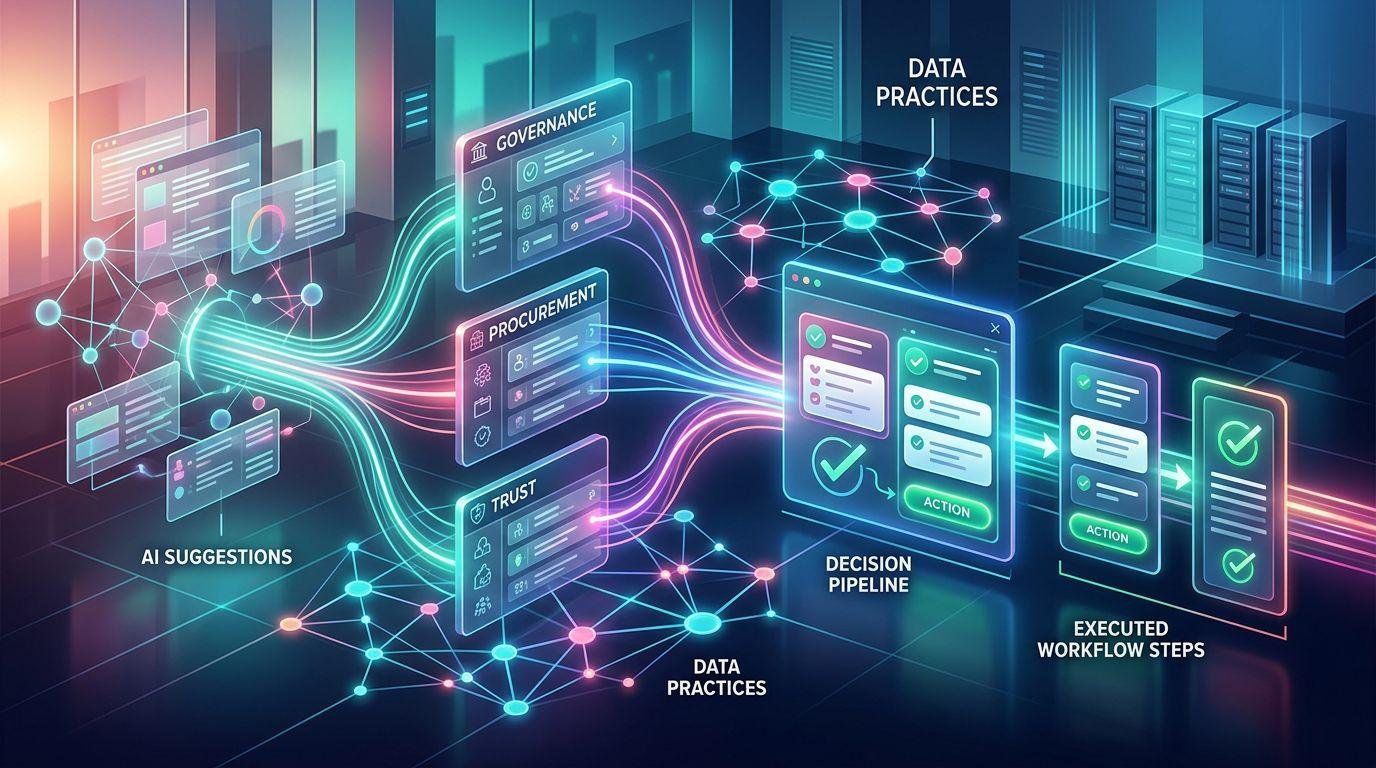
Embedded AI is no longer a future-facing add-on for enterprise software; it is becoming part of the machinery of everyday work. According to research highlighted by Security Middle East Magazine, 56% of organisations already use embedded AI capabilities within the vendor tools they own, while Gartner expects 40% of enterprise applications to include a task-specific AI agent by the end of 2026. That shift matters because it changes not just what software can do, but how it is governed,...
Continue Reading This Article
Enjoy this article as well as all of our content, including reports, news, tips and more.

By registering or signing into your SRM Today account, you agree to SRM Today's Terms of Use and consent to the processing of your personal information as described in our Privacy Policy.
The most important thing about embedded AI is also the easiest to overlook: it is built into the applications people already use. A sales representative may see a suggested reply in a CRM, a finance team may get an automatic anomaly flag in an ERP system, and an employee may receive a summary or draft response inside an email client. Unlike a standalone chatbot, there is no separate login, no new tab to remember and often no obvious signal that an AI system is at work. That invisibility is part of why adoption has accelerated so quickly, but it is also what makes oversight so difficult.
Vendors have strong commercial reasons to fold AI into their core products. A separate AI application has to win its own budget and justify its own procurement process. An embedded feature, by contrast, can be introduced as part of an existing renewal or platform upgrade, which makes it easier to adopt and harder for buyers to resist. SAP, Salesforce, Microsoft and Oracle have all moved in this direction, each weaving models into the application layer rather than positioning AI as a distinct layer beside it.
Technically, embedded AI tends to sit across four linked layers. Data access feeds the model, retrieval pulls only the relevant records, the model generates a suggestion or action, and an orchestration layer decides whether the output is merely shown to a user or executed automatically. Early versions of embedded AI usually stopped at recommendation: draft the email, rank the lead, flag the anomaly. Newer systems are moving further, enabling task-specific agents that can update records, send messages or trigger workflow steps with minimal human intervention. That is the difference between a passive assistant and an active agent, and it is where both the promise and the risk intensify.
The most consequential architectural issue is identity. An embedded agent rarely behaves like a human user with a single, clearly bounded role. More often it operates through a service account that may touch many records at once, sometimes with broader rights than a person would normally receive. That makes least-privilege design essential. Enterprises are increasingly asking vendors for permissions maps that show exactly what data, fields and actions each AI feature can access. In practice, that request has become almost as important as the model itself.
Latency and cost also shape how these features are built. A system that calls a large model on every interaction can become expensive very quickly, so vendors now increasingly route simpler work to smaller models and reserve larger systems for more complex reasoning. This model-cascade approach is invisible to most users but highly visible to procurement teams once the invoices arrive. The more AI becomes embedded into routine workflows, the more buyers need to ask not just what it does, but what infrastructure is required to keep it economical.
Gartner’s projection underscores how quickly the market is changing. It has said fewer than 5% of enterprise applications carried a task-specific agent in 2025, rising to 40% by the end of 2026. That is not a gentle adoption curve; it is a step-change. The implication is that many companies will move from using AI to draft or summarise to using it to initiate action. Once that happens, governance can no longer be treated as an afterthought.
That governance gap is already visible. Research cited in the source material suggests that 56% of organisations are using embedded AI, yet 44% worry employees do not even recognise when they are using AI inside vendor tools. Only 34% maintain a formal AI model inventory, and just 31% have AI-specific incident response procedures. Those numbers reveal a troubling mismatch: AI use is becoming normal before organisations have finished building basic oversight.
The blind spot is partly cultural. Traditional AI policy was written with standalone public tools in mind, the kind of software employees knowingly open, test and mention in conversation. Embedded AI does not announce itself so clearly. A summary feature in a CRM or a routing agent in a support platform may be treated as just another product enhancement, even though it is making judgments over company data. Governance teams are therefore having to rewrite policy language so that it applies to any AI capability, whether or not the company buys it as a separate product.
Security teams face a related but distinct problem. Embedded AI creates a new class of data leakage risk because the movement happens inside trusted software rather than across a clearly suspicious boundary. A model may summarise a restricted contract clause and store that summary in a less restricted field, or surface information a user was permitted to see but not meant to automate. Traditional data-loss tools were never built to monitor this kind of internal data motion, so companies are being forced to rethink what counts as a sensitive workflow in the first place.
The best deployments therefore begin with a complete inventory of embedded AI features across the software estate. That means checking which applications already have AI turned on, who owns them, what data they can reach and whether they have the authority to act. It also means assigning responsibility across IT, security, legal and the business team that uses the feature every day. Without that map, organisations can find themselves relying on AI systems they never formally approved.
Data readiness is equally important. An embedded feature is only as useful as the records beneath it. A CRM full of duplicate contacts, inconsistent field names or years of unstructured notes will produce weak outputs regardless of how sophisticated the model is. Search quality matters as much as model quality because many embedded systems retrieve a handful of records before generating a result. If retrieval is poor, the output can be confidently wrong.
That is why the practical work of preparation is usually duller than the marketing around AI suggests. Organisations need clean records, clear sensitivity labelling, up-to-date search indexes and a realistic understanding of where the relevant data lives. The temptation is to treat embedded AI as a feature toggle. In reality, successful adoption often requires months of data housekeeping and process design before the feature should be switched on broadly.
Deployment strategy matters too. Rolling out embedded AI to an entire business at once is a common mistake. A narrower pilot gives teams time to identify data quality issues, workflow mismatches and user hesitation before those problems scale. A group of 20 to 50 users is often enough to surface genuine usage patterns without flooding support teams with avoidable problems. It also gives change managers a chance to build training around real behaviour rather than assumptions.
That training needs to go beyond button clicks. Employees do not need to learn a new application, but they do need to learn when to trust a suggestion and when to override it. If the system drafts an email, highlights a record or proposes the next action, the human still has to decide whether the output is appropriate. In other words, the skill shift is from manual execution to judgement. That is a subtle but profound change in how work is done.
Feedback loops are critical because failures inside embedded workflows can have immediate consequences. A bad suggestion in a standalone chatbot wastes time; a bad suggestion inside a customer record can affect a live interaction. Successful adopters build easy ways for users to flag poor outputs, which then feed back into better retrieval, permissions tuning or model adjustment. Without that loop, small errors can spread silently through the organisation.
The identity problem becomes even more acute as agents become more autonomous. Microsoft’s approach to enterprise agent governance, for example, reflects a broader industry trend towards giving agents their own managed identities, audit trails and lifecycle controls. That shift is important because an agent should not inherit the full access rights of whichever employee happened to configure it. Least privilege has always mattered in cybersecurity; embedded AI simply makes the consequences of violating it more obvious.
There is also a less visible but increasingly important issue: many employees may not realise when they are using AI at all. That creates a governance problem because policy, training and incident response all depend on awareness. If workers cannot identify an AI feature when they use one, it becomes much harder to establish accountability or to explain what should happen when the system goes wrong.
This is where shadow risk differs from the older shadow IT problem. Shadow IT involved unapproved software; shadow AI often involved people pasting sensitive information into public tools. Embedded AI is different again: the risky behaviour can happen inside software the company already approved. That makes the threat harder to detect and easier to underestimate. A feature inside a trusted platform can still create an untrusted data flow.
Measurement is another challenge. It is harder to prove value from embedded AI because the feature is woven into existing workflows rather than sitting in a separate product with its own usage dashboard. Companies are therefore tracking metrics such as draft acceptance rate, time to close a support case, error rates in data entry and the speed of ticket resolution. If people do not use the feature, or use it and then edit everything it produces, that is useful evidence. It may indicate poor model quality, poor placement or simply the wrong use case.
Cost control follows from the same discipline. Some companies discover that they are paying for embedded AI features across multiple licences while using them heavily in only a few teams. Others find that renewal pricing includes an AI tier they never asked for. Because embedded AI is tied to the core platform, it can be harder to walk away from than a standalone tool. The workflow itself has already been reshaped around it, which gives vendors more leverage at renewal time.
That is why a quarterly review cycle is becoming a sensible operating norm. The review should cover usage, cost, risk and business value. It should ask whether the feature is expanding productivity, whether it is still safe to run and whether it belongs in the next contract term. Companies that do this well tend to treat embedded AI as an ongoing service to be governed, not a one-off feature to be admired.
The wider implication is that embedded AI is changing work by removing routine steps and pushing human effort towards judgement, exception handling and oversight. For some employees, that is a relief. For others, it raises concerns about skill atrophy, especially if routine work is where expertise was previously built. Managers will increasingly need to preserve opportunities for practice, even as more execution shifts to software.
The future direction is clear enough. Vendors are moving from assistants that help people work to agents that can act within the boundaries set for them. Research cited in the source material suggests that agentic AI could become a major enterprise software market over the next decade, with multiple specialised agents eventually working together on complex tasks. The technical hurdle is no longer whether AI can assist. It is whether companies can govern AI well enough to let it act.
That is the real change embedded AI brings. It does not merely place intelligence inside enterprise software. It changes the terms on which software is trusted, purchased, monitored and used. Companies that prepare by mapping their systems, tightening permissions and defining accountability will be better placed to benefit. Those that do not may find that the most powerful AI tools in their business are the ones they never properly noticed were there.
Source: Noah Wire Services
Subscribe to Industry Updates
Get the latest news and updates directly to your inbox.

