Enterprise AI is moving closer to the point of action. For years, much of its value has come from helping people search faster, surface anomalies and decide what to do next. The harder question now is what happens when software is no longer just advising but carrying out the decision.
That shift matters most in ERP, supply chain management, enterprise asset management and field service, because those systems sit at the heart of day-to-day operations. Once an agent can update a ...
Continue Reading This Article
Enjoy this article as well as all of our content, including reports, news, tips and more.

By registering or signing into your SRM Today account, you agree to SRM Today's Terms of Use and consent to the processing of your personal information as described in our Privacy Policy.
IFS Loops, the company’s agentic AI platform, is being positioned around that exact problem. The real issue is not whether a digital worker can automate another routine task. It is whether the platform can combine industrial context, governed permissions and coordinated action in a way that produces measurable business value. That is the question hanging over the technology as IFS prepares to showcase it further at Unleashed.
The importance of the underlying systems has not diminished as AI has advanced. If anything, they matter more. Agents depend on the transactions, permissions, rules and operational history already embedded in enterprise software to understand what is true before they act on it.
Picture a manufacturing press that begins to run hotter and vibrate more than usual, even though output still appears to be within specification. An alert on its own tells the organisation very little. Whether the best response is to keep running, inspect at the next changeover or stop sooner depends on maintenance records, open work orders, spare parts availability, production targets and the customer order linked to that line.
That is why trusted context has become the currency of enterprise AI. A signal without surrounding business knowledge can easily lead to the wrong action. The same data point may warrant very different responses depending on whether the plant has just changed over, whether a failure pattern resembles a prior breakdown, or whether the required part is already on hand.
IFS argues that its ERP, enterprise asset management and field service tools provide much of that operational backdrop, while Loops adds digital workers with configurable actions and governance controls. The test is whether those components can work together well enough for an agent to understand not only the condition of an asset, but also its effect on the production plan, service commitments and customer deliveries.
The problem is not unique to one vendor. Vaibhav Vohra, chief executive of Epicor, recently highlighted a related challenge when he noted that two customers using the same software can still define processes and transaction data in very different ways. An agent may understand the application perfectly and still misunderstand the business if the surrounding rules and definitions are incomplete.
That is where decision architecture becomes central. Once software is allowed to update a transaction, trigger a workflow or carry out an approved change, the business must decide who can authorise what, when a human needs to step in and how responsibility is assigned when something goes wrong.
In practice, that means defining boundaries before an agent is ever put to work. A digital worker might be allowed to create an inspection task automatically, while a decision to shut down a line remains with an operations manager. Reserving a replacement part may be routine, but moving a production order can affect labour, freight, inventory and customer service. The more consequential the action, the more carefully those rights have to be designed.
IFS describes a path from assistance towards greater independence for its digital workers, but autonomy is presented as something to be earned rather than granted upfront. Authority should expand only where the workflow is well understood and the outcomes are consistent. Human oversight remains essential for exceptions and high-risk decisions, while auditability is required to show what was known, what was approved and what was done.
That distinction matters because most companies already know when something has gone wrong. Dashboards, alerts and copilots can surface the issue quickly. The gap appears afterwards, when a supplier is late, a machine shows signs of deterioration or a customer order is at risk and someone still has to coordinate the response across different systems and teams.
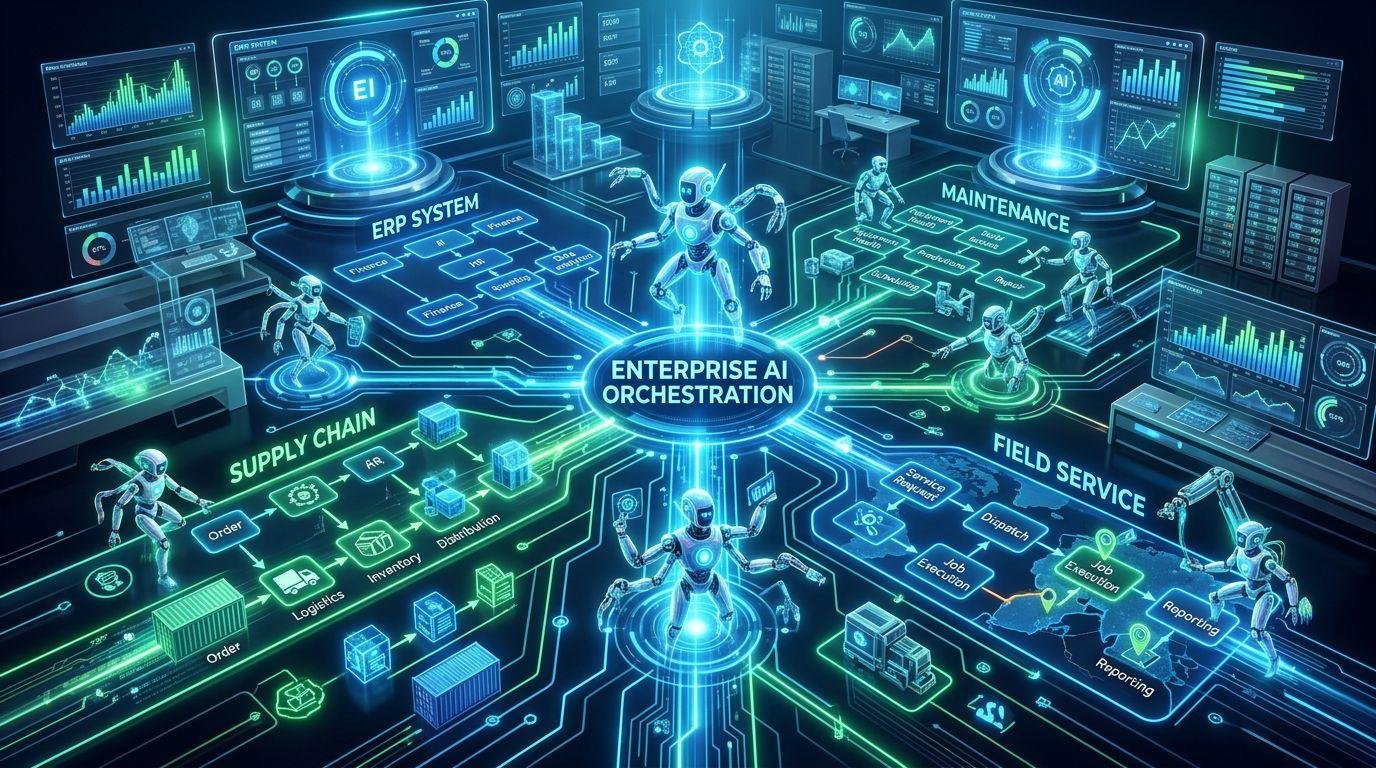
IFS Loops is intended to close that gap. The platform is designed to let digital workers carry an approved response through the workflow and execute authorised actions across enterprise systems, rather than merely recommending a course of action. The value, however, depends on whether each step remains inside the relevant business rules, approval limits and operating conditions.
IFS points to Kitron Group as an early example. The manufacturer is rolling out purchase-to-order digital workers across all 13 of its sites by the end of 2026, while retaining existing business rules, controls and approval processes. During the rollout, one digital worker flagged a part-number error that had reportedly gone unnoticed for about a decade. The case illustrates both the promise and the caution of agentic automation: it can expose hidden data problems inside established processes, but it also raises the question of how much rework, error reduction and operational improvement follow over time.
The implications are more immediate on the shop floor. In the press example, a digital worker could take an approved maintenance decision and carry it into execution by coordinating the work order, parts requirement, technician schedule and production plan. That kind of orchestration could remove manual admin without handing over open-ended control.
Kodiak Gas Services offers a more direct illustration of business impact. Its Material Replenisher digital worker gives more than 800 field technicians access to live inventory, warehouse location and ordering information across roughly 150 warehouses. Kodiak says that if half of those technicians use the agent once a day, the company could recover more than 90,000 hours of labour and generate about $3 million in annual return on investment. That kind of metric is more useful than counting agents for their own sake, because it ties the technology to time, capacity and financial value.
That is also the right way to judge the technology more broadly. The relevant measures are the ones that matter to the operation itself: cycle time, throughput, capacity, service levels, downtime, asset utilisation, inventory, working capital, operating expense and margin. A digital worker that completes thousands of tasks but creates more exceptions or slows decisions has not improved execution.
The workforce effect matters too. Industrial companies are coping with leaner teams, retiring experts and the need to preserve know-how that used to live in people’s heads. A maintenance specialist should not have to reconstruct an asset’s history from multiple systems if a digital worker can assemble the relevant context reliably. Likewise, a planner should not spend hours resolving routine exceptions that already fit established rules.
That is why Industry 5.0 is better understood as an operating model than as a slogan. The real question is how people and digital workers divide the labour, how knowledge is retained and where human judgement must still carry the final call. Technology may enable the shift, but people determine whether it produces a better result.
IFS says its Industrial AI Harness is intended to provide the context and control structure surrounding digital workers. The bigger question is how consistently that model holds up once it is in production.
At Unleashed, the most useful evidence will come from the workflows customers are already willing to let digital workers execute, the reasons those use cases were selected first and the conditions that had to be met before authority was expanded. It will also be important to see how Loops behaves when work moves across IFS and non-IFS systems. If an action succeeds in one application but fails in another, who notices, who fixes it and who owns the outcome?
The same applies to the workforce. If a digital worker takes over routine activity in procurement, planning, service or maintenance, what changes for the employee the next day? Returned time only creates value if it is redirected towards better decisions, stronger service, higher throughput or some other measurable operational gain.
Digital workers will only earn a bigger role if they operate with the right context, stay within clearly defined authority and improve the metrics the business already tracks. If customers cannot point to a meaningful change in how the organisation runs, the technology has not yet proved its case.
In the end, trust is built in production, not in presentation. Results will decide where AI is allowed to go next.
Source: Noah Wire Services
Subscribe to Industry Updates
Get the latest news and updates directly to your inbox.