


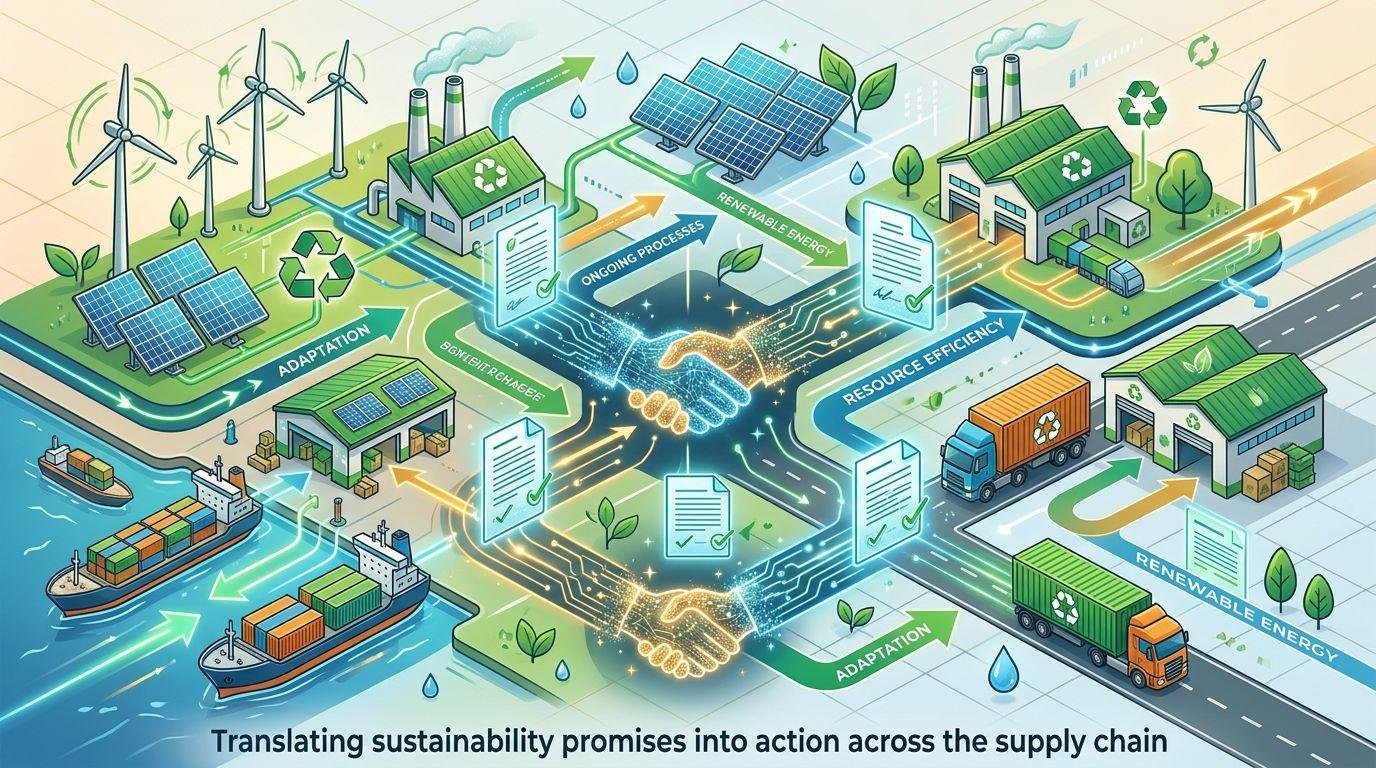
Firms increasingly set ambitious sustainability goals, but those goals often depend on suppliers, contractors and other business partners to make them real. That is where many strategies lose traction. The difficulty is not always weak intent; more often it is the absence of a shared understanding of what the commitment means, who must do what, what evidence will count, and how obligations should change when circumstances do. A new theory-synthesis article in Business Strategy and the...
Continue Reading This Article
Enjoy this article as well as all of our content, including reports, news, tips and more.

By registering or signing into your SRM Today account, you agree to SRM Today's Terms of Use and consent to the processing of your personal information as described in our Privacy Policy.
The article brings together sensemaking, proactive contracting and contract design to build a sensemaking-based contracting framework. Its central claim is that contracts do more than record promises. When designed and used well, they help firms turn broad sustainability ambitions into workable arrangements for action. The framework identifies four interconnected functions. Framing establishes what the relationship is actually meant to govern. Translation links that purpose to responsibilities, information flows and operating routines. Adaptation creates legitimate ways to revisit commitments when conditions change. Signalling connects performance within the relationship to credibility outside it.
The paper starts from a familiar problem in business sustainability: the language of “net zero”, “responsible sourcing” or “circularity” may sound clear at board level, but those phrases can acquire very different meanings as they move through procurement, legal, compliance and operations functions, and then on to suppliers. A requirement can be agreed in principle while still being interpreted in incompatible ways. The authors argue that this is not simply a communication failure. It is a governance problem rooted in interpretation. Before anything can be measured or enforced, actors have to decide what the requirement means in context, what counts as relevant information and what action is expected.
Sensemaking theory provides the starting point. It explains how people construct plausible interpretations in conditions of ambiguity and then refine those interpretations through interaction and action. In sustainability supply chains, that matters because responsibility, authority, information and operational capability are rarely concentrated in one place. Firms may share an overall objective, but they do not automatically share the same reading of it. The article notes that formalisation can help by focusing attention, prompting discussion and exposing inconsistencies. Yet it can also mislead if it becomes too rigid, or if contractual language stabilises an interpretation that should remain open to revision.
That is where proactive contracting enters the picture. Rather than treating the contract as the final product of negotiation, proactive contracting views it as part of an ongoing lifecycle that begins early, involves different disciplines and continues through implementation and revision. In sustainability contexts, this means thinking not only about remedies and compliance, but also about prevention, collaboration and the practical conditions for performance. The article’s point is that sustainability obligations do not become operational merely because they are written down. They depend on how the agreement addresses data, capabilities, costs, review processes and changing circumstances.
Contract design adds a further layer. Even a technically sound contract may fail as a working instrument if the people expected to use it cannot find, understand or apply it. The article therefore emphasises usability: structure, plain language, visual presentation, definitions, responsibility matrices, data annexes and review modules. These features do not just make contracts easier to read. They make it easier for different actors to move between the strategic purpose of the agreement and the detail needed to perform it. The authors are careful, however, not to confuse clarity with fairness. A clear contract can still encode a one-sided view if the process of creating it excludes relevant voices.
Taken together, these strands support the article’s four-part framework.
Framing is about setting the interpretive boundaries of the relationship. Sustainability terms do not carry a single operational meaning across firms, so the contract needs to establish what the parties are actually governing: the scope of the relationship, the trade-offs that matter and the principles that will guide decisions. Framing does not eliminate disagreement, but it makes differences visible early enough to discuss them. The article notes that this function is not neutral. In unequal relationships, the stronger party may shape the framing and, by extension, the entire interpretive field.
Translation is the work of connecting that shared purpose to actual responsibilities and routines. This is where the agreement turns aspiration into operating logic: who reports what, who verifies it, which data sources are acceptable, what happens if information is incomplete and how disputes are escalated. The article warns that sustainability information can become distorted as it passes between functions or organisations, even without deliberate concealment. Translation is therefore about making sure the message survives the journey from strategy to day-to-day practice.
Adaptation addresses the fact that sustainability relationships do not stand still. Standards change, reporting methods evolve, technologies improve and market conditions shift. A useful contract must therefore contain legitimate procedures for revision: scheduled reviews, material-change triggers, staged targets, pilot periods, renegotiation mechanisms and routes for resolving disagreement. But flexibility is not enough on its own. Revision procedures also have to be perceived as fair and intelligible, or they risk becoming sources of distrust. The article gives examples of supply-chain clauses that combine collaboration, cost-sharing, assistance and responsible exit to manage change without abandoning accountability.
Signalling is the outward-facing function. Firms increasingly have to demonstrate to regulators, investors, customers and other stakeholders that their sustainability claims are backed by credible internal arrangements. The article argues that private contracts do not automatically function as public signals. Their signalling value depends on whether the relationship produces auditable metrics, traceable evidence, assurance rights, corrective-action processes and a coherent link between what is promised and what is actually done. In this sense, signalling is inseparable from implementation. If the relationship does not generate reliable evidence, external claims will look thin, even if the language of the contract is impressive.
The article’s broader significance lies in how it reframes contracting within sustainability governance. Rather than seeing contracts only as tools of compliance or risk allocation, it treats them as part of the machinery through which sustainability meaning is made usable across organisational boundaries. That matters because sustainability strategy is often imagined as if it is settled inside the lead firm and then pushed outward. In practice, its meaning is renegotiated at each interface between sustainability teams, procurement, legal departments, operations teams and suppliers.
The paper also draws a distinction between documentary continuity and substantive continuity. A clause may be repeated in policies, contracts, procedures and reports, yet the original purpose may still drift away from the actual conditions of performance. In other words, the words can stay the same while the governing meaning changes. This is one of the article’s most important insights. It suggests that success is not simply a matter of replicating sustainability language across documents. The more meaningful question is whether the connections among purpose, responsibility, capability, revision and evidence remain intact as obligations move through the supply chain.
Power is the final and unavoidable condition. The article is clear that shared meaning does not emerge automatically from good drafting. Whether contracting supports sensemaking depends on who can question interpretations, whose knowledge counts and whether weaker parties can raise difficulties without disproportionate commercial penalty. In asymmetric relationships, contracts may instead become tools for transferring burden, preserving unilateral discretion or translating the stronger party’s vocabulary into enforceable form. Capability and network position matter as well. Smaller suppliers may have limited resources, limited data systems and less visibility, making it harder for them to meet ambitious contractual requirements without additional support.
The article concludes that contracting should be understood as complementary to, not a replacement for, relational governance and wider institutional frameworks. Its value lies in organising the conditions under which sustainability commitments can be discussed, implemented, adjusted and evidenced across organisational lines. The practical implication is straightforward but demanding: firms should pay as much attention to the interpretive and procedural design of sustainability contracts as they do to the clauses themselves.
In that sense, the article makes a persuasive case that the real challenge in sustainable business-to-business governance is not simply writing stronger promises. It is preserving the meaning of those promises as they travel.
Source: Noah Wire Services
Subscribe to Industry Updates
Get the latest news and updates directly to your inbox.

