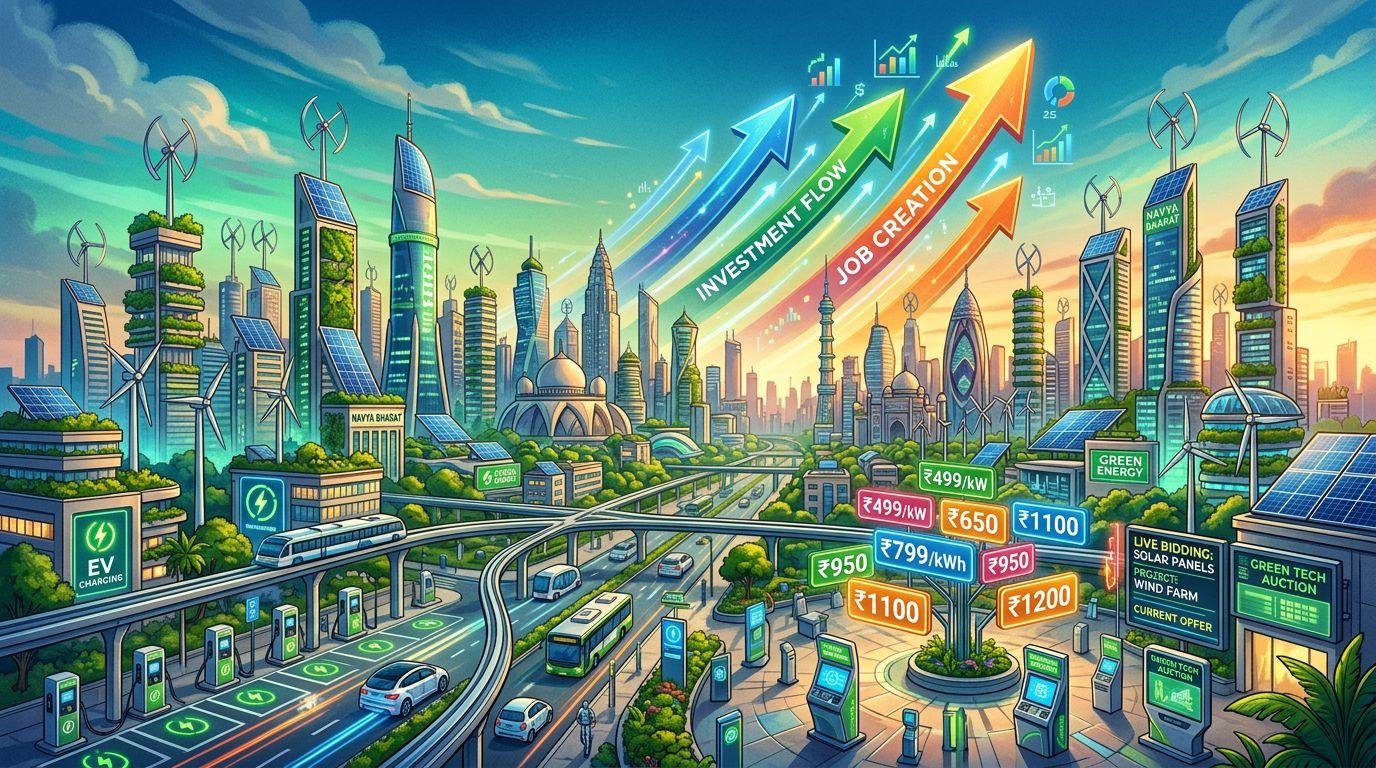
India’s green economy could become a vast engine of investment and employment, but entrepreneurs building in the space say that demand, policy and financing still lag behind the scale of ambition.
A study by the Council on Energy, Environment and Water suggests the country could attract almost $4.1 trillion in green investment by 2047 and create 48 million jobs. The analysis maps 36 green value chains across energy transition, circular economy and bio-based solutions, pointin...
Continue Reading This Article
Enjoy this article as well as all of our content, including reports, news, tips and more.
By registering or signing into your SRM Today account, you agree to SRM Today's Terms of Use and consent to the processing of your personal information as described in our Privacy Policy.
g to a market opportunity that extends well beyond the climate sector into manufacturing, logistics, waste recovery and agriculture.
Yet turning that potential into mass adoption remains difficult. Ajay Menon, senior practice lead at TechnoServe India and programme director of the Greenr Sustainability Accelerator, said the central problem is that most sustainable products still have to compete in markets where buyers are highly price-sensitive and often unwilling to pay a premium for greener alternatives.
“If a green product functionally matches the conventional alternative, then a customer will look at the price and convenience,” he said, giving the example of green building materials such as fly ash bricks and autoclavated aerated concrete blocks, which struggle against cheaper red clay bricks. In his view, the sector would expand far more quickly if policy required a minimum share of green materials in construction projects.
Menon’s programme supports 350 green start-ups across three cohorts and is backed by the Ikea Foundation and Visa Foundation. He said the accelerator was created not only because of the scale of the opportunity identified by CEEW, but also because the ecosystem needs systemic support rather than isolated interventions. “We need consortia of funds coming in, where you have multiple donors,” he said.
He added that government action could be decisive in widening the market for sustainable businesses. India’s extended producer responsibility framework, which places responsibility for a product’s post-consumer stage on manufacturers, importers and brand owners, is one example of the kind of regulation that can shift procurement patterns and strengthen demand for circular solutions. Menon said similar policies are gradually being introduced, particularly as larger conglomerates come under pressure to decarbonise supply chains and align with net-zero targets over the next decade.
That shift, he believes, could be transformative for start-ups trying to break out of the pilot stage. The Greenr programme has seen a steady rise in interest, with roughly 390 applications when it launched in January 2023 and about 590 companies applying for its second cohort. Waste management, food and agriculture, and cleantech and renewable energy have emerged as the most common sectors across the three cohorts.
Menon said around 90 per cent of the founders in the programme are first-time entrepreneurs, which makes business-building support especially important. Many need help with everything from understanding financial statements to designing go-to-market strategies, identifying the right customer segment and building a product narrative that works for both business-to-business and business-to-consumer markets. In his words, the accelerator focuses both on tactical levers that improve unit economics and on strategic levers that can lift revenue over the longer term.
The constraints facing founders are not limited to demand. Menon said green start-ups often struggle to find appropriately priced capital and to recruit the right talent. He also argued that current policy continues to favour linear business models over circular ones, creating an uneven playing field for companies trying to build low-carbon or resource-efficient alternatives.
That challenge was echoed by Rajat Vardhan, co-founder and chief executive of ScaNxt, an agritech and climate-smart technology start-up incubated at IIT Kanpur. He said deep-tech green entrepreneurs need balanced teams and strong research capabilities to move from laboratory work to commercial deployment. Most of his technical team, he said, comes from IIT Kanpur and the Indian Institute of Remote Sensing.
ScaNxt has spent more than five years developing soil-monitoring technology aimed at reversing land degradation. According to Vardhan, the company’s system has now been deployed in 24 states, with operations spanning more than 200 districts and exports to seven countries. It has also secured another patent for pest monitoring technology that helps farmers track harmful infestations, which Vardhan said are responsible for nearly 40 per cent of crop yield losses.
The company also offers a solar dryer designed to extend the shelf life of produce by six to eight months and improve the price farmers can obtain in the market. Vardhan said support from accelerator programmes is important because research-driven solutions often require significant time and capital before they can scale.
Like Menon, he argued that public policy could accelerate adoption. India is one of the country’s largest buyers of goods and services, he noted, and procurement rules that allow start-ups to compete beyond the lowest-bidder framework could open more doors for innovation. Once a technology reaches scale, he said, the cost curve usually improves.
Vardhan also pointed to state-backed research funding as a crucial part of the picture, saying schemes such as the Anusandhan National Research Foundation and the Research, Development and Innovation initiative could help move green technologies from promising prototypes to globally competitive businesses. A fund of the scale of the ₹1 lakh crore RDI allocation, he said, could play a major role in helping Indian climate technologies reach international markets.
For now, the message from both investors and founders is that India’s green opportunity is real, but not automatic. The country may have the ingredients for a large sustainable economy: deep research talent, a fast-growing industrial base, and a policy environment beginning to move towards circularity and decarbonisation. The harder task is turning that framework into everyday purchasing decisions, supply-chain commitments and procurement rules that make green products competitive on scale, not just on principle.
Source: Noah Wire Services