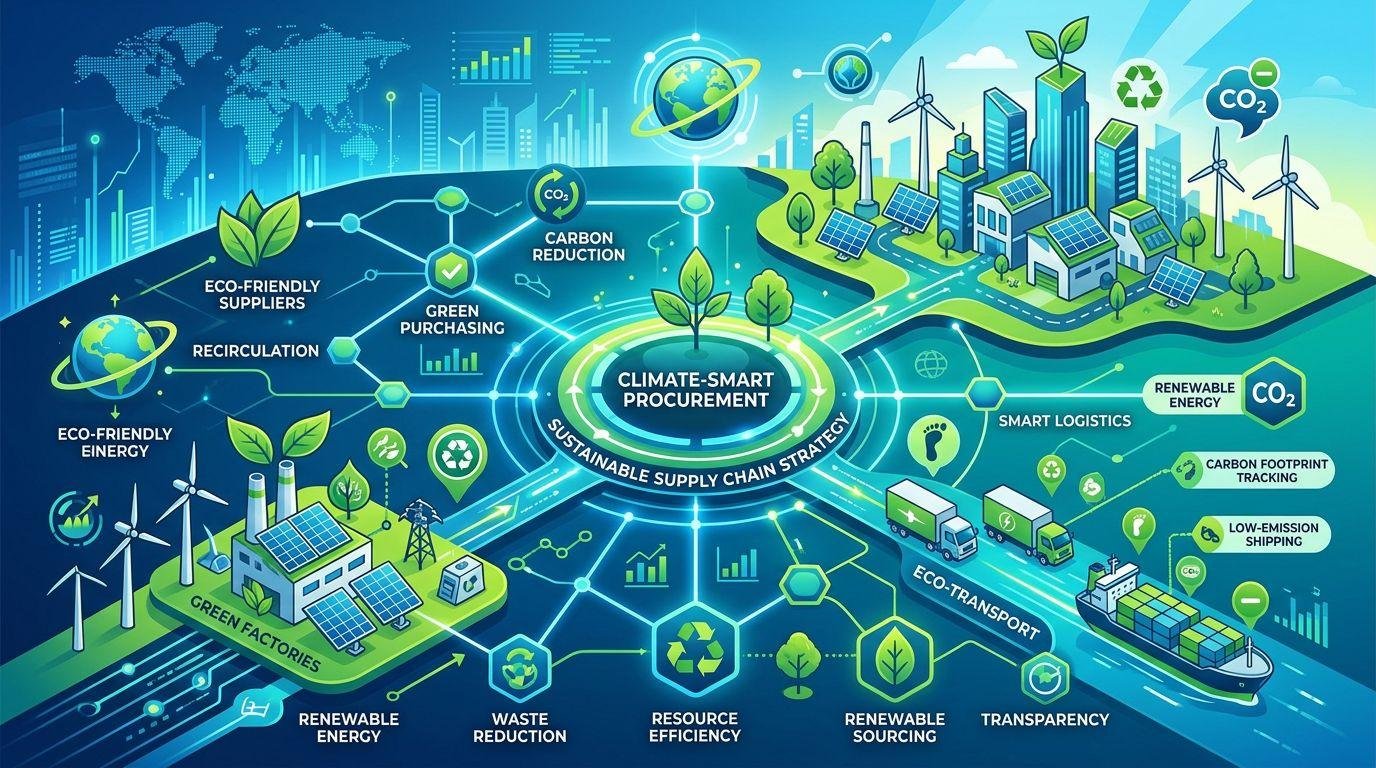
The role of procurement is shifting from a function measured mainly on price, quality and delivery to one that is increasingly central to corporate climate strategy. A report produced by the World Economic Forum and Kearney suggests that green procurement is no longer a side issue for sustainability teams, but one of the most important levers available to businesses trying to cut emissions, reduce risk and protect long-term competitiveness.
That argument is rooted in the scale ...
Continue Reading This Article
Enjoy this article as well as all of our content, including reports, news, tips and more.
By registering or signing into your SRM Today account, you agree to SRM Today's Terms of Use and consent to the processing of your personal information as described in our Privacy Policy.
of Scope 3 emissions, the indirect emissions generated across a company’s value chain. In many sectors, including transport, food and drink, capital goods and construction, these emissions account for more than 90% of total output, according to the report. Much of that footprint sits upstream in purchased goods and services, which means the environmental consequences of a company’s operations are often determined less by its own factories and offices than by the suppliers it chooses and the standards it imposes.
This is what makes procurement such a decisive battleground for climate ambition. The World Economic Forum’s wider commentary on the subject describes green procurement as a practical test of whether companies are serious about delivering on their environmental pledges. If purchasing teams continue to focus narrowly on unit cost, firms are likely to miss the emissions embedded in their supply chains. If, by contrast, they build carbon considerations into sourcing decisions, procurement can become a direct instrument of decarbonisation.
The report sets out a maturity model that divides green procurement into four stages: compliance-led, risk management, value creation and sustainable leadership. That framework is intended to help companies avoid treating sustainable sourcing as a single fixed programme. Instead, businesses are encouraged to assess where they are now and progress in line with their own capabilities, governance structures and data maturity.
To support that transition, the report identifies eight core building blocks for stronger green procurement: senior leadership commitment, governance, business-case development, greener purchasing processes, supplier management, cross-industry collaboration, data and technology, and workforce capability. Together, these elements are presented as the foundation for turning procurement into a strategic function rather than an administrative one.
For many organisations, the biggest obstacle is not intent but execution. A review in Nature on supply-chain emissions data sharing found that companies often rely on estimates, industry averages and other approximations when calculating Scope 3 emissions, which can undermine accuracy. That challenge was echoed in the report’s findings, which point to limited product-level carbon data from suppliers, inconsistent standards and weak digital infrastructure as persistent barriers to action.
Large enterprises face an additional complication: the sheer number of suppliers they must manage. With thousands of vendors in some cases, it is rarely practical to pursue deep collaboration across the entire supply base. The report therefore recommends a segmented approach, starting with a baseline of supplier emissions, identifying the most material hotspots, grouping suppliers by priority, agreeing reduction roadmaps with key partners and then using training and performance reviews to keep progress on track.
The report also argues that green procurement should be embedded earlier in commercial processes. Among the measures it recommends are carbon assessments at supplier onboarding, sustainable supplier scorecards and the use of internal carbon pricing. It also suggests that tender evaluations should include environmental weighting and that contracts should spell out emissions targets, reporting obligations and continuous-improvement expectations. In effect, it calls for environmental costs to be treated alongside financial ones rather than as an optional extra.
Digital tools are becoming increasingly important to making this possible at scale. According to the report, leading companies are already using digital platforms to centralise supplier carbon data, applying artificial intelligence to speed up data collection and creating procurement-specific sustainability metrics that feed into management reporting. Microsoft is cited as an example: the company says around two-thirds of its bill of materials is now tracked at supplier and component level for carbon data, the number of suppliers providing 100% carbon-free electricity has risen sharply, and waste recycling rates at a large number of factories now exceed 90%.
The broader message is that procurement is moving into the centre of corporate transformation. Deloitte has also argued that procurement is crucial to tackling Scope 3 emissions and achieving environmental, social and governance commitments, reinforcing the idea that purchasing decisions can no longer be separated from sustainability strategy. As companies face tighter regulation, more volatile supply chains and rising pressure to decarbonise, the purchasing function is becoming a test not just of operational discipline, but of corporate credibility.
Seen in that light, green procurement is evolving from a responsibility exercise into a source of competitive advantage. Businesses that can combine supplier engagement, better data, digital tools and disciplined governance are likely to be better placed to manage emissions, strengthen resilience and create value. What was once a back-office task is increasingly becoming one of the most strategic choices a company makes.
Source: Noah Wire Services