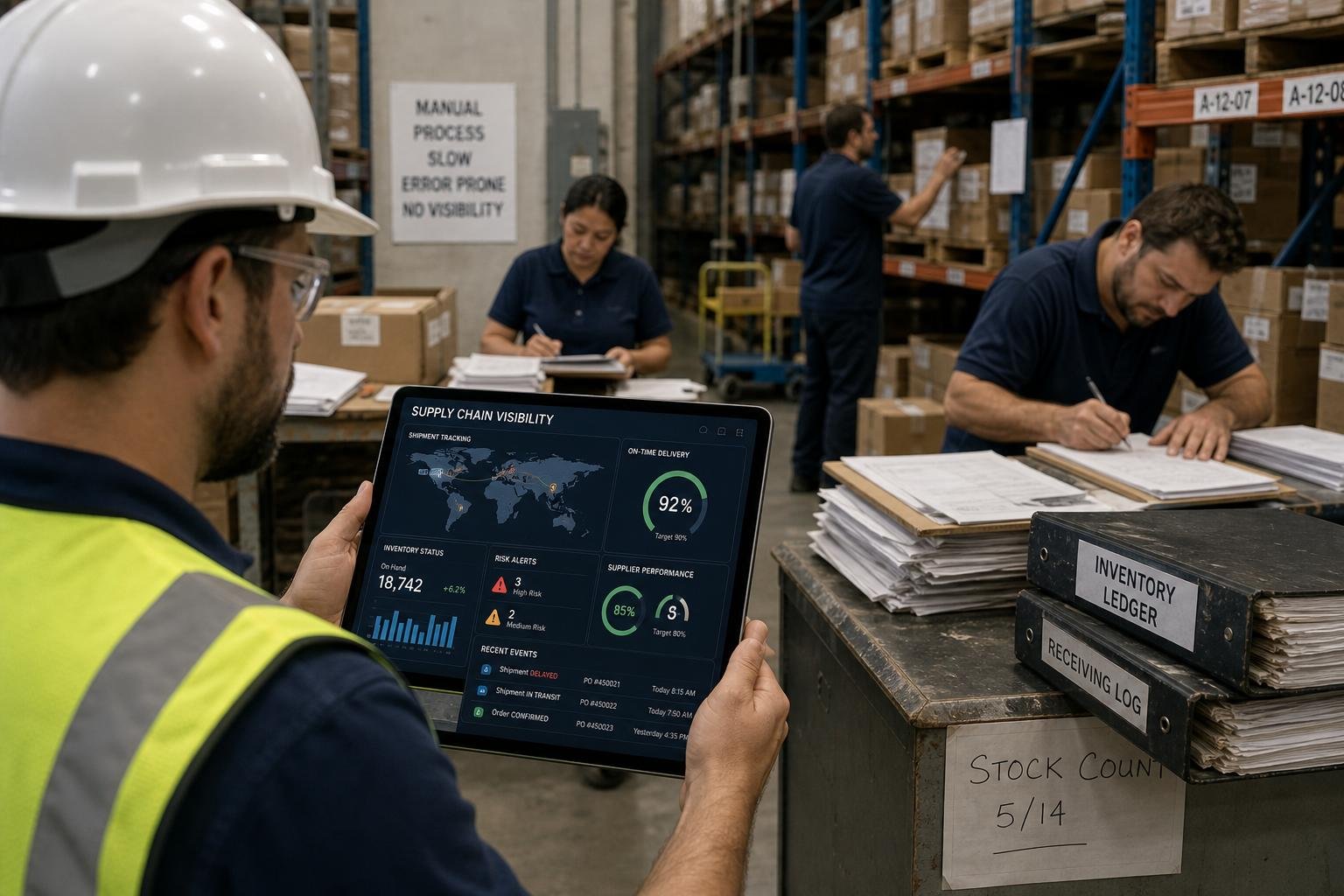
For many early-stage founders, supply chain visibility looks like a straightforward answer to a painful operational problem. If goods are late, inventory goes missing or partners miss deadlines, the instinct is to assume the business needs better tracking, sharper analytics and a more intelligent dashboard. In practice, that assumption is often wrong.
The deeper issue is usually not that the company cannot see what is happening, but that the people in the chain have little reas...
Continue Reading This Article
Enjoy this article as well as all of our content, including reports, news, tips and more.
By registering or signing into your SRM Today account, you agree to SRM Today's Terms of Use and consent to the processing of your personal information as described in our Privacy Policy.
on to behave differently once they do. A supplier can have perfect information and still deliver late. A carrier can know the route and still game the process. An operations team can have beautiful live data and still spend its days chasing people by phone, email and WhatsApp.
That is why supply chain visibility platforms often create disappointment. IBM has described visibility as the ability to track goods in transit and make data available to stakeholders, but it has also noted the obstacles that routinely block meaningful adoption: data silos, inconsistent standards and resistance to change. In other words, visibility is necessary in many cases, but it is not sufficient on its own.
The distinction matters because founders often treat a coordination failure as if it were an information failure. They respond with sensors, RFID tags, predictive models and layered dashboards. Yet, as industry commentary from Supply Chain Brain makes clear, the value of visibility only emerges when businesses also change the processes around it. Without workflow changes, better data can simply expose the same dysfunction more neatly.
That is the trap. A company may think it needs real-time tracking when, in fact, it needs stronger incentives, clearer accountability or a simpler operating model.
There are, broadly, two types of supply chain problem. The first is a genuine visibility gap: nobody knows where shipments are, what condition they are in or when they will arrive. The second is a coordination gap: everybody knows the situation, but the system does not encourage the right behaviour. If a supplier is paid regardless of whether it misses a delivery window, visibility alone is unlikely to improve performance. If a warehouse process loses inventory once it arrives, better forecasting will not help much either.
AI can help with both categories, but only if it is deployed against the right one. IT Pro has noted that machine learning is already useful in forecasting and anomaly detection, while newer generative and agentic systems are being used to handle messy data and support decisions in real time. Shippeo has made a similar point, arguing that AI can strengthen visibility by improving prediction, responsiveness and planning. But none of that removes the need for businesses to ask what problem they are actually solving.
The evidence on adoption supports that caution. Research cited in the article suggests that many AI-led supply chain projects fail not because the technology breaks, but because people do not use it. That is a familiar pattern in enterprise software: the system works, but the workflow does not.
The most effective visibility projects tend to be narrower than vendors suggest. Instead of trying to map every node in the chain, successful operators start with the smallest gap that directly affects revenue. If customers are complaining because they cannot see where an order is, that may justify a visibility investment. If the issue is that suppliers are ignoring agreed timelines, the fix may lie in payment terms, penalties or other incentives rather than in a more elaborate control tower.
Trackonomy has highlighted another recurring barrier: trust. If partners do not trust the data, they will find ways around the system. That is why some of the most effective solutions are not the most sophisticated ones, but the ones embedded in existing behaviour. A simple photo confirmation tied to automatic payment can outperform a complicated platform that asks suppliers to adopt yet another app.
There is also a hard commercial reality. The visibility software market is crowded, and not every company needs a bespoke build. For smaller businesses, the cost of custom development can be hard to justify, especially when the operational problem is still changing. The more fragmented the chain, the more important adoption becomes. A tool that works through SMS or an existing ordering portal may beat one with more advanced analytics if it is actually used.
The broader lesson is that supply chain visibility is not a product decision alone. It is an operating model decision. Businesses that treat it as a technology purchase often end up with elegant dashboards and little else. Those that treat it as a question of incentives, process design and trust are far more likely to see value.
AI can absolutely improve supply chain performance. It can reduce uncertainty, automate routine tasks and help managers respond faster. But the first question should not be how much visibility a company can buy. It should be whether visibility is the real constraint at all.
Source: Noah Wire Services