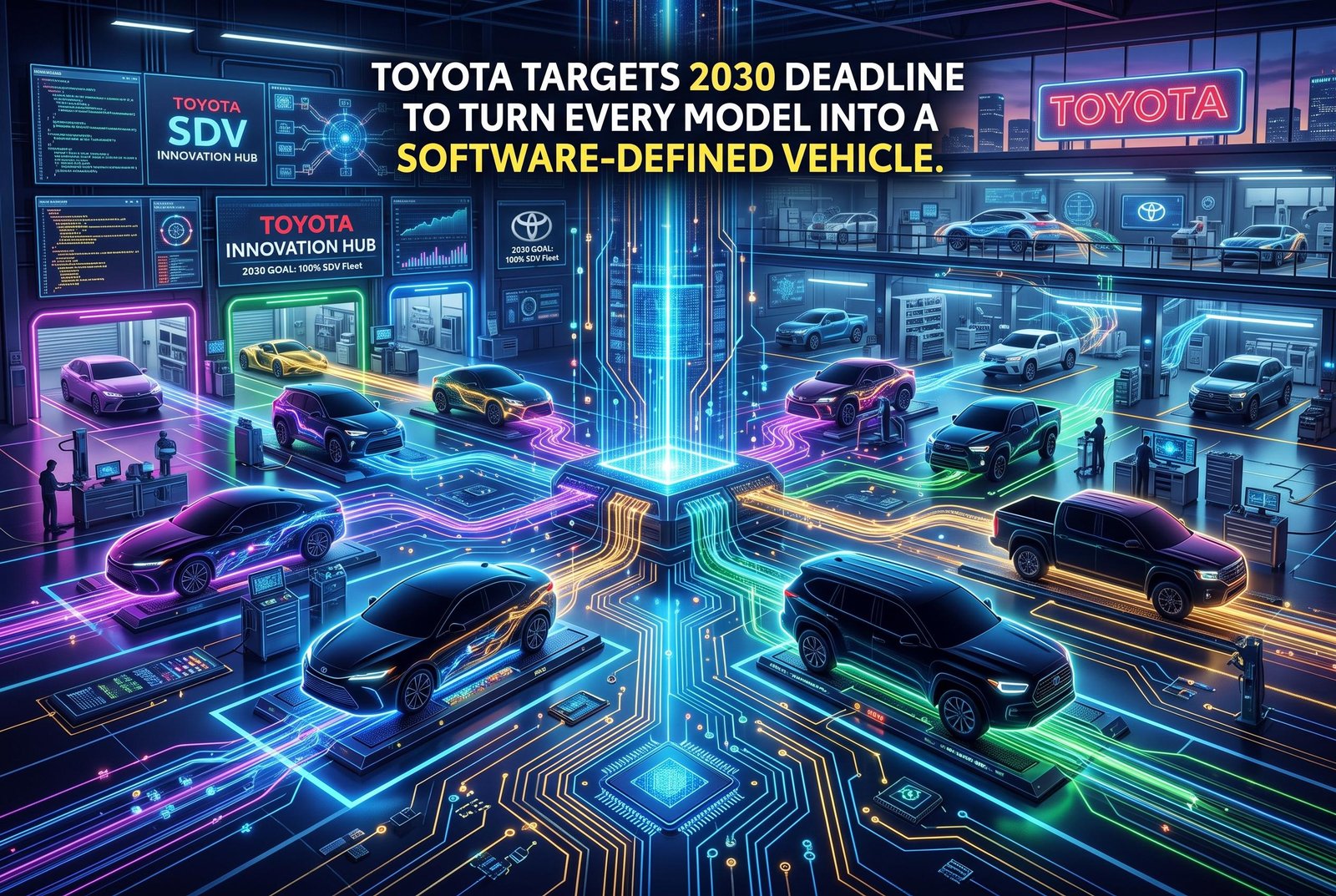
Toyota is preparing one of the most significant shifts yet in the global car industry, with plans to turn all of its roughly 50 models into software-defined vehicles by 2030, according to Nikkei and other reports citing the company’s investor briefing.
The move would mark a sharp break from the manufacturing philosophy that has long defined Japanese carmaking. For decades, Toyota and its suppliers have relied on “suri-awase” – a meticulous process of fine-tu...
Continue Reading This Article
Enjoy this article as well as all of our content, including reports, news, tips and more.
By registering or signing into your SRM Today account, you agree to SRM Today's Terms of Use and consent to the processing of your personal information as described in our Privacy Policy.
ning the interaction between parts so that each component is optimised within the wider vehicle. That approach has helped underpin Japan’s reputation for quality and efficiency. But as cars become increasingly dependent on code, sensors and over-the-air updates, the industry is being forced to rethink whether hardware integration alone is enough.
Toyota’s plan centres on its proprietary Arene software platform, which was first used in the redesigned RAV4 sport utility vehicle launched in 2025. The company intends to extend Arene across its entire model range by 2030, and then make the technology available to partner automakers by 2035, according to reports from the Japan Times, Autoblog and others.
The strategy reflects a wider attempt by Toyota to catch up in a market where Tesla and Chinese manufacturers have taken the lead in software-defined vehicle development. Industry rankings cited by Nikkei show those rivals at the top end of the scale for SDV readiness, while Toyota and other Japanese groups remain far behind. For Toyota, the challenge is not simply technical. It is also commercial. An SDV platform opens the door to revenue streams long after a car leaves the showroom, including paid software upgrades and new digital services.
That potential is especially significant for a company of Toyota’s scale. With annual sales of around 10 million vehicles, even modest software subscription income could become a major new business line. According to the Japan Times, Toyota’s aim is to install its software platform in about 10 million new cars a year, creating a foundation for post-sale revenue from software updates and additional functions.
If Toyota succeeds, the implications will reach well beyond its own product line. Suppliers that have traditionally competed on precision-engineered components may have to adapt to a world in which the most valuable part of the car is the code running inside it. Instead of tailoring individual parts to each model, they may increasingly need to compete to supply software-compatible systems and highly integrated electronic hardware. That could weaken the long-established hierarchy of Japan’s automotive supply chain and shift influence towards the companies controlling platforms and operating systems.
The transition is also likely to reshape how future vehicles are developed. In an SDV model, the car is built more like a connected digital product than a fixed mechanical object, allowing features such as driver assistance, infotainment and performance improvements to be added or refined after purchase. For Toyota, moving from a hardware-first model to one centred on software would amount to a cultural as well as industrial transformation.
Source: Noah Wire Services