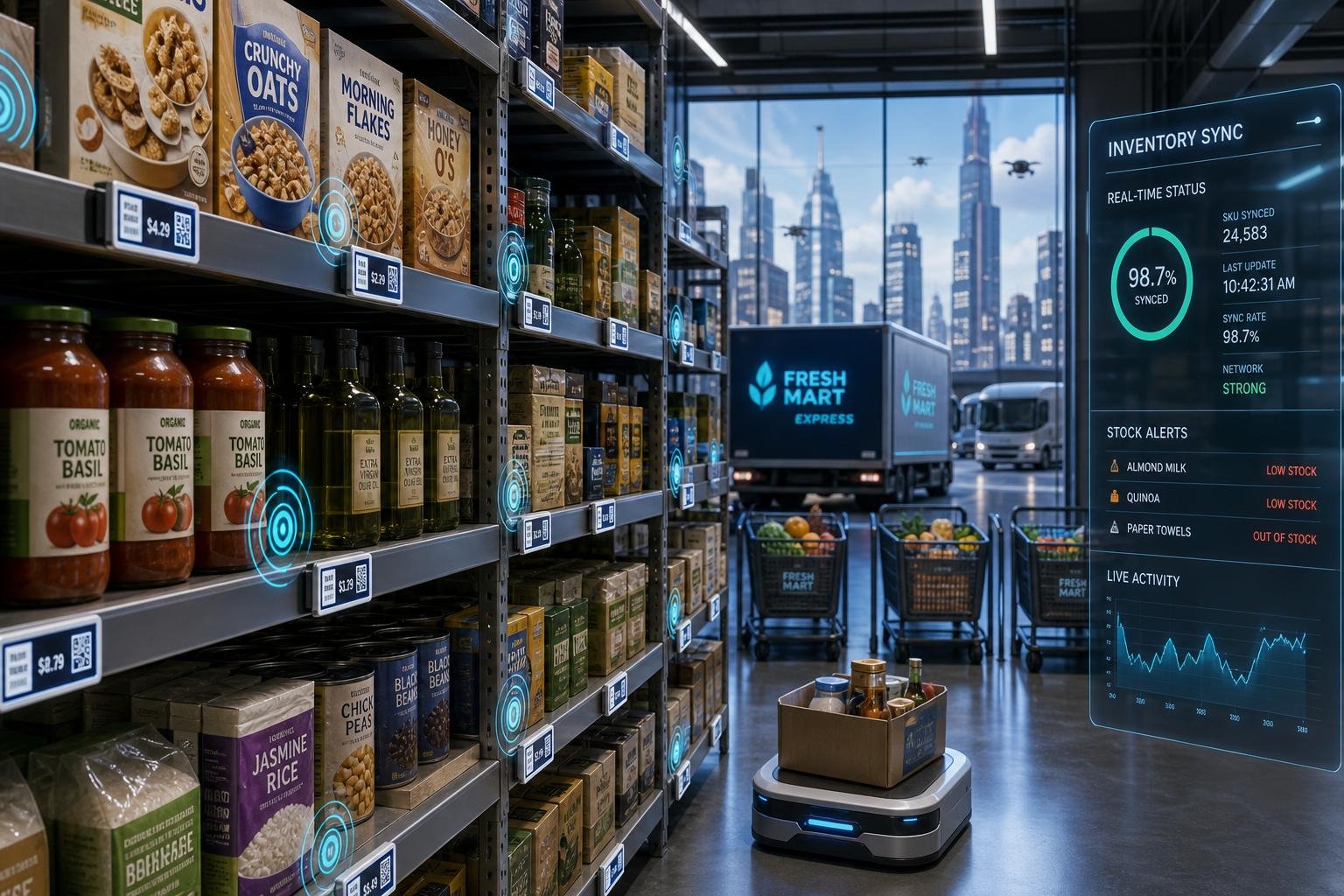
Online grocery has crossed a threshold that is forcing retailers to rethink the mechanics of getting food from supplier to customer. In 2025, sales rose by more than 20%, with monthly volumes repeatedly topping $10bn and closing the year at record levels, according to Grocery Trader. That scale is changing the requirements of the grocery supply chain itself, pushing it away from a model built for pallets, cases and shelf replenishment towards one that can support real-time fulfilment ...
Continue Reading This Article
Enjoy this article as well as all of our content, including reports, news, tips and more.
By registering or signing into your SRM Today account, you agree to SRM Today's Terms of Use and consent to the processing of your personal information as described in our Privacy Policy.
at the level of the individual item.
The shift is especially visible in omnichannel retail, where stores are no longer just places to sell products in person but also mini fulfilment hubs for online orders. In that environment, retailers need to know exactly what is on hand, where it is located and whether it is fit for sale. Periodic counts and manual checks, which were once adequate for store-based replenishment, are increasingly too slow and too blunt for an operation in which stock is constantly moving between shop floor, back room, picking area and delivery network.
That is why visibility has become the new bottleneck. For groceries sold online, the challenge is not simply having inventory in the system; it is knowing whether the item is physically available, in the right place and still within the right handling conditions. Fresh food makes the problem even harder. Produce, dairy and prepared meals all have narrow temperature and freshness tolerances, so retailers need continuous oversight if they are to reduce waste, avoid spoilage and protect customer trust.
Wiliot is presenting its Ambient IoT platform as one answer to that problem. According to the company, its technology turns products into connected data sources, allowing items to communicate their location and condition as they move through production, distribution centres, stores and last-mile fulfilment. The system is designed to create a live layer of operational intelligence rather than a series of snapshots taken at fixed intervals.
The company says that approach is being tested at scale through its collaboration with Walmart. Wiliot and Walmart have described the work as the first large-scale retail deployment of ambient IoT, with millions of Wiliot IoT Pixels integrated across the chain. Industry reports say the rollout is already active at about 500 Walmart locations, with plans to expand across 4,600 Supercentres and Neighbourhood Markets as well as more than 40 distribution centres in 2026. Walmart’s target is to reach 90 million of the battery-free sensors by the end of that year.
The significance of that deployment goes beyond tracking stock more precisely. By feeding high-resolution inventory data into Walmart’s AI systems, the collaboration is intended to improve efficiency, sharpen inventory accuracy and strengthen cold-chain compliance. It also aims to reduce the kinds of discrepancies that can lead to substitutions, missed picks and avoidable labour costs, which become more damaging as online grocery volumes rise.
For retailers, the message is clear: the old warehouse-to-store model is no longer enough. Digital grocery requires a network that can track the movement and condition of products continuously, not intermittently. As online demand keeps climbing, the winners are likely to be those that can turn inventory from a static estimate into a live operational signal.
Source: Noah Wire Services