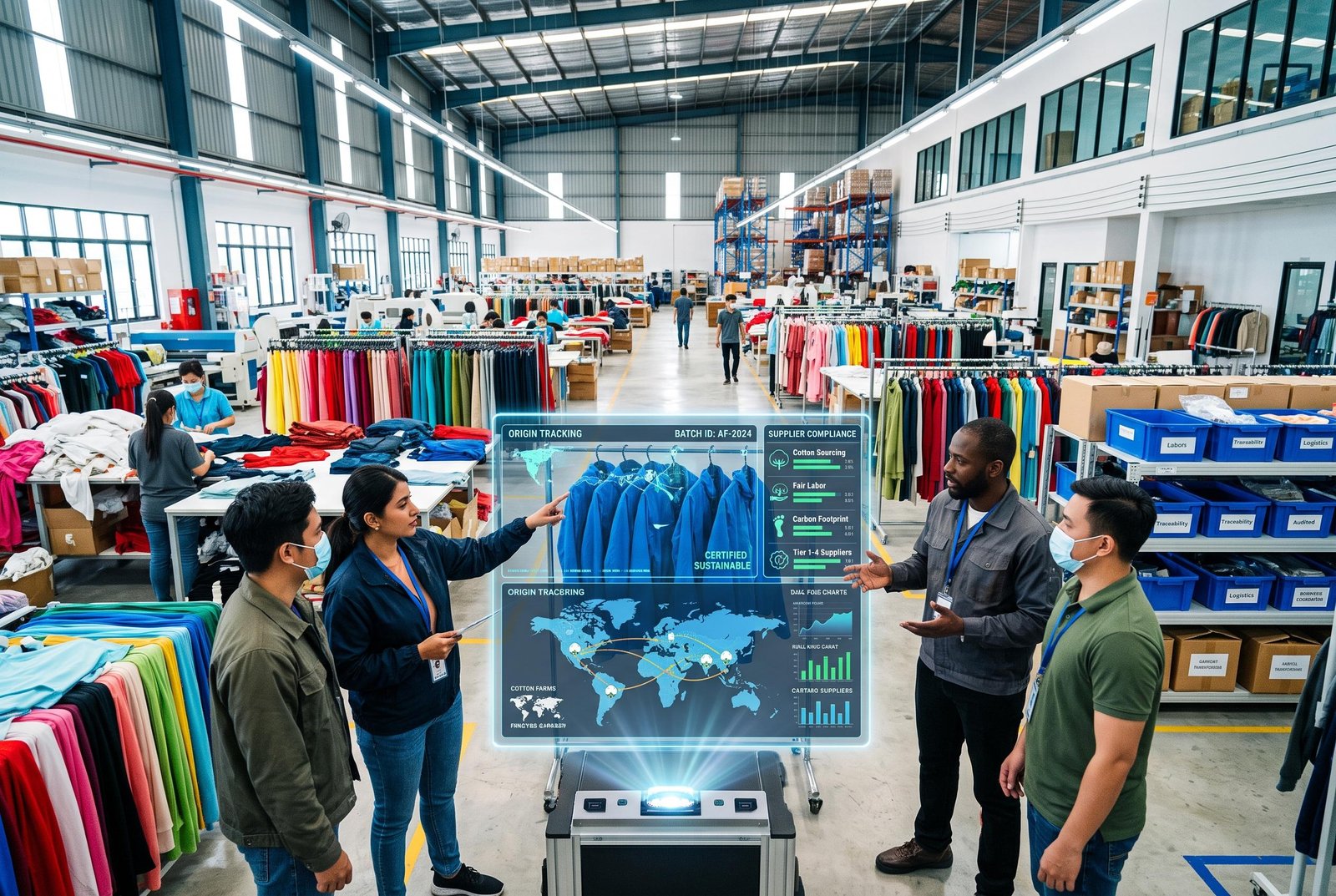
As regulators on both sides of the Atlantic press ahead with tougher rules, apparel groups are under growing pressure to see far deeper into their supply chains than ever before. The challenge now is not only tracking direct factories, but also the mills, farms, processors and logistics partners further upstream that shape whether a garment can be sold, audited and, increasingly, proved compliant.
Mark Burstein, senior vice-president for the Americas at Inspectorio, the supply-...
Continue Reading This Article
Enjoy this article as well as all of our content, including reports, news, tips and more.
By registering or signing into your SRM Today account, you agree to SRM Today's Terms of Use and consent to the processing of your personal information as described in our Privacy Policy.
chain software company used by retailers including Gap and Mango, said forthcoming measures such as extended producer responsibility rules in the US and digital product passports in Europe are forcing brands to gather far more detailed evidence about where products come from and how they were made. That evidence can include factory audits, purchase orders and records covering water use or carbon emissions.
The timing matters. The apparel alliance behind the Supply Chain Taxonomy, including the Apparel Impact Institute, Cascale, Textile Exchange and ZDHC Foundation, launched Version 2 of its framework in July 2026 to improve consistency and visibility across the textile, clothing, leather and footwear sectors. In Europe, the European Commission published transparency guidance for AI systems on 20 July 2026, with the AI Act’s transparency obligations taking effect from 2 August 2026. Together, those developments underline how regulation is increasingly pushing companies towards structured, machine-readable supply-chain data.
For brands, the appeal of artificial intelligence is partly speed. Burstein said tasks that once took days can now be cut to around an hour, because AI agents can help assemble chain-of-custody records, gather documents and generate compliance reports. Manual methods, by contrast, often rely on suppliers completing spreadsheets and staff chasing missing information, a process he described as increasingly unworkable as rules multiply.
The compliance burden is already familiar in the United States, where the Uyghur Forced Labor Prevention Act has required importers since 2022 to show documented proof that goods were not made with forced labour. Industry specialists say that in apparel, where a single product can involve cotton grown in one country, milled in another and sewn somewhere else entirely, the paperwork can quickly become unmanageable without automation.
That is one reason more retailers are experimenting with AI traceability tools. According to Business Insider, companies such as ASOS, H&M and Gap are using these platforms to map sourcing networks, assess tariff exposure, track water use and flag regulatory or weather-related risks. Kenchen Bharwani, a fashion consultant at Empire Apparel, said AI helps surface hidden problems before they turn into operational disruption.
Smaller businesses are reaching for the same tools. Brad Rhyne, chief executive and co-founder of OMJ Clothing in Charlotte, North Carolina, said he used Claude in March to build a custom dashboard that pulls together factory orders and status updates into what he called a single source of truth. Before that, he said, delays were often discovered only after a customer asked for an update; now the company can spot them earlier and either switch suppliers or warn the buyer in advance.
Larger groups are also using AI to identify human-rights and environmental risks. Bharwani said Vera Bradley uses TrusTrace to monitor Customs and Border Protection risk databases for forced-labour indicators, while Adidas uses the same platform alongside the World Resources Institute’s Aqueduct tool to assess flood exposure at mills. H&M has previously said it has used AI to identify flood risks and factory closures in Bangladesh, helping it reduce production there.
The push for transparency is also being reflected in the industry’s partnerships and product development. In April 2026, Trimco Group announced a tie-up with Retraced to deliver a combined labelling and supply-chain intelligence offering aimed at textile and footwear compliance. That suggests the market is moving beyond one-off traceability projects towards more integrated systems that blend product identification, supplier collaboration and regulatory reporting.
Even so, the sector remains far from uniformly prepared. Bharwani said some companies have made impressive progress, citing ASOS as an example of a retailer that has traced supply chains down to the farm level. But she added that such depth remains unusual, and most brands are still working to get anywhere near that level of visibility.
With US states rolling out their own extended producer responsibility regimes at different speeds and the European Union refining digital product passport requirements, apparel companies now face a moving target. The result is a scramble to replace manual compliance work with systems that can keep pace with changing rules, identify risk sooner and prove, with documentation, that a product’s journey can be traced from raw material to retail shelf.
Source: Noah Wire Services