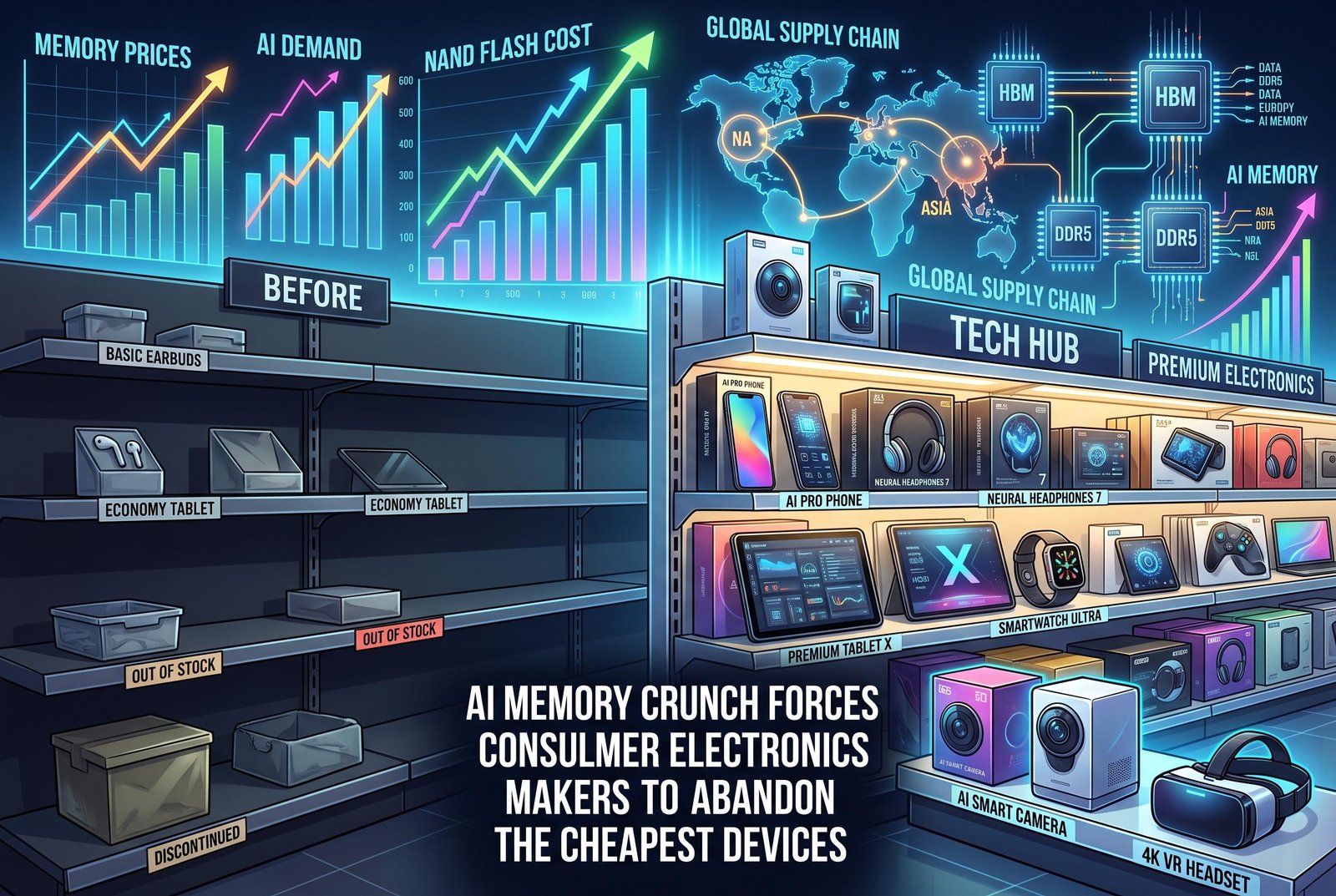
The most acute pressure point in consumer electronics supply chains is now the memory market, where surging demand from artificial intelligence infrastructure is rippling far beyond servers and into phones, laptops, consoles and accessories. Omdia has said memory prices have risen by as much as 400% over the past two years, and its more recent research points to a sharp deterioration in the economics of lower-priced smartphones, where the market for handsets below $400 has fallen by m...
Continue Reading This Article
Enjoy this article as well as all of our content, including reports, news, tips and more.
By registering or signing into your SRM Today account, you agree to SRM Today's Terms of Use and consent to the processing of your personal information as described in our Privacy Policy.
ore than a fifth year on year. In practice, that means manufacturers are being forced to rethink not just procurement, but which products they can profitably make at all.
Willy Shih, the Robert and Jane Cizik professor of management practice in business administration at Harvard Business School, told Supply Chain Dive that the mood across the sector has shifted from careful optimisation to something closer to crisis management. He described the atmosphere as one of “desperation”, a reflection of the way memory scarcity, trade volatility and logistics disruption are colliding at the same time.
The first response from many companies has been to return to longer-horizon planning. During the pandemic, electronics makers were pushed into more rigorous forecasting and inventory management, but some of that discipline faded once the emergency passed. Now, according to Cori Masters of Gartner and Joseph Fitzgerald of Boston Consulting Group, firms are once again rebuilding those capabilities, with a greater emphasis on multi-year roadmap planning rather than annual budgeting alone. That includes renewed investment in planning software and a cautious use of artificial intelligence to improve demand sensing and replenishment.
The pressure is not limited to memory alone. Higher input costs are changing product design, pricing and portfolio decisions across the industry. Sony raised prices on several PlayStation consoles and accessories in April, citing continuing global economic strain, while Microsoft lifted Xbox prices by as much as $150 this summer. TrendForce has also warned that, although memory price increases may begin to slow as consumer demand resists further rises, DRAM and NAND costs are still expected to climb through the third quarter of 2026, keeping the squeeze on retailers and device makers.
That is already reshaping the kinds of products companies choose to support. Omdia has said the rising cost of memory is hitting the budget segment hardest, with vendors trimming or freezing specifications in lower-end devices even as they continue to add capacity to premium models. The result, analysts say, is a more polarised market, with manufacturers concentrating on higher-margin devices and retreating from the cheapest tiers where margins have become too thin to absorb component inflation.
There are similar signs in adjacent categories. Reports on the storage market show steep price rises for memory cards and flash drives, with some products seeing triple-digit increases, underscoring how broad the shortage has become. For consumer electronics brands, the challenge is no longer confined to a single component class; it now extends across DRAM, NAND and the wider set of parts needed to keep production lines moving.
At the same time, supplier relationships are becoming more strategic and more exclusive. Rather than relying on one-year agreements, companies are increasingly striking three- to five-year deals for chips and other constrained components, sometimes making advance payments to secure priority allocation. Venky Ramesh of AlixPartners said larger players have an advantage here because they can commit more capital upfront and offer suppliers longer-term certainty. Apple and Hewlett-Packard Enterprise have both leaned into that model, and Apple’s recent multi-year arrangement with Broadcom for custom silicon reflects how important locked-in supply has become.
Those closer partnerships are also being used to improve visibility into provenance and traceability. Masters said manufacturers and suppliers are working more closely to understand not just where parts are made, but where they move once they leave the factory. That has made collaboration more sophisticated, with joint ventures, investment agreements and take-or-pay structures all part of the playbook. In an environment where component access can determine product availability, the ability to secure supply is as much about relationship management as it is about price.
A broader diversification of the supply base is also under way. Dell Technologies has said it has faced shortages beyond memory, including constraints in storage, CPUs, rack-level cooling, networking and power components tied to AI computing. Apple, too, has flagged limited advanced-node capacity for its systems-on-chip. Such bottlenecks are encouraging firms to move away from narrow sourcing strategies and spread production across more suppliers and locations.
That diversification is happening alongside a gradual regionalisation of manufacturing. As companies seek to reduce risk and match local requirements more closely, many are shifting some production nearer to end markets. For some, this is about resilience; for others, it is about lower transport costs and more control over trade exposure. Ramesh said larger manufacturers are also working to reduce their dependence on China over time, although that transition cannot happen quickly because new vendor networks and manufacturing footprints take years to mature.
Logistics decisions, meanwhile, are being rewritten by scarcity rather than freight cost. In the past, shipping mode choices were largely driven by transport expense. Now, if a part is short, companies will often pay for air freight simply to prevent a production halt. Ramesh said the cost of expediting a constrained component is trivial compared with the damage caused by an idle factory line. Fitzgerald added that some firms are balancing that by reserving faster transport for the most urgent shipments while moving a larger share of predictable volumes by sea to protect margins.
Taken together, these shifts show an industry that is no longer just coping with cyclical volatility. Consumer electronics supply chains are being rebuilt around a new reality in which AI demand, memory scarcity, tariff uncertainty and regional risk are all forcing tougher choices about what to make, where to make it and how much resilience companies are willing to pay for.
Source: Noah Wire Services