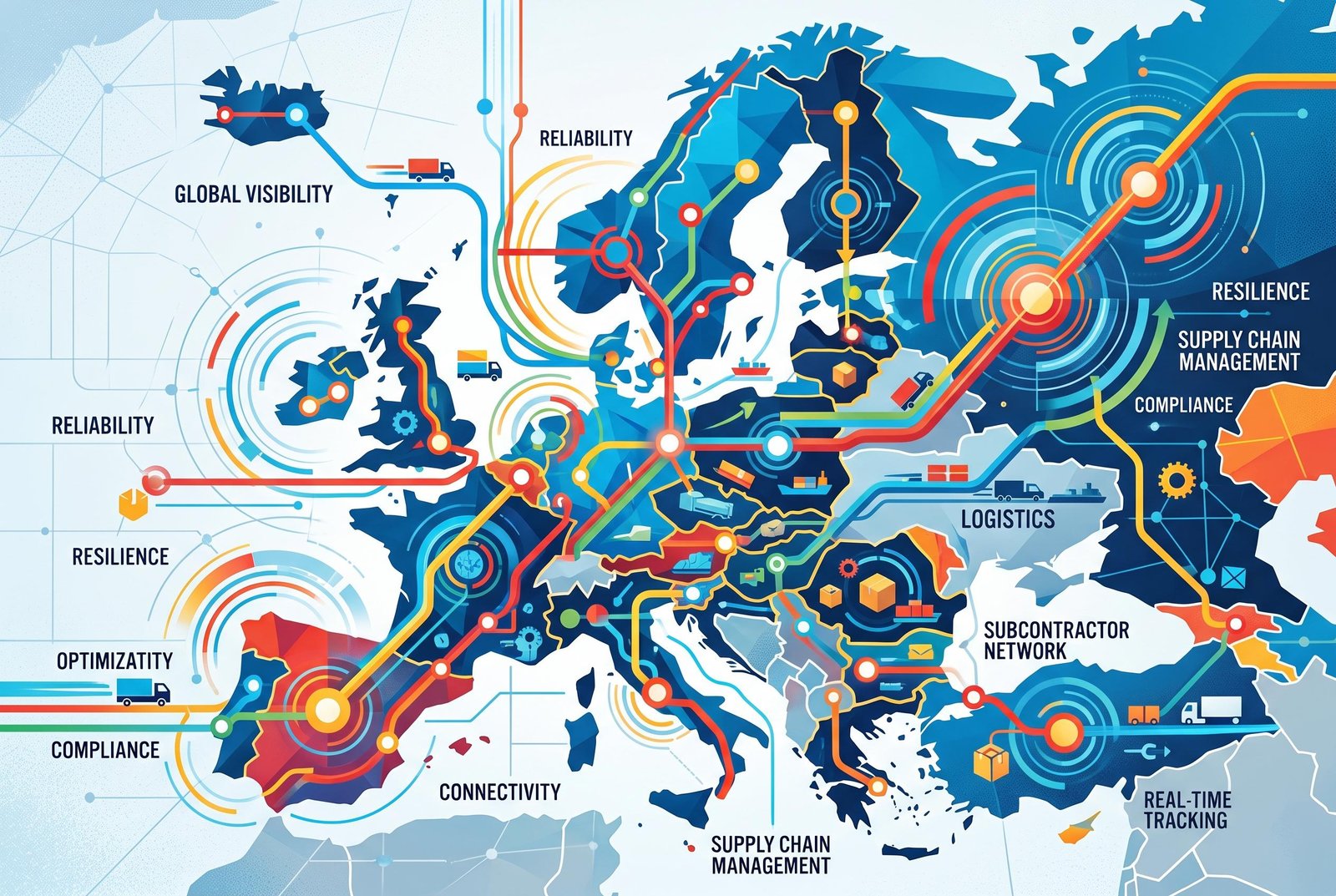
European supply chains are built on movement, handovers and compromise. A single consignment can leave a plant in one country, cross several borders by road, pass through different carriers and customs processes, and reach its destination only after a sequence of transfers that each introduce another chance for delay or confusion.
That complexity is not merely an inconvenience. As the European Business Review article argues, the real problem is that many organisations still man...
Continue Reading This Article
Enjoy this article as well as all of our content, including reports, news, tips and more.
By registering or signing into your SRM Today account, you agree to SRM Today's Terms of Use and consent to the processing of your personal information as described in our Privacy Policy.
age valuable equipment and cargo without knowing, in real time, where those assets are. When visibility is weak, businesses absorb a range of hidden costs: emergency replacements, missed deadlines, idle crews and compliance headaches. In practice, a lost or unaccounted-for asset rarely stays a single problem for long; it becomes a chain of expenses that are difficult to isolate, and therefore easy to underestimate.
The issue becomes even more pronounced across Europe, where operations often span multiple regulatory environments, customs regimes and logistics partners. A shipment that moves easily within one national network can become much harder to trace once it passes into another jurisdiction and into the hands of subcontractors. Each transfer widens the gap between the physical item and the paperwork that is meant to describe it. For companies running lean, that gap can be costly. For insurers and compliance teams, it can be worse still, because an incomplete audit trail may affect both claims and premiums.
The case for better asset visibility has therefore shifted from administrative tidiness to operational necessity. Modern tracking systems now rely on GPS and mobile connectivity to provide more frequent location updates than the manual check-ins many firms still depend on. They can add geofencing to alert teams when an asset leaves an authorised area, and tamper warnings when equipment is interfered with. Where satellite positioning is unreliable, such as in warehouses, dense urban sites or underground locations, network-based tracking helps maintain continuity. Just as importantly, these systems are no longer limited to trucks and high-value machinery; they can also monitor unpowered items such as pallets, cages and toolboxes, bringing a wider share of working capital into view.
That visibility has strategic value well beyond loss prevention. Usage data can show whether equipment is genuinely needed in one region or whether it is sitting idle while another site hires in replacements. In that sense, tracking becomes a planning tool as much as an operational one. It can support decisions on fleet size, capital expenditure and cross-border redeployment, helping companies avoid unnecessary purchases and reduce reliance on short-term hire. The same data can also strengthen service levels. Businesses able to show customers where consignments are and when assets will arrive are better placed to protect contracts and win new ones.
The broader lesson is that supply chain resilience increasingly depends on shared information rather than isolated internal systems. A company may have a clear view of its own assets, yet still lose control at the handover points where those assets move to carriers, suppliers or subcontractors. That is why accurate, shared data matters: it reduces disputes over responsibility, makes handovers easier to verify and gives partners a common operational picture. Industry commentary on supply chain visibility has long noted that transparency improves decision-making, risk management and compliance, while also supporting more responsible and efficient operations. The same logic applies here. Without trustworthy location data, even the most sophisticated digital system can replicate the same blind spots in a more elegant form.
In the end, the businesses most likely to manage Europe’s complex logistics networks effectively will not necessarily be those with the largest fleets or the most intricate routes. They will be the ones that treat visibility as a core capability. Knowing where an asset is, who has used it and whether it is available may sound modest, but across a continental supply chain it becomes a practical lever for lowering cost, improving reliability and making cross-border operations genuinely resilient.
Source: Noah Wire Services