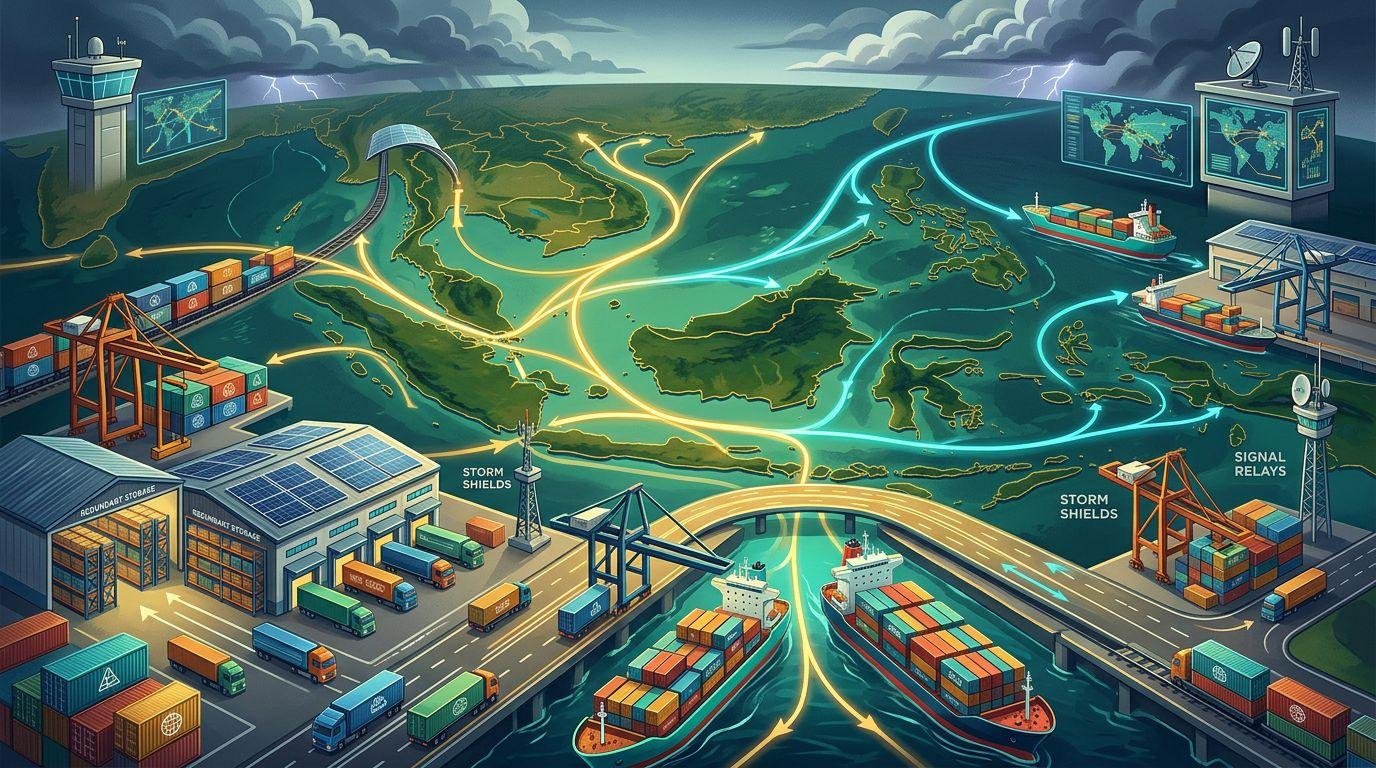
Two hundred days into the war, the clearest lesson for Southeast Asia is not that supply chains have snapped, but that they have changed shape under pressure.
What began as a question about whether the disruption would fade has become a broader reckoning about permanence. According to Dr Raymon Krishnan, writing for CargoNow, the Strait of Hormuz has moved from being one of global trade’s most reliable passages to something far less predictable, with shipping patterns showing...
Continue Reading This Article
Enjoy this article as well as all of our content, including reports, news, tips and more.
By registering or signing into your SRM Today account, you agree to SRM Today's Terms of Use and consent to the processing of your personal information as described in our Privacy Policy.
a dramatic collapse in normal commercial traffic. The result, he argues, is not a simple interruption to trade flows but a structural reset in the way companies think about risk, routing and cost.
That shift matters acutely for ASEAN. The region sits at the crossroads of energy imports, export manufacturing and transhipment activity, which means even distant conflict can be felt quickly in port charges, insurance premiums, fuel bills and freight rates. For businesses across the bloc, the consequences do not stop at the quayside. They filter into factory schedules, warehouse strategy, trucking, aviation, retail pricing and ultimately household budgets.
The immediate effect of a chokepoint crisis is usually easy to identify: less capacity, higher costs and slower movement. The deeper impact is more subtle. As cargo is diverted on longer routes, and as insurers and carriers charge more for the added risk, landed costs rise across the board. Governments, meanwhile, may seek to shield domestic energy supplies or tighten trade restrictions, which can further distort procurement decisions and squeeze availability. What starts as a disruption to maritime traffic becomes a wider commercial squeeze.
That is why the second- and third-order effects may prove more consequential than the first. Higher energy prices feed into transport costs, which then lift production costs, which in turn alter sourcing decisions, stockholding policies and working capital requirements. Companies that once relied on lean inventories and single-route efficiency are increasingly being pushed towards redundancy: more suppliers, more safety stock and more regional distribution capacity.
Consultants and industry researchers say this is part of a broader redefinition of resilience. S&P Global has described 2026 as a year in which geopolitical risk, tariff policy and climate pressures are driving supply chains away from a short-term mitigation mindset and towards system-level adaptability. That means resilience is no longer simply a question of better dashboards, stronger visibility or more sophisticated forecasting tools. It is about whether a company has workable alternatives when the cheapest route no longer works.
The same conclusion appears in research on geopolitical supply-chain risk that argues conventional contingency planning is no longer sufficient for trade wars, sanctions and armed conflict. Instead, companies are being urged to understand signals earlier, pre-position options before crisis hits and adapt rapidly when it does. In practice, that can mean qualifying extra suppliers, building regional inventory buffers, changing transport modes or shifting production closer to customers.
The growing emphasis on redundancy also reflects a broader regional trend. Analysts at S&P Global have pointed to stronger intra-Asia trade links and a gradual regionalisation of supply networks, as firms respond to fragmentation in global trade. Tariffs, export controls and recurring geopolitical shocks are making it harder to depend on the assumption that the lowest-cost route will remain available. In that environment, proximity, flexibility and political alignment are gaining weight alongside price.
The Strait of Hormuz crisis has made that point with unusual force. Grand View Research has said the disruption has tightened global oil markets, raised freight and insurance costs and pushed import-dependent regions such as Asia and Europe to treat energy security as a strategic issue rather than a narrow procurement concern. It also warned that Middle Eastern exports have fallen sharply, underscoring how quickly a chokepoint can ripple through the wider economy.
Independent analysis cited in March by the Supply Chain Intelligence Institute Austria, the Complexity Science Hub and TU Delft reached a similar conclusion, saying a prolonged closure of the strait could severely disrupt global supply chains and destabilise energy markets. The concern is not confined to oil majors or maritime insurers. If the flow of crude, refined products and liquefied natural gas is constrained, the strain spreads through manufacturing, logistics and consumer markets far beyond the Gulf.
For executives, the strategic questions are therefore becoming more uncomfortable. Which trade lanes can still be trusted? Which suppliers have turned into liabilities? Where is the next bottleneck likely to emerge? IMD has argued that those are now the right questions to ask, because the old model of resilience, built around isolated shocks and temporary workarounds, is being overtaken by a world of repeated, overlapping disruptions.
The broader historical context is sobering. Globalisation encouraged companies to organise around efficiency, assuming that the trading system would remain broadly open and predictable. The war in Ukraine began to challenge that confidence; the Red Sea crisis and the conflict linked to Hormuz have deepened the reassessment. As Dr Krishnan argues, supply chains are not simply breaking under pressure. They are adapting in ways that may permanently alter their architecture.
That may mean a more geographically diverse model of trade, with firms willing to pay more for resilience, security and optionality. It may also mean a lasting premium on capacity that can be guaranteed, routes that can be rerouted and inventories that can absorb shocks. In that sense, the real issue is not whether supply chains can survive the next geopolitical jolt. It is whether businesses and governments are prepared for the price of making them sturdier.
Source: Noah Wire Services