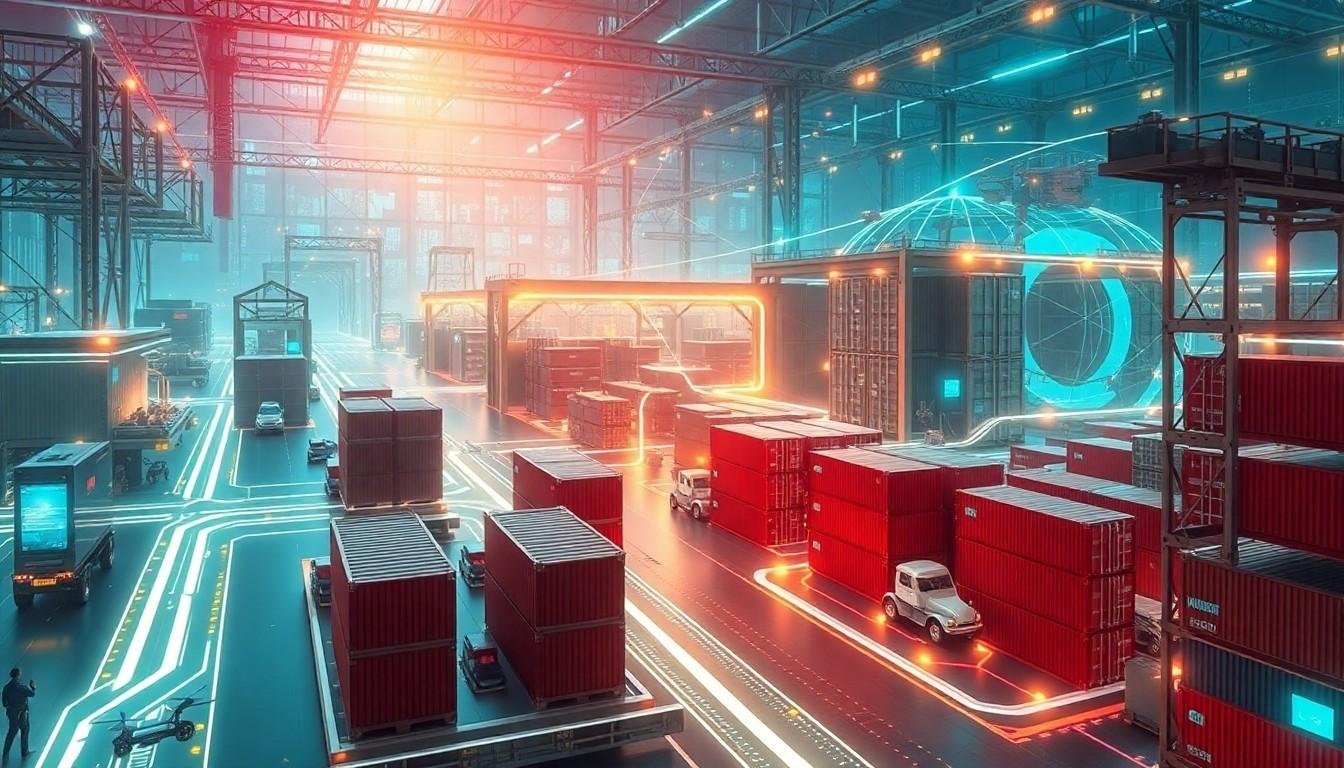
Nvidia has begun using Palantir software to manage its own supply chain, a sign that the two firms are trying to turn an internal deployment into a broader product aimed at industry and government alike. According to Nvidia’s own announcement, the system combines the chipmaker’s Nemotron open models with Palantir’s Foundry platform and Artificial Intelligence Platform, all organised through Palantir’s Ontology layer to give planners a shared view of constraints and allocation ...
Continue Reading This Article
Enjoy this article as well as all of our content, including reports, news, tips and more.
By registering or signing into your SRM Today account, you agree to SRM Today's Terms of Use and consent to the processing of your personal information as described in our Privacy Policy.
decisions.
The rollout gives Nvidia an early test case for a platform the companies say could be applied well beyond chips. Palantir says the same architecture can be deployed in enterprise data centres and adapted for organisations that want more control over their data and AI systems. The companies describe the approach as “sovereign intelligence”, a phrase that reflects rising demand from governments and corporations for AI stacks that can be kept on their own servers rather than handed over to outside cloud providers.
For Nvidia, the stakes are unusually high. The company sits at the centre of the global AI infrastructure boom, and its own ability to move components through the supply chain helps determine how quickly new data centres, factories and computing clusters can come online. Fast Company reported that each Vera Rubin rack involves thousands of suppliers and roughly 1.3 million parts spanning compute, memory, networking, power, cooling and mechanical systems. Nvidia has said it intends to support up to $500 billion of AI infrastructure in the United States through partnerships and federal initiatives.
Justin Boitano, Nvidia’s vice-president of enterprise AI, told Fast Company that the point is not simply to speed up one company’s logistics, but to build a system that can be used wherever complex supply chains need orchestration. He said the software can help manage everything from the timing of power connections to the arrival of cooling equipment and compute hardware, with human planners still making the final calls. Palantir’s Kevin Kawasaki, its global head of business development, argued that the real measure of sovereignty is whether a company’s own AI stack improves performance, not merely whether its data remains on local servers.
The partnership has roots in work for defence and intelligence customers, where disconnected or classified systems have long made cloud dependence impractical. Palantir and Nvidia have already pitched similar tools to government buyers, and Fast Company noted that more than 180 government-backed sovereign AI projects are now underway worldwide, according to the Center for a New American Security. Palantir has also been expanding in Europe, including a £1.5 billion partnership in the UK last year and a separate Ministry of Defence contract in December.
The software stack also fits into a broader shift in the AI market towards open-weight models that companies can adapt themselves. Boitano told Fast Company that Nvidia’s internal tests showed post-training could be done in minutes rather than requiring large clusters, suggesting that custom models are becoming more practical for specific industrial tasks. Palantir, which does not build large language models of its own, instead sells the control layer above them: tools for audit, fine-tuning, logging and workflow automation.
That focus on operational control is what the companies say differentiates their pitch from the large frontier-model providers. The system is designed to keep humans in the loop while gradually automating more decisions as trust builds. According to the companies, the first use case is supply-chain allocation, but the broader ambition is to turn AI into a working layer for manufacturing, retail, pharmaceuticals, agriculture and public-sector operations. In practice, Nvidia and Palantir are betting that the race to build AI will increasingly depend not only on better chips and better models, but on who can make the whole industrial machine run faster.
Source: Noah Wire Services