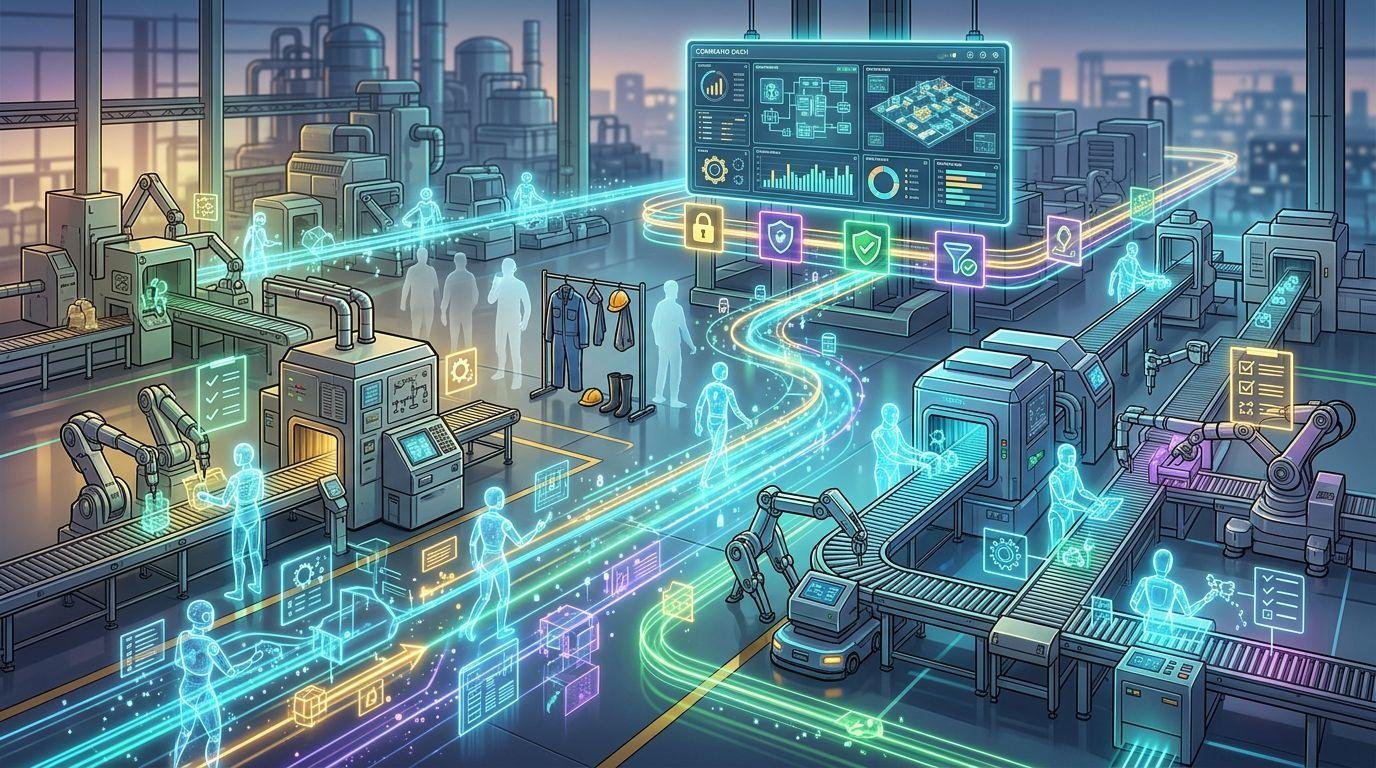
Industrial organisations are increasingly turning to agentic digital workers as a way to relieve a mounting shortage of time, talent and operational bandwidth. In new research commissioned by IFS and carried out by The Futurum Group, industrial staff were found to lose 41% of their time to manual, repetitive work, a drain that is widening what the company describes as a capacity gap between what businesses need to do and what their teams can actually complete.
The pressure is b...
Continue Reading This Article
Enjoy this article as well as all of our content, including reports, news, tips and more.
By registering or signing into your SRM Today account, you agree to SRM Today's Terms of Use and consent to the processing of your personal information as described in our Privacy Policy.
eing intensified by demographic change. Across factories, utilities and supply chains, experienced engineers and operators are retiring, just as businesses are trying to keep pace with demand, maintenance obligations and complex procurement processes. According to IFS, many companies want the efficiency gains promised by automation but remain cautious about handing over too much control to software, which is why human-in-the-loop models are becoming central to deployment strategies.
That approach is at the heart of the Loops Agentic Platform, which IFS says is designed to create digital workers that can monitor operations, make decisions within defined limits and carry out tasks end to end, only escalating to people when judgement is needed. The company says the platform can automate 60% of agentic transactions without manual intervention, while the remaining 40% retain human review and approval steps to preserve oversight and validation.
IFS argues that this blend of autonomy and control is the difference between generic AI tools and systems built specifically for industrial use. Its platform is framed as a way to embed digital workers directly into the enterprise software companies already use, rather than forcing businesses to clean up data or redesign workflows before getting started. The vendor says this lets organisations capture capacity gains more quickly while keeping existing rules and approval chains intact.
Early customer examples suggest the model is already moving from theory to production. IFS says manufacturers including Kitron Group and KLN Family Brands are using digital workers to recover hours each week in procurement and order-to-pay processes, with some organisations moving towards fully automated handling of routine transactions. Kitron is rolling out purchase-to-order digital workers across all 13 of its sites by the end of 2026, and IFS says one deployment exposed a long-standing part-number error that manual checks had failed to catch for years.
In another example cited by the company, Ependion brought its Supply Order Manager digital worker live across the business in a 10-week staged rollout. IFS says the pace of implementation matters because industrial organisations need measurable results quickly, not drawn-out transformation projects. It presents those case studies as evidence that digital workers can be deployed inside existing guardrails, rather than as a replacement for established governance.
The wider research points to a strong commercial imperative. Automation.com, reporting on the same theme, said 77% of decision-makers have delayed or abandoned strategic initiatives because their teams did not have enough capacity to deliver them. That finding adds weight to the argument that the problem is not simply labour shortages, but the loss of time to low-value work that slows decision-making and delays improvement programmes.
There is, however, a growing warning chorus around the governance of agentic AI. TechRadar has highlighted the need for clear accountability, access controls, behavioural guardrails and auditability as autonomous systems take on more enterprise work. That caution is consistent with the industrial preference for a supervised model: businesses appear willing to let digital workers handle repetitive, rules-based activity, but they still want people to remain responsible for exception handling and strategic judgement.
For IFS, that balance is now the commercial case for agentic AI. The company says the challenge facing industrial businesses is no longer whether to adopt automation, but how to deploy it in a way that is reliable, transparent and trusted enough to operate at scale. In its view, the winners will be those that use digital workers to reclaim lost capacity without losing control of the process.
Source: Noah Wire Services