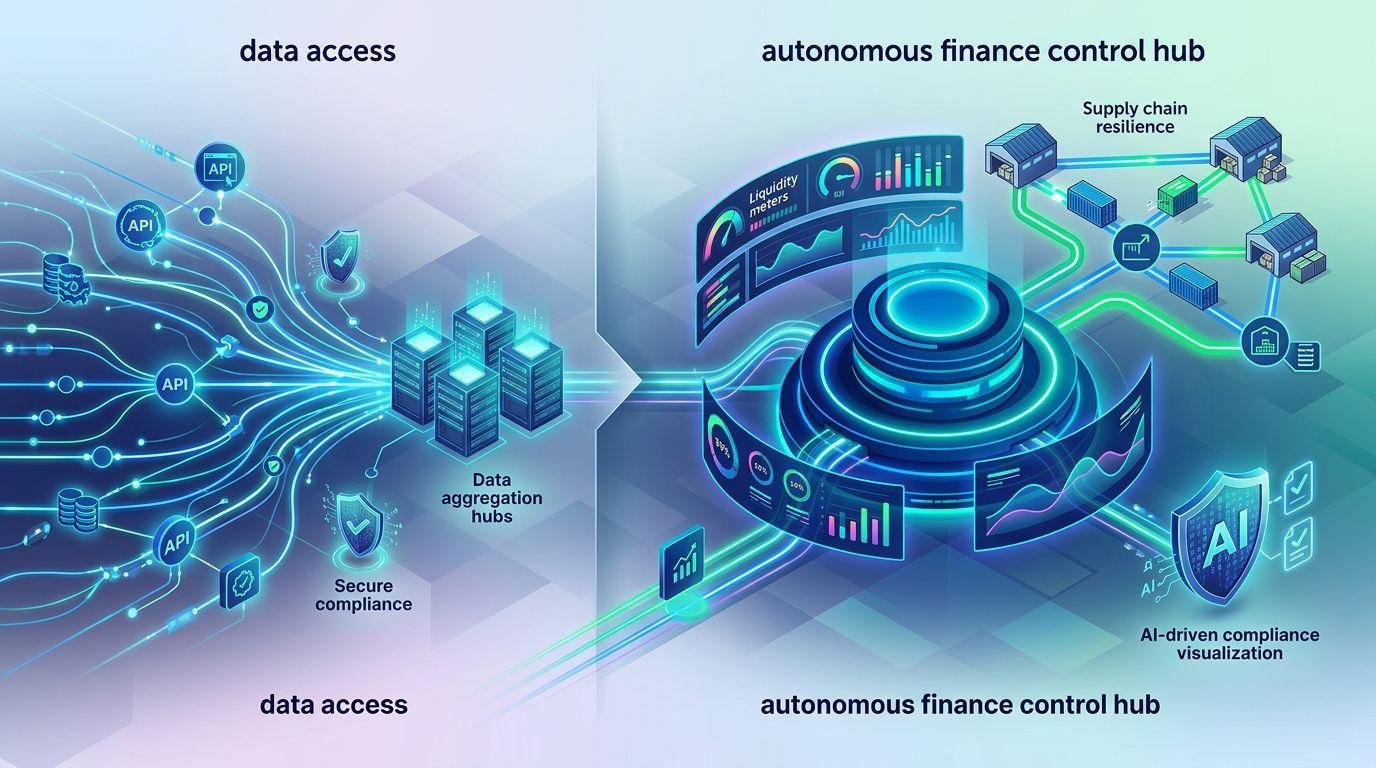
Eight years after PSD2 began reshaping payments and data access in the UK and Europe, open banking is moving beyond its original role as a retail-facing aggregation tool. What began as a framework for permissioned account data is increasingly being treated as the backbone for a new phase of enterprise automation: corporate agentic finance, in which AI systems do not merely interpret financial information but are given the authority to act on it.
That shift matters because the v...
Continue Reading This Article
Enjoy this article as well as all of our content, including reports, news, tips and more.
By registering or signing into your SRM Today account, you agree to SRM Today's Terms of Use and consent to the processing of your personal information as described in our Privacy Policy.
alue of open banking has changed. In its early years, the emphasis was on connectivity, secure APIs and standardised access to bank data. The emerging model is less about visibility alone and more about execution. In practice, that means software agents that can monitor balances, detect anomalies, initiate transfers, trigger hedging decisions or route payments without requiring a human to approve every step. The consequence is a treasury function that can react in near real time rather than waiting for batch processing or end-of-day reporting.
The Finextra blog argues that this is the point at which open banking becomes less of a data layer and more of an operating infrastructure. That view is echoed by a growing number of treasury technology providers, many of which are now building tools around autonomous or semi-autonomous financial workflows. Ripple Treasury, for example, describes a platform for cash, payments, risk and liquidity management that combines traditional and digital asset oversight with AI-driven automation. Kyriba has also introduced agentic AI capabilities aimed at orchestrating liquidity workflows under human governance, while Nilus focuses on real-time cash visibility and self-correcting forecasting for treasury teams.
The most immediate use case is liquidity management. For corporate treasurers, the combination of open banking data and AI decision-making creates the possibility of continuous cash orchestration across multiple entities and geographies. Instead of relying on manual sweeps or static funding schedules, an agent can spot a likely shortfall in one account, identify surplus cash elsewhere and move funds accordingly. It can also direct idle balances into instruments that appear more attractive at that moment, based on intra-day forecasts rather than historical assumptions. In foreign exchange, the same logic could support faster micro-hedging decisions when payment flows create exposure across currencies.
Supply chains offer another obvious application. By linking open banking feeds with enterprise resource planning systems, firms can build more responsive financing and payments processes. If a supplier’s transaction history suggests rising risk, an AI agent could recommend tighter terms, accelerate invoice financing or flag the relationship for review. Where invoice data and bank references do not match, the same system could cross-check records, identify missing reconciliation codes and restart the payment process with fewer delays. The promise is not only efficiency, but a reduction in the friction that often slows working capital across large business networks.
Fraud prevention and compliance are also central to the case for agentic finance. As financial crime becomes more sophisticated, passive monitoring is increasingly seen as inadequate. The next generation of systems aims to behave more like an internal control loop, continuously scanning transaction patterns, comparing them with expected behaviour and isolating activity that looks unusual before a payment is completed. Some providers say their platforms can also generate audit trails automatically, helping compliance teams document why a transaction was paused or a risk rule was triggered.
Yet the rise of autonomous finance also raises a governance question that the open banking industry has only partly resolved: how much authority should an AI agent be allowed to exercise? That issue is already shaping product design. Catena, which positions itself as a governance platform for AI agents, says each agent should have a distinct identity, rule-based permissions and full observability over every action it takes. That model reflects a broader consensus among vendors that autonomy in finance will need tight controls, with deterministic policy frameworks and human oversight remaining essential, at least for the foreseeable future.
Regional differences are likely to influence how quickly these systems take hold. In the UK, the direction of travel is towards broader commercial use of open banking, including business lending and trade finance. In the United States, the challenge remains the lack of common standards across a fragmented banking landscape, which makes scale harder even when the technology exists. India presents a different picture again: its Account Aggregator network is being used to support data-driven underwriting and supply-chain financing for enterprises that need live cash-flow information.
The broader market suggests the technology is moving from concept to deployment. Companies such as Itemize, which says it processes more than 100,000 transactions a day, are already using AI to automate accounts payable, accounts receivable and compliance workflows. That does not mean fully autonomous treasury is mainstream, but it does show that the building blocks are already in production. What remains is the integration of those tools with the open banking infrastructure that can supply them with reliable, permissioned data.
If the first chapter of open banking was about opening the rails, the next is about what travels on them. Corporate agentic finance points to a future in which treasury systems do more than inform decision-making. They make decisions themselves, within boundaries set by policy, compliance and human oversight. That is a significant evolution from the original promise of open banking, and one that could redefine how large companies manage liquidity, risk and payments in the years ahead.
Source: Noah Wire Services