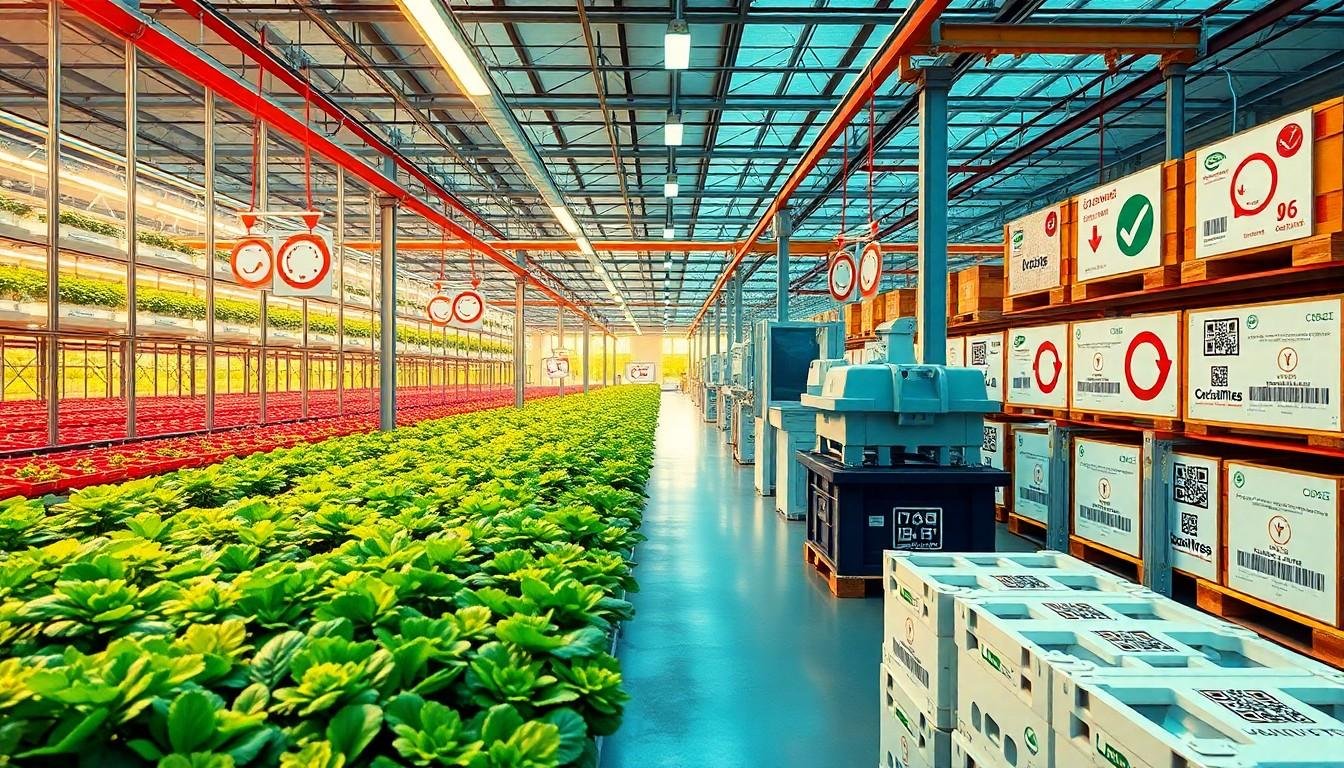
For commercial controlled-environment agriculture growers, the challenge of reaching premium retailers begins long before a crop leaves the greenhouse. As Henk Stander, chief technical manager for aquaculture in Stellenbosch University’s Department of Animal Sciences and the Stellenbosch University Water Institute, argued at NAMPO Cape 2026, the real test is whether an operation can perform reliably across the entire chain, from seed selection to shelf delivery.
His message i...
Continue Reading This Article
Enjoy this article as well as all of our content, including reports, news, tips and more.
By registering or signing into your SRM Today account, you agree to SRM Today's Terms of Use and consent to the processing of your personal information as described in our Privacy Policy.
s a pointed reminder that production technology alone does not win a place in a supermarket. Hydroponics, greenhouse systems and other protected growing methods may help produce high-quality crops, but they are not in themselves a sales proposition. Retail buyers are looking for dependable supply, food safety, consistency and quality, and many will want samples before committing to a relationship. In practical terms, that means a grower must be able to demonstrate more than yield potential; the operation has to show discipline, documentation and repeatability.
That distinction matters especially for new entrants who may assume that a sophisticated growing system is enough to secure a customer. According to Stander, formal retail does not work that way. A retailer is unlikely to be persuaded by the promise of a production method alone. What counts is whether the crop meets the required specification, arrives in the right condition and can be supplied at the agreed volume week after week.
The contrast between informal and formal markets is central to his view of the sector. Smaller, less structured channels can absorb variability in volume, packaging and pricing. Supermarket supply is different. Retailers typically expect fixed grades, defined pack formats, certifications and regular delivery schedules. A grower may find it relatively straightforward to sell a single tray or a few heads of lettuce, but scaling that up to thousands of units introduces a very different level of operational discipline.
Once a supply agreement is in place, the obligation shifts decisively to the producer. If a retailer has ordered 10,000 units, then 10,000 units must arrive. Weather, seasonality and production setbacks do not alter the expectation. That makes retail contracts potentially attractive, because they can create longer-term relationships and more predictable demand, but it also means the grower takes on much greater responsibility for continuity.
Stander’s wider point is that the value chain begins well before harvest and continues well after it. Seed quality, seedling production, water and nutrient management, harvesting, chilling, packaging, transport and distribution all influence whether a crop can be sold as a premium retail product. In his view, many growers concentrate so heavily on production that they underinvest in the downstream work needed to turn a harvested crop into something a retailer can accept. The processing side, he suggested, is too often treated as an afterthought.
That downstream work can be surprisingly technical. Premium supply may require cartons, pallets, reusable crates, labels and barcodes that match specific customer instructions. Delivery windows can be narrow, and distribution-centre procedures may leave little room for improvisation. In that sense, logistics becomes part of the growing system itself. A greenhouse may produce the lettuce, herb or leafy green, but the business only succeeds if the crop arrives in the correct quantity, condition and format at the right destination and at the right time.
The compliance burden is layered. Stander pointed out that national legislation provides the baseline before a producer even reaches the retailer, covering areas such as product standards, grading, packaging, fertilisers, agricultural remedies, food safety, water and hygiene. On top of that come retailer-specific requirements, which may include additional local or international certifications. Research published by the US Department of Agriculture has also found that retailers often require third-party food safety audits from growers, even when such audits are not explicitly required by law, underlining how commercial expectations can exceed the minimum regulatory standard.
That same widening of standards is visible in broader wholesale and grocery supply chains. Suppliers are often expected to complete customer applications, meet operational rules and comply with safety protocols that extend beyond the field. Guidance for growers selling into grocery channels likewise stresses packaging, labelling and distribution-centre logistics as essential hurdles rather than optional extras. The common thread is that retail access is governed by systems, not just by product quality.
Environmental sustainability has become another important part of the retailer checklist in South Africa, alongside ethical sourcing, labour standards and traceability. For growers, that means the conversation increasingly extends to staff welfare, training and workplace safety. As Stander noted, businesses may be expected to show how they pay workers, whether protective clothing is supplied and whether training programmes are in place. In other words, the retail customer is not only buying the crop; it is also assessing the integrity of the operation behind it.
Consistency remains the commercial benchmark. A technically impressive growing system is not enough if the producer cannot maintain quality and supply over time. Stander urged growers to think about collaboration as well, including the possibility of co-operatives or complementary supply arrangements that can help keep programmes moving when one operation faces shortfalls. That kind of resilience is especially important in a sector where drought, infrastructure problems or production setbacks can quickly unsettle delivery commitments.
His broader conclusion was that successful controlled-environment agriculture for premium retail must be designed as a fully integrated business, not a standalone production unit. The greenhouse or aquaponics facility may be where the crop begins, but the commercial outcome depends on everything that follows. For premium retailers, the question is not simply whether a crop can be grown. It is whether it can be grown, handled, documented, moved and delivered with sufficient reliability to become part of a retail programme.
Source: Noah Wire Services