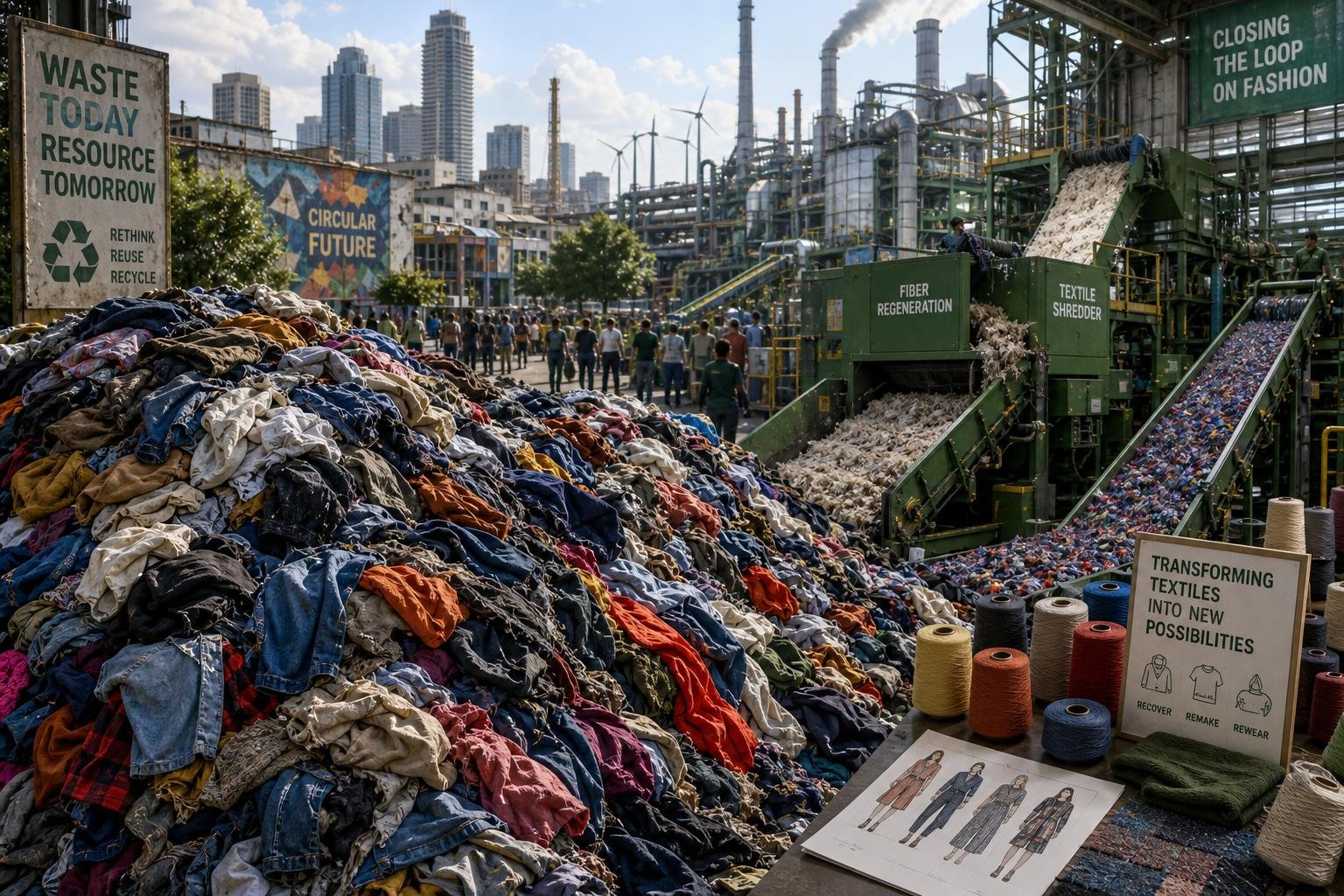
Textile-to-textile recycling is still widely seen as one of fashion’s most promising circular economy goals, but industry leaders say the real obstacle is not only technical capability.It is the absence of a joined-up system that can supply feedstock, sort waste, finance production and create reliable demand.
That was the message from a panel at the recent Textiles Recycling Expo in Charlotte, North Carolina, where representatives from Accelerating Circularity, Target, Unifi,...
Continue Reading This Article
Enjoy this article as well as all of our content, including reports, news, tips and more.
By registering or signing into your SRM Today account, you agree to SRM Today's Terms of Use and consent to the processing of your personal information as described in our Privacy Policy.
Reju and Elevate Textiles argued that the sector will not move from pilot projects to broad adoption unless brands, mills, recyclers and consumers all pull in the same direction.
Sarah Coulter, Americas programme director at Accelerating Circularity, said the industry often fixates on processing technology while overlooking the structural challenge. The much-cited figure that only around 1% of the roughly 90 million tonnes of textiles generated each year is recycled, she said, reflects a system problem as much as a technology gap.
Unifi, which processes post-industrial and post-consumer textile waste through its Repreve Takeback programme, has been an early mover in the area. But Meredith Boyd, the company’s executive vice president and chief product officer, said the market will only expand if stakeholders at every point in the chain commit to the material.
She said the products already exist, but wider adoption depends on mills, brands and shoppers creating enough demand to justify larger investment.
Target’s Janelle Hibbard said cost remains the biggest barrier for a retailer trying to scale recycled textiles, alongside questions about volume and whether mills can run the material efficiently. In her view, lower costs are the prerequisite for scale, not the result of it.
Jimmy Summers, chief sustainability officer and vice president of environmental, health and safety at Elevate Textiles, said feedstock availability and economics remain stubborn obstacles, though he pointed to encouraging momentum in mechanical and chemical recycling, as well as sorting. His comments reflect a wider shift in the market: while closed-loop systems once seemed far off, several companies are now moving from concept to commercial supply.
Recent partnerships underline that change. Textile World reported in April that RE&UP Recycling Technologies had teamed up with Madewell and fabric maker ISKO to transform about 20,000 pairs of post-consumer jeans into recycled feedstock for a denim capsule, a sign that textile-to-textile recycling is beginning to work in a commercially relevant category. Vogue has also reported growing activity around recycled polyester, including Syre’s expanded role in the market and a partnership with Nike, while Vogue Business said Gap has agreed to use 10,000 tonnes a year of Syre’s recycled polyester across its brands.
Diane Woods, global head of business development and product at Reju, said the industry must stop comparing post-consumer textile recycling with cheaper, already-established virgin or post-industrial systems. She argued that turning an old T-shirt back into a new T-shirt is fundamentally different from recycling bottles or factory offcuts, and should be judged accordingly on price.
The challenge is not only financial. Hibbard said companies must be willing to share risk during pilot programmes, because post-consumer feedstocks are unpredictable and quality issues are likely to emerge. That means building contingency plans with designers, quality teams and suppliers rather than expecting a flawless first attempt.
Boyd pointed to Unifi’s early experience with Repreve, the recycled polyester yarn now used by brands including Nike, The North Face, J.Crew and Levi’s, as evidence that initial doubts can be overcome. She said the company had to work through misconceptions about recycled polyester before the material gained broad acceptance.
Feedstock sourcing remains one of the sector’s most persistent bottlenecks, but Woods said collaboration can help solve that too. She cited Reju’s work with Waste Management and Goodwill, which aims to build a chain from collection to repair, resale and then recycling for material that has no remaining use. In that model, the system first captures anything that can be reused before sending the remainder to recycling.
Across the industry, the same conclusion is emerging: textile-to-textile recycling is no longer just an ambitious concept, but it is still far from effortless. As participants at the Charlotte event argued, the next phase will depend less on waiting for a perfect solution and more on building enough commercial confidence, shared infrastructure and long-term commitment to make the imperfect systems of today work at scale.
Source: Noah Wire Services