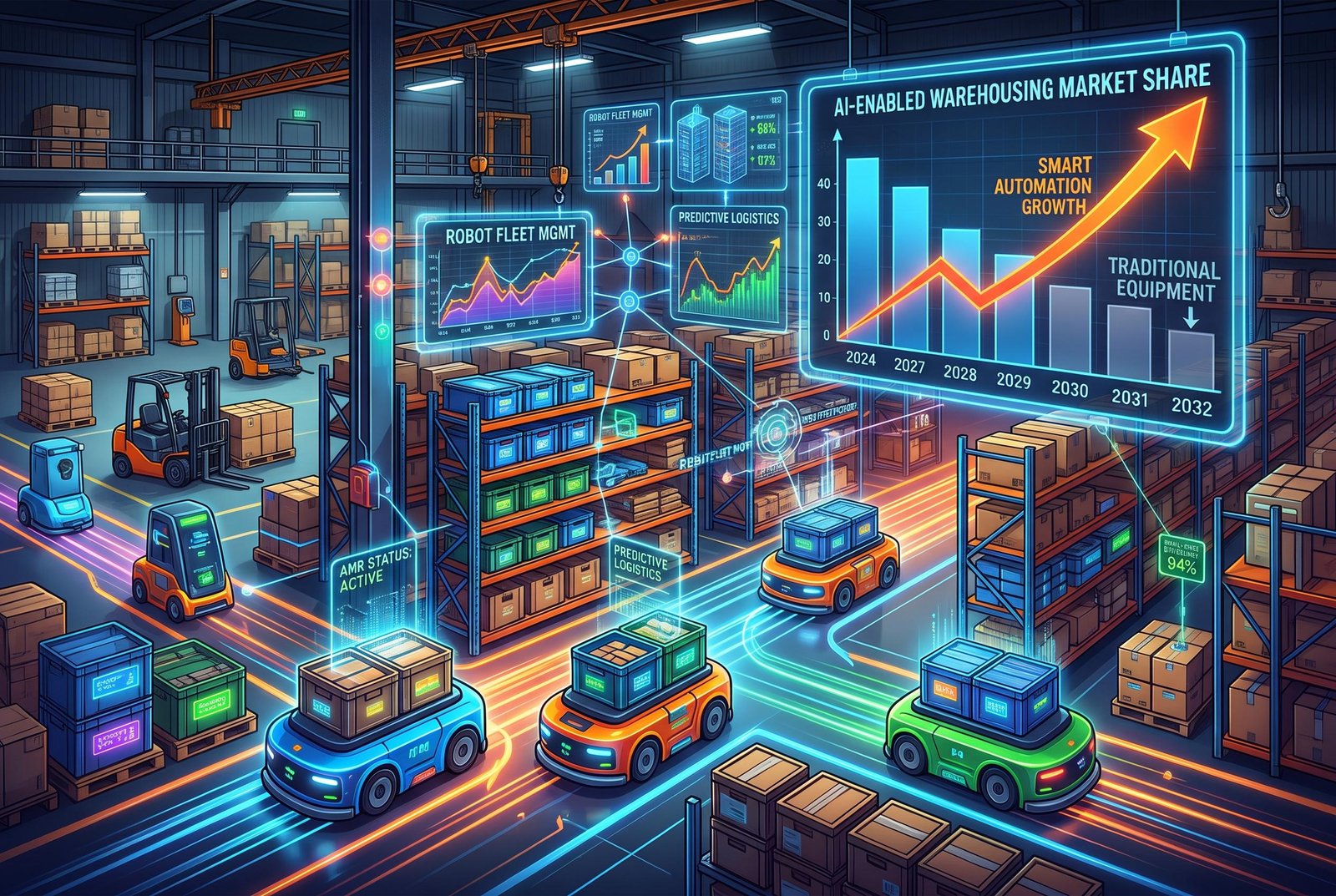
The global intralogistics market is on course to expand sharply over the rest of the decade, with IoT Analytics projecting that it will rise from US$96 billion in 2025 to US$133 billion by 2030. That implies compound annual growth of 6.7%, driven by persistent labour shortages, growing pressure for faster fulfilment and a stronger focus on squeezing more capacity out of existing warehouses and distribution centres.
The research suggests the market is changing shape as well as g...
Continue Reading This Article
Enjoy this article as well as all of our content, including reports, news, tips and more.
By registering or signing into your SRM Today account, you agree to SRM Today's Terms of Use and consent to the processing of your personal information as described in our Privacy Policy.
rowing. Spending is increasingly moving towards software and mobile robotics rather than being concentrated solely on conventional handling equipment. IoT Analytics said no single supplier spans the full breadth of the sector, with most vendors concentrated in only part of the wider stack covering warehouse software, automation and material-handling systems. Companies with a broader footprint across multiple categories include Siemens, Honeywell, Zebra, Swisslog and Körber.
The study points to five forces behind the push towards automation. Labour remains the most immediate problem, with retirements outstripping new entrants and some manual-picking operations reporting annual staff turnover of 200% to 300%. Warehouses are also being asked to adapt more quickly as tariffs, supply chain disruption and shifting order patterns create a need for more flexible layouts. Rather than locking themselves into large fixed installations, some operators are opting for modular systems that can be rearranged more easily.
Capital discipline is another factor. Higher interest rates have made new greenfield sites less attractive, pushing many businesses to improve throughput and storage density in buildings they already own. That has boosted interest in vertical lift modules, shuttle systems and other technologies designed to make tighter use of available space. At the same time, same-day and next-day delivery expectations across large product ranges are increasing demand for goods-to-person systems and automated storage and retrieval technologies.
Safety concerns are also reinforcing the case for automation. According to IoT Analytics, warehouse workers often walk more than 10 kilometres a day and repeatedly lift heavy cases, which has encouraged employers to use robots to reduce physical strain and lower the risk of injury.
Some of the fastest growth is expected in software. IoT Analytics forecasts that this segment will expand from US$6.3 billion in 2025 to US$10.8 billion by 2030, a compound annual rate of 11.4%. The report attributes that acceleration to wider adoption of artificial intelligence in warehouse management and warehouse execution systems, as well as the emergence of orchestration software that can coordinate different automation tools.
Mobile robots are also expected to outpace the broader market. Revenue from autonomous mobile robots and automated guided vehicles is forecast to increase from US$4.3 billion in 2025 to US$8.4 billion by 2030, equal to annual growth of 14%. That compares with 5.7% growth for the wider mobile material-handling segment.
IoT Analytics highlighted three technology shifts that it believes will shape the next phase of the market. The first is the use of AI agents for control-desk work such as labour allocation, replenishment and maintenance planning, while human operators continue to set priorities and manage exceptions. The second is the rise of a vendor-neutral orchestration layer between warehouse management software and physical automation, allowing operators to introduce robots from different suppliers without rebuilding integrations each time. The third is the development of autonomous mobile manipulation robots, which combine a robotic arm with a mobile base so that one machine can move and handle goods.
Competition is also becoming more software-driven. Rather than competing mainly on hardware specifications, suppliers are increasingly trying to differentiate themselves through openness, interoperability and service support. Justina-Alexandra Sava, senior analyst at IoT Analytics, said the market’s expansion is being fuelled by labour scarcity, but that the source of growth is changing. She said software and mobile robots are now growing roughly twice as fast as the overall market, while AI agents are taking on more decisions previously handled by control-room teams.
Other industry research points in a similar direction, though with different market-size assumptions. Grand View Research has valued the global intralogistics market at US$56.2 billion in 2024 and forecast growth to US$131.2 billion by 2033, while Coherent Market Insights has projected a rise from US$16.2 billion in 2026 to US$32.1 billion by 2033. A separate March 2026 report published via GlobeNewswire estimated the intralogistics automation solutions market at US$22.4 billion in 2024, rising to US$34.7 billion by 2030. The differences reflect varying definitions of the market, but the direction of travel is consistent: warehouses are becoming more automated, more software-led and more dependent on technologies that can adapt quickly to changing commercial conditions.
Source: Noah Wire Services