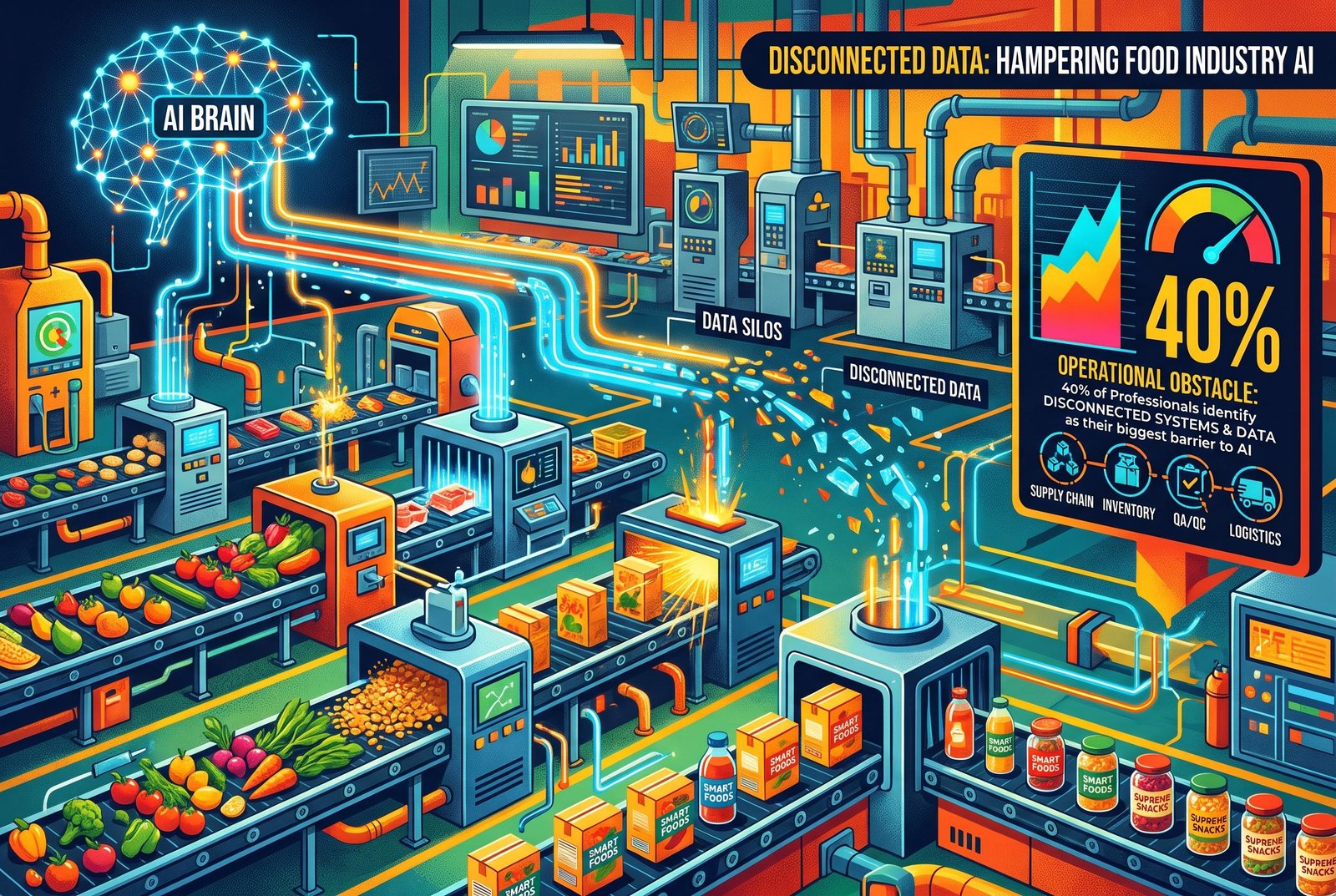
A fresh survey from TraceGains suggests that the food and beverage industry is eager to embrace digital tools and artificial intelligence, but still struggles with the most basic prerequisite for transformation: connected data.
The study, titled “The State of Digital Transformation in Food & Beverage 2026”, drew on responses from 423 professionals in 28 countries, with most participants working in quality management, food safety and regulatory affairs. The findi...
Continue Reading This Article
Enjoy this article as well as all of our content, including reports, news, tips and more.
By registering or signing into your SRM Today account, you agree to SRM Today's Terms of Use and consent to the processing of your personal information as described in our Privacy Policy.
ngs point to a sector that has made meaningful progress on digital investment, yet continues to be held back by fragmented systems, isolated workflows and weak links between departments.
According to the research, 40% of respondents said disconnected systems and data were their biggest operational obstacle. Only 9% reported that their organisations already had fully connected processes across departments, while 37% described their businesses as still being marked by silos in some areas. The consequences, respondents said, are delays in operations, slower innovation, compliance difficulties and weaker decision-making. For 29%, poor connectivity was the single biggest challenge they expected to face in 2027.
The report suggests that the problem is no longer simply one of technology adoption, but of operational cohesion. Many companies are investing in digitalisation, but without an integrated structure for suppliers, quality teams, regulatory functions, product developers, packaging specialists and traceability systems, the benefits are limited. TraceGains argues that the ability to move information smoothly across those functions will be central to improving efficiency and resilience.
The study also paints a cautious picture of artificial intelligence adoption. More than half of respondents, 53%, see AI’s main value in automating repetitive tasks. Yet enthusiasm is tempered by concern: 43% said they were interested in AI but remained wary, while 30% identified trust and accuracy as their biggest barriers. A quarter said stronger data protection at enterprise level and better compliance safeguards would make them more confident in using the technology.
That caution reflects a broader tension in highly regulated industries. AI may be seen as a route to faster and smarter operations, but respondents appear unwilling to rely on it unless they can trust the underlying data, governance and controls. In other words, the appetite for automation is there, but confidence depends on whether organisations can first establish dependable digital foundations.
The report also highlights where the industry may be heading next. End-to-end traceability was identified by 34% of respondents as a key future success factor, while 32% said connected real-time data would be among the most important operational priorities in the years ahead. TraceGains says these results show that companies increasingly view integrated data platforms not as a nice-to-have, but as a competitive necessity.
That view is echoed in wider regulatory and industry discussions. The US Food and Drug Administration has said effective interoperability does not require every participant in a supply chain to use the same software, but does depend on common data standards and consistent frameworks for sharing information. The World Bank has also noted that agrifood traceability systems need secure, interconnected databases if they are to work properly across supply chains, while warning that fragmented implementation can leave platforms incomplete and less useful than intended.
TraceGains positions its own network as part of that answer, saying it connects manufacturers, brands and suppliers from raw material sourcing through to shelf-ready products. The company says its system brings together data and processes covering procurement, compliance, quality, product development and labelling, and that its integration with Esko extends this to packaging design and artwork. TraceGains says more than 1,500 companies in 167 countries use its platform, supported by a network of 118,000 supplier locations and more than 11 million supplier documents.
The larger message of the survey is that digital transformation in food and beverage is no longer about whether companies should modernise, but whether they can build the connected infrastructure needed to make digital tools genuinely useful. AI may accelerate routine work, but the report suggests that real progress will depend on breaking down silos, standardising information flows and creating a single operational view across the business.
Source: Noah Wire Services