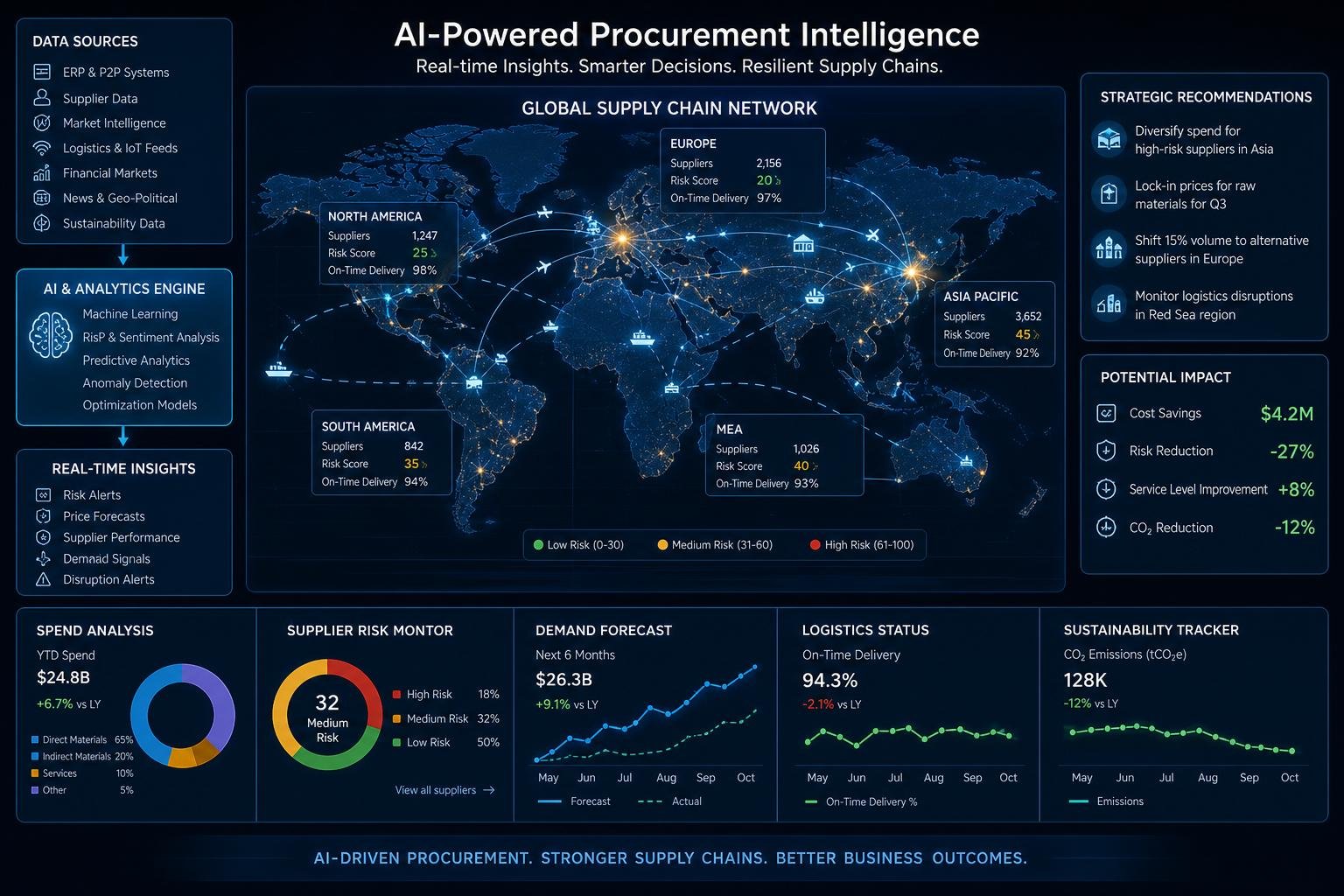
Procurement analytics is steadily moving from a back-office reporting tool to a central part of corporate decision-making, as companies try to control costs, harden supply chains and respond more quickly to market shocks. Grand View Research projects the global market will reach $18.18bn by 2030, up from $3.33bn in 2022, reflecting a compound annual growth rate of 23.6% through the decade.
That growth points to a broader shift in how businesses now view procurement. What was on...
Continue Reading This Article
Enjoy this article as well as all of our content, including reports, news, tips and more.
By registering or signing into your SRM Today account, you agree to SRM Today's Terms of Use and consent to the processing of your personal information as described in our Privacy Policy.
ce treated largely as a savings function is increasingly being used as a strategic engine for resilience, supplier management and operational performance. As inflation, logistics disruption and regulatory scrutiny continue to weigh on supply networks, firms are turning to analytics to identify risk earlier and act with greater precision.
The technology itself is also changing. Early procurement tools were built mainly to show spend data: what was bought, from whom and at what price. Today’s platforms are more ambitious, combining internal transaction records with external signals such as commodity movements, supplier financial health, transport bottlenecks and wider economic indicators. That allows organisations to spot pricing pressure and supply risk before those issues affect operations.
Artificial intelligence is central to that evolution. According to the industry analysis from Grand View Research, machine learning and AI are helping reduce manual effort while improving decision-making. Sievo says its own platform uses AI-driven classification, supplier normalisation and enriched supplier data to help teams move faster, while Proconomy.ai says its platform is designed to automate source-to-pay workflows across multiple industries. SpendSupply, meanwhile, describes a system that brings procurement, expense management and supply chain visibility into a single environment.
The result is a noticeable move away from static dashboards and retrospective reports. Procurement teams are increasingly using predictive tools to model commodity swings, flag financially weaker suppliers and detect contract leakage or non-compliance as it happens. In some cases, AI systems are beginning to take on more autonomous tasks, including supplier evaluation, contract monitoring and the initiation of sourcing events under set conditions.
That shift is also changing the pace of procurement. Instead of waiting for monthly or quarterly updates, companies can now work with near-real-time data on supplier performance, spending patterns and emerging risks. Natural-language interfaces are making those insights easier to access, allowing users to query systems directly rather than interpret complex dashboards manually.
The competitive landscape is filling out quickly. SAP, Oracle, SAS Institute, Coupa, Genpact, Rosslyn Data Technologies, Microsoft, IBM, Cisco and GEP are among the established players building broader procurement ecosystems that link spend analysis, supplier intelligence, contract management and forecasting. The emphasis is increasingly on unifying fragmented tools into one decision layer that can support the full procurement cycle.
As a result, procurement analytics is being judged on more than savings alone. Companies are using it to balance price against supply security, optimise supplier portfolios and strengthen long-term resilience. Sustainability and compliance are also becoming more visible in procurement models, with analytics increasingly used to track ESG metrics alongside commercial performance.
For procurement teams, that means a changing role. Routine analysis is becoming more automated, freeing specialists to focus on strategic sourcing, supplier collaboration and scenario planning. In practical terms, procurement is becoming less about looking backwards and more about anticipating what comes next.
Source: Noah Wire Services