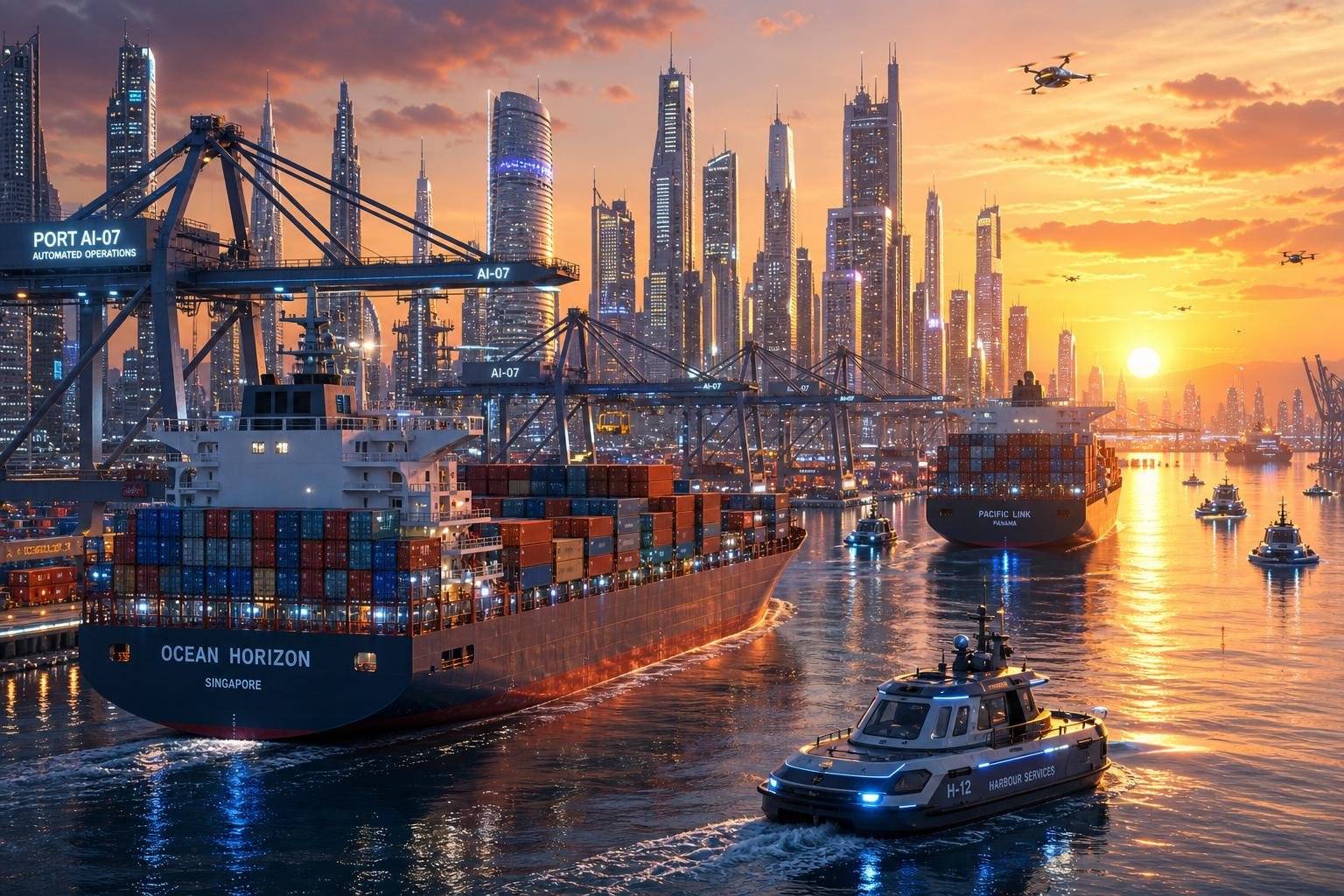
China’s maritime industry is moving rapidly from experimentation to routine use of intelligent systems, as autonomous vessels, automated terminals and electric propulsion reshape one of the country’s most strategic sectors.
What once sounded futuristic, including ships that can plot their own course, detect hazards in real time and berth with the help of robotic cranes, is increasingly becoming standard practice in China. Industry officials and state media say the shift is ...
Continue Reading This Article
Enjoy this article as well as all of our content, including reports, news, tips and more.
By registering or signing into your SRM Today account, you agree to SRM Today's Terms of Use and consent to the processing of your personal information as described in our Privacy Policy.
being powered by advances in artificial intelligence, big data and digital control systems, all of which are being folded into a wider national push for “smart shipping”.
Geng Xiongfei, an expert from the Ministry of Transport, described smart shipping as a transport system centred on vessel autonomy, supported by digital infrastructure and coordinated operational control. He said the aim is to improve safety, efficiency and environmental performance at sea.
China has ample incentive to push ahead. It already has the world’s largest merchant fleet and the biggest port network, and it has led global cargo and container throughput for years. That scale has made the maritime sector a key testing ground for technologies that can strengthen supply chains while cutting emissions and labour-intensive handling.
Recent months have brought a series of milestones. On April 16, China’s first 10,000-tonne-class pure electric intelligent container ship, Ning Yuan Dian Kun, entered commercial service after being delivered in Ningbo, Zhejiang province. According to Chinese state media, the vessel was independently designed and built, and combines all-electric propulsion with intelligent operation and zero-carbon ambitions. It is expected to reduce fuel use and emissions sharply, underlining how electrification is becoming part of the country’s maritime modernisation.
The bigger story, however, is not just propulsion but autonomy. In February, China recorded what was described as its first full-process unmanned container vessel operation at Qingdao Port in Shandong province. The smart feeder ship Zhi Fei completed autonomous navigation, berthing and cargo handling, while automated terminal systems took over loading and unloading. Reports said the vessel was secured by a vacuum-based mooring system in less than 30 seconds, eliminating manual line handling.
That kind of ship-to-shore coordination is central to the next phase of development. Geng said a smart ship cannot function effectively without a smart port, and China has already built 60 automated container and dry bulk terminals. Automated berths now account for roughly 28% of those handling vessels above 10,000 tonnes, according to the Ministry of Transport.
China has also been expanding its digital port infrastructure beyond the headline projects. Ningbo-Zhoushan Port opened an autonomous driving test zone in early 2024, and later that year unmanned container trucks began regular round-the-clock operations at one of its terminals, reflecting how automation is spreading across the logistics chain rather than remaining confined to demonstration projects.
Authorities are now trying to turn these scattered advances into a broader industrial system. The Ministry of Transport has unveiled an action plan to speed up the integration of advanced technologies into shipping, while Chen Deli, an official with the ministry’s maritime agency, said pilot projects are being accelerated. He said the next step is to develop representative pilot ships, routes and integrated pilot zones to push the commercial use of smart shipping across the sector.
For Beijing, the appeal is clear: cleaner vessels, faster port turns, lower operating costs and more resilient logistics. For the global shipping industry, China’s progress suggests that the race to build intelligent maritime networks is no longer theoretical. It is already under way.
Source: Noah Wire Services