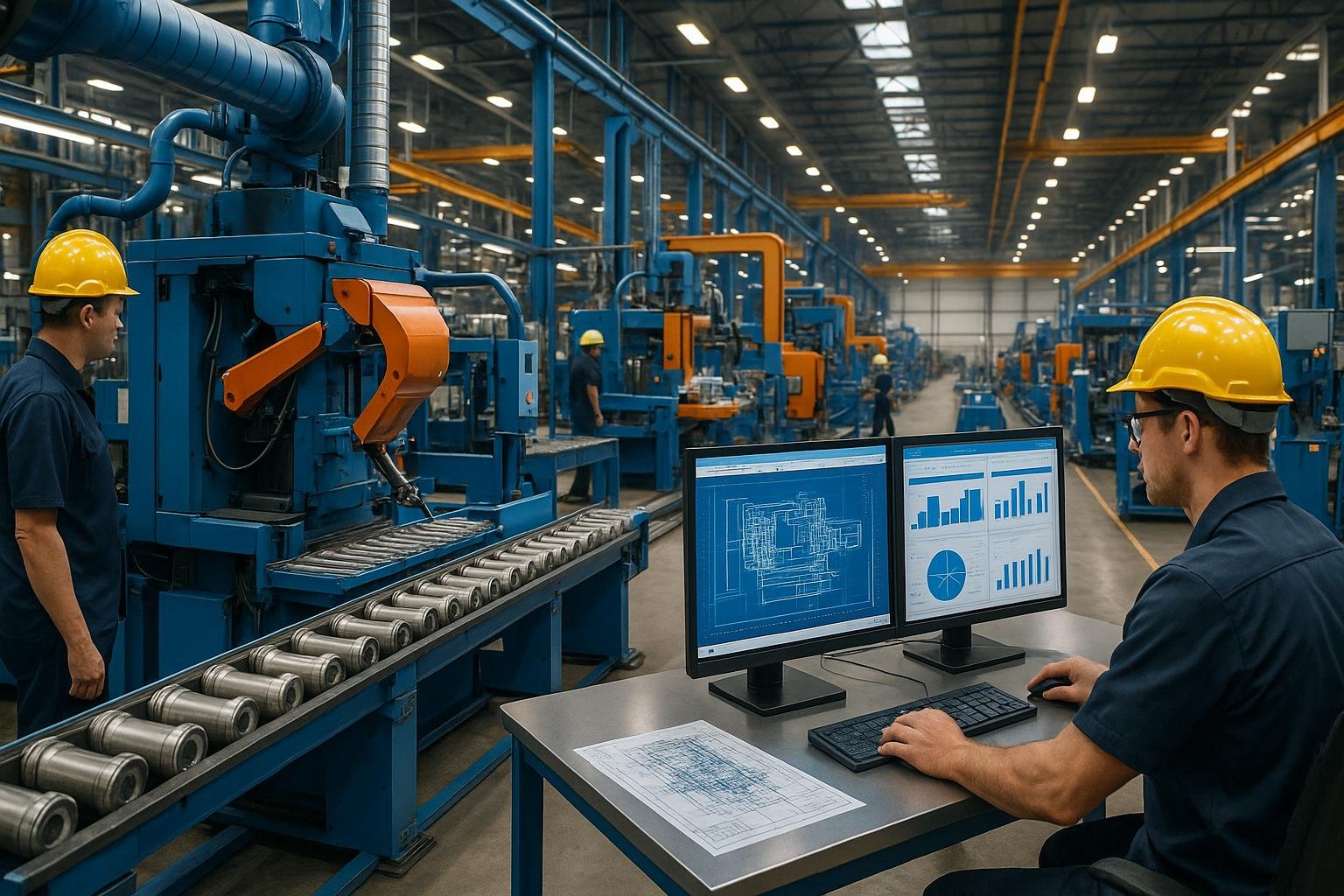
Manufacturers are finding that the promise of artificial intelligence is easier to demonstrate than to deploy. Pressure from labour shortages, higher costs, volatile supply chains and rising demand has pushed AI to the top of the agenda, but Microsoft argues that many projects still stall before they reach day-to-day operations.
In a customer session on Microsoft Marketplace, the company said the central challenge is no longer whether AI can work in manufacturing, but how it ca...
Continue Reading This Article
Enjoy this article as well as all of our content, including reports, news, tips and more.
By registering or signing into your SRM Today account, you agree to SRM Today's Terms of Use and consent to the processing of your personal information as described in our Privacy Policy.
n be embedded safely, economically and at scale. That difficulty is showing up across the sector: fragmented operational data, complicated links between factory systems and cloud platforms, and a gap between ambition and the maturity needed to industrialise new tools. Microsoft says more than half of manufacturers remain in pilot phase.
The underlying problem, according to Microsoft’s manufacturing material, is not usually model quality. It is the architecture around the model. If data remains trapped in separate systems, even a successful proof of concept can stay isolated from the realities of production. Microsoft’s broader manufacturing strategy has therefore focused on interoperability, responsible AI and secure scaling, with the aim of turning data into a usable asset across engineering, operations and the supply chain.
A recurring theme is that AI only becomes valuable when it is connected to a broad operational picture. That means bringing together ERP platforms, manufacturing execution systems, maintenance records, IoT sensors, historians, logs and frontline expertise. With that foundation in place, AI agents and analytics can move beyond reporting and start supporting decisions in context. Microsoft says this is the difference between producing insights and enabling action.
The same logic applies to the divide between edge and cloud. In manufacturing, the two are not alternatives but partners. Edge computing is suited to low-latency inference near machines, where milliseconds matter. Cloud resources, by contrast, are better for heavier analytics, cross-site comparison, digital twins and larger-scale optimisation. Microsoft’s view is that a governed data layer linking the two can help manufacturers improve operations without disrupting production.
The company points to several common use cases where AI is already proving its worth. Predictive maintenance is one, because it draws on telemetry, failure histories, work orders, inspection notes and the accumulated knowledge of experienced staff. When that information is combined, manufacturers can cut unplanned downtime without replacing existing maintenance systems. Production optimisation is another, using process data and AI reasoning to spot bottlenecks, yield loss and throughput constraints. Frontline enablement is a third, with agents and assistants helping workers access instructions and operational know-how at the point of need.
Microsoft’s manufacturing materials also stress that there is no single route to adoption. Some companies will build their own systems to preserve differentiation. Others will buy ready-made solutions to move faster. Many will choose a blend, keeping proprietary logic in-house while using partner products for common capabilities. Microsoft says Marketplace is designed to support all three approaches by offering vetted applications, models, agents and connectors that can be deployed into Azure with governance and cost controls in place.
That emphasis on procurement and governance reflects a wider message from Microsoft’s manufacturing guidance: pilots often fail not because the technology is unusable, but because the path to production is too cumbersome. According to the company, organisations should start with a high-value use case, ensure the data is connected and governed across IT and OT systems, and make an explicit decision about what to build, buy or blend.
The message is consistent across Microsoft’s manufacturing content. AI is being presented less as a standalone tool than as part of a broader industrial operating model, one that links data, security, deployment discipline and partner ecosystems. For manufacturers under pressure to improve resilience and productivity, the winning edge may come not from launching more experiments, but from turning the right ones into reliable production systems.
Source: Noah Wire Services