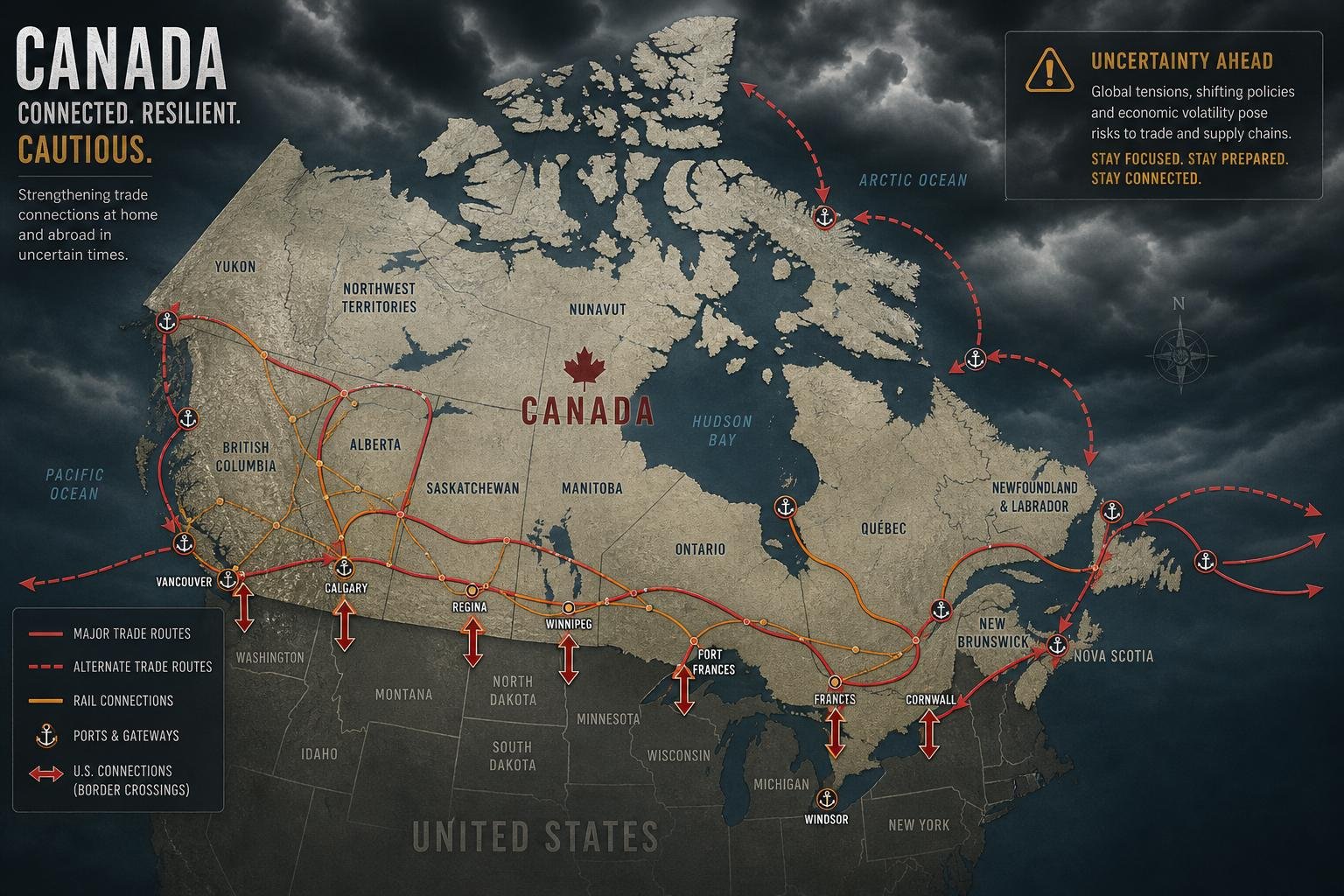
Canada’s economy is built on a paradox: the same integration that made it prosperous now leaves it unusually exposed. More than three-quarters of its goods exports are sold to the United States, and roughly 97 per cent of its crude oil exports flow there as well. That concentration has long been a feature of Canadian growth; in 2025 and 2026, it became a central economic risk after Washington’s tariff moves disrupted trade, weakened investment and forced policymakers to contend wi...
Continue Reading This Article
Enjoy this article as well as all of our content, including reports, news, tips and more.
By registering or signing into your SRM Today account, you agree to SRM Today's Terms of Use and consent to the processing of your personal information as described in our Privacy Policy.
th a shock largely outside their control.
Canada is a wealthy, resource-rich economy of about 41 million people, with a large services sector and a heavy reliance on natural resources, especially oil, gas, metals and agricultural commodities. In nominal terms it ranks among the world’s largest economies, but its apparent stability masks a deeper vulnerability: it is tethered to commodity prices, to housing conditions at home and, above all, to American demand. The result is an economy that has benefited enormously from openness while becoming highly sensitive to shifts in US policy.
That dependence has deep roots. From the auto pact of 1965 through the Canada-US Free Trade Agreement, NAFTA and now the United States-Mexico-Canada Agreement, Canadian industry has been organised around a continental supply chain. Autos, energy, agriculture and manufactured goods all moved into the US market with little friction for decades. According to the Bank of Canada, that arrangement now faces a period of structural adjustment, as tariffs and uncertainty force firms to rethink markets, sourcing and investment plans.
The scale of the exposure is stark. Canada is the largest foreign supplier of US energy imports, while also sending the bulk of its own exports south. Goods trade between the two countries runs into the hundreds of billions of dollars a year, making Canada both a major customer for American exports and a major source of American imports. The trade relationship has long produced efficiency gains, but it has also concentrated risk in a single corridor. When the relationship is constructive, Canada gains from scale and proximity; when it turns hostile, it has few quick alternatives.
That is exactly what happened in 2025. After the United States imposed tariffs on most Canadian imports, citing border-related concerns, the Canadian economy slowed sharply. The Bank of Canada said in its October 2025 outlook that tariffs and uncertainty would push output lower over the following year, with only a gradual recovery expected later. By early 2026, the central bank was still describing the economy as one undergoing adjustment rather than returning to normal, and its January report warned that the effects of trade restrictions would take time to work through the system.
The damage showed up in exports, business investment and the labour market. The Canadian government’s Spring Economic Update 2026 said the economy proved more resilient than many had feared, avoiding the recession that some had predicted in early 2025, but it also acknowledged that US tariffs had weighed on goods exports, slowed investment and cost jobs in exposed sectors. That mixed picture is important: Canada did not collapse, but it did absorb a meaningful hit to growth and confidence.
The Bank of Canada has been left trying to manage those effects while keeping inflation under control. Its April 2026 Monetary Policy Report projected modest growth and said inflation would rise in the near term before easing towards the 2 per cent target in early 2027. The same report noted that the Middle East conflict had lifted oil prices, adding to inflation through fuel costs. For Canada, that is a double-edged development. Higher oil prices support export revenues, but they also raise domestic transport and energy costs, complicating the outlook for households and businesses.
This is why the loonie often behaves like a commodity currency. When oil and other resource prices rise, the Canadian dollar tends to strengthen; when they fall, it weakens. In 2026, the stronger US dollar and uncertainty around trade left the loonie under pressure. A weaker currency can help exporters in normal times, but its benefit is limited when the problem is not price competitiveness but restricted access to the main market.
Beneath the trade shock, Canada still faces two long-running domestic weaknesses. Housing has become a drag after years of price inflation that pushed affordability to the limit. Residential investment has softened, household debt remains elevated and consumers are more sensitive to higher borrowing costs than in many comparable economies. Productivity is the other persistent problem. Canada has struggled to generate strong output growth per worker, and that gap has widened relative to the United States. Weak business investment outside the resource sector, a smaller technology base and dependence on population growth have all held back living standards.
The Bank of Canada’s latest projections point to only modest expansion through 2026. In its April report, it described an economy still adjusting to tariffs and trade uncertainty, with inflation pressures likely to ease only gradually. Earlier reports had already signalled that export growth would resume from a lower base and that business investment would remain subdued. In other words, even if the immediate shock fades, the economy may settle into a slower trajectory than before.
The bigger issue is strategic. Canada has spent decades building a model around access to the US market, and that model has delivered prosperity. But it has also left the country vulnerable to a single political decision in Washington. The policy answer is obvious in broad terms: diversify trade, boost investment, improve productivity and build the infrastructure needed to move resources to other markets. The difficulty is that these are long-term fixes, while the trade shock is immediate.
For now, Canada remains a rich, capable economy with strong resource endowments and deep institutional strengths. Yet 2026 has made clear that its central challenge is structural rather than cyclical. The country’s prosperity still rests on the same foundation that now threatens it: an economy built to sell to one overwhelmingly dominant buyer.
Source: Noah Wire Services