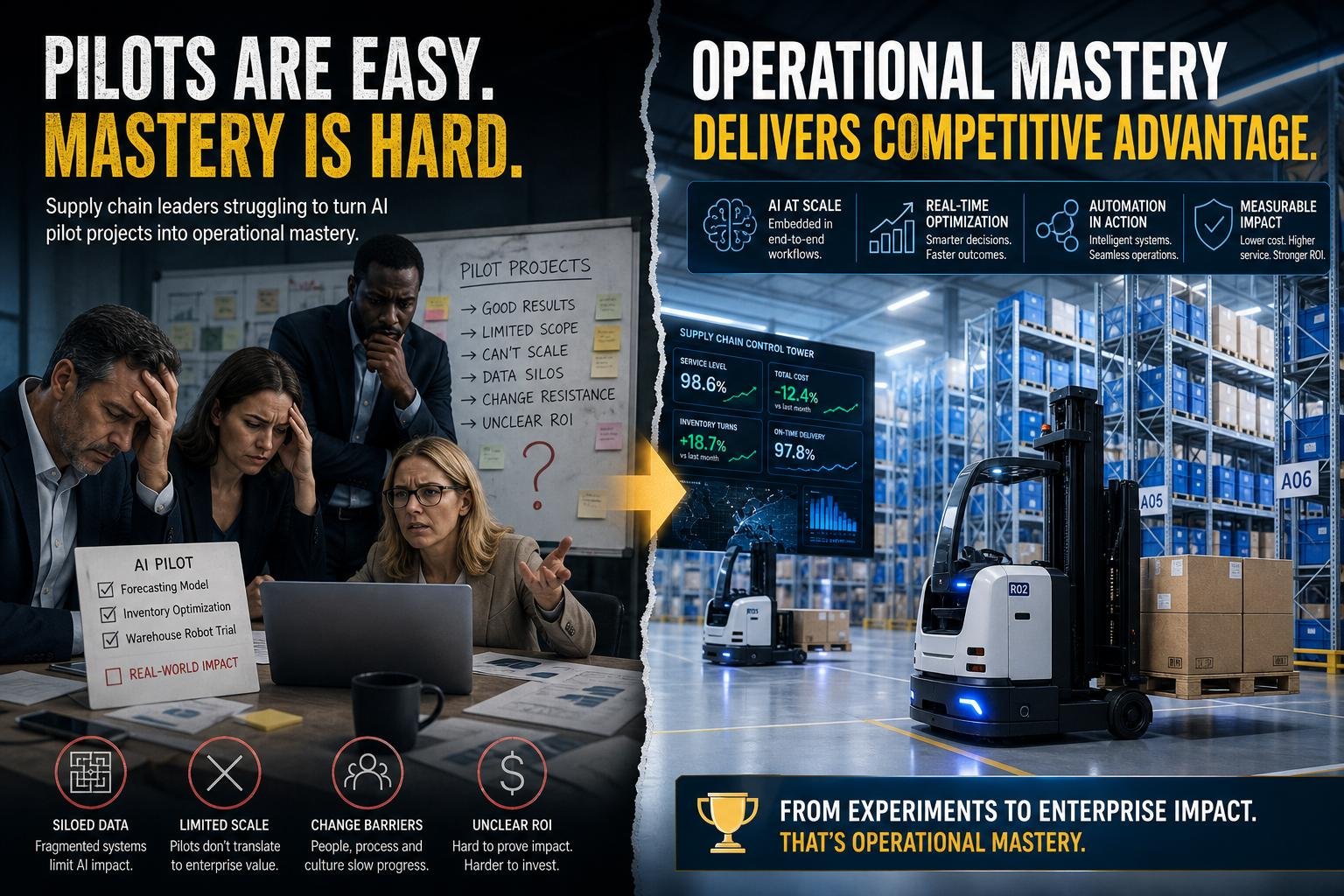
Supply chain leaders have grown accustomed to AI systems that can spot anomalies, forecast demand and flag risk. What many are still waiting for is the moment when those insights start changing outcomes. Too often, that moment never arrives.
The reason is usually not a weak model. It is not even simply a data problem. The deeper issue is that many AI tools still do not understand the operating environment well enough to act inside it. They can recognise patterns, but they canno...
Continue Reading This Article
Enjoy this article as well as all of our content, including reports, news, tips and more.
By registering or signing into your SRM Today account, you agree to SRM Today's Terms of Use and consent to the processing of your personal information as described in our Privacy Policy.
t always grasp the decision rules, commercial trade-offs and human judgement that shape how supply chains actually run.
That gap has become a familiar theme across the sector. Project44 has argued that the overwhelming majority of enterprise AI pilots fail to produce measurable returns, not because the underlying technology is useless, but because it is not embedded in the real execution layer of the business. Procurement Mag has made a similar point, saying AI investment often disappoints when the surrounding processes are too immature to absorb it.
The problem is easy to define and hard to fix. A system may correctly identify a shortage or a service risk, yet still fail to trigger action because it does not know who has authority to intervene, what threshold warrants escalation, or which customer commitments override standard logic. In that sense, an alert without context is not intelligence; it is a more polished notification.
This helps explain why so many supply chain teams remain trapped in a cycle of expediting, overriding and reconciling system outputs with operational reality. The business may have better visibility than it did before, but visibility alone does not close the loop between insight and execution.
A new Supply Chain Brain report said the wider challenge is not simply generating more AI use cases, but turning pilots into enterprise-scale processes. That is where many programmes stall: they can demonstrate promise in controlled settings, but struggle once they meet the complexity of live operations, with their exceptions, workarounds and local rules.
Gartner has found that most supply chain leaders are still taking a cautious path. According to the firm’s survey, only 17% are using AI for immediate transformational redesigns, while 83% are pursuing smaller changes. The reasons include patchy data readiness, fragmented vendor landscapes and the need to train employees to work differently, not just faster.
That caution is understandable. In supply chains, the value of any recommendation depends on whether it can be trusted, governed and executed in the right sequence. AI agents may be reusable in principle, but the context they need is highly specific. One company’s replenishment logic is not another’s. One customer’s service promise is not another’s. One organisation’s escalation path may rely less on formal rules than on institutional knowledge built over years.
The companies seeing better results are therefore approaching AI less as a standalone product and more as an operational design exercise. They are defining which decisions the system is meant to support, what guardrails it must observe, where human judgement stays in the loop and how its recommendations will translate into action.
That shift matters because the competitive edge in AI is likely to move away from access to models, which will become increasingly common, and towards the ability to build the context layer around them. That layer includes process visibility, role clarity, business rules, feedback loops and the practical know-how that turns a recommendation into a changed decision.
In supply chain, the question is no longer whether AI can see the problem. It is whether the organisation has done enough work to let it understand how the business really behaves. If not, the result will be more dashboards, more alerts and more pilots that look impressive on paper but never quite reach the operational finish line.
Source: Noah Wire Services