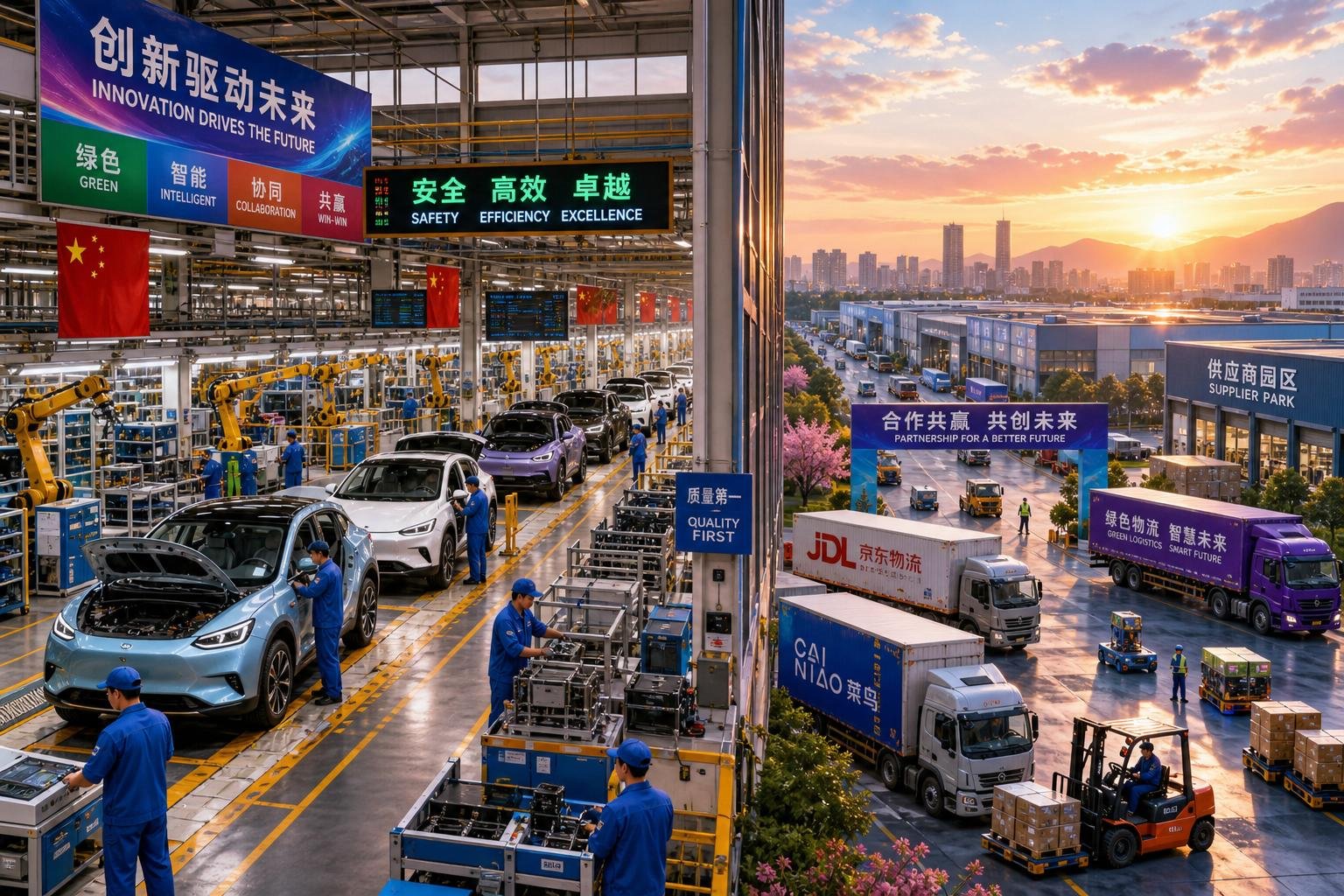
Toyota, Nissan and Honda are all moving deeper into China’s supplier base as the electric vehicle market forces Japanese carmakers to abandon parts of the long-standing keiretsu model that once defined their industry.
According to Gasgoo, the shift is already visible in Toyota’s China-made bZ series, where Chinese suppliers provide the bulk of components and local engineers now have a far greater role in product development than they did in the past. The 2026 Bozhi 3X, laun...
Continue Reading This Article
Enjoy this article as well as all of our content, including reports, news, tips and more.
By registering or signing into your SRM Today account, you agree to SRM Today's Terms of Use and consent to the processing of your personal information as described in our Privacy Policy.
ched by GAC Toyota in May, draws on a wide range of Chinese inputs, including voice technology, lidar, software algorithms, batteries and domain control systems, while Toyota says Chinese suppliers account for 65% of its overall supply chain for the model. Gasgoo said the same localisation rate was achieved on the previous version as well, underlining that this is now a structural approach rather than a one-off adjustment.
The pace of change is not limited to Toyota. Nissan’s Dongfeng Nissan-developed N7 has also raised its reliance on Chinese-made parts, while the company is using the model as part of a broader transformation push in China. At Auto China 2026, Dongfeng Nissan unveiled the NX8 as it moved into what it called a second phase of its joint-venture overhaul, with executives stressing that the company must evolve in step with Chinese teams, technology and market rhythms. Gasgoo also reported that Nissan’s internal cost and delivery managers are now explicitly studying Chinese-style operating methods.
Honda, meanwhile, has begun to follow the same path, albeit more cautiously. In May, it said it would adopt more standardised local parts in China and use Chinese technology more directly in new products, including through platforms shared with its local partners. That marks a notable turn for a company whose battery electric vehicle sales in China have been weak, and it reinforces the view that foreign brands can no longer compete in the market without closer integration into Chinese engineering and supply networks.
The reasons are straightforward. Chinese suppliers are typically 30% to 40% cheaper than Japanese rivals, can move from order to mass production in roughly 10 months rather than more than 18, and are now widely seen as matching Japanese quality in key areas, according to the material cited by Gasgoo and News18. Toyota Boshoku executive vice-president Yasuhiro Yasuda went so far as to say that there is now “no longer any difference” in quality, according to News18. Price comparisons also show how much the competitive gap has narrowed: where Toyota and Nissan once faced huge pricing disadvantages against BYD in China, the difference had shrunk sharply by 2025.
This change is also reshaping Japan’s supplier landscape. As carmakers source more from China, traditional parts makers in Japan are losing business, and some are being forced to restructure or close facilities. At the same time, a few are adapting by seeking new customers in China, with some gaining orders from domestic Chinese EV makers instead.
The implications go beyond China. Reuters-style reporting in the supplied material suggests Toyota intends to extend Chinese sourcing to Southeast Asia as well, including at its Thailand hub from 2028. That would mark an important shift from simple local procurement to a broader reworking of regional supply chains.
For Chinese parts makers, the opportunity is significant, but it may not last forever. As Japanese carmakers rebuild their procurement systems, they could eventually create fresh barriers of their own. For now, though, the balance of power in EV supply chains appears to be moving towards China, where speed, cost and software-led development are increasingly setting the pace.
Source: Noah Wire Services