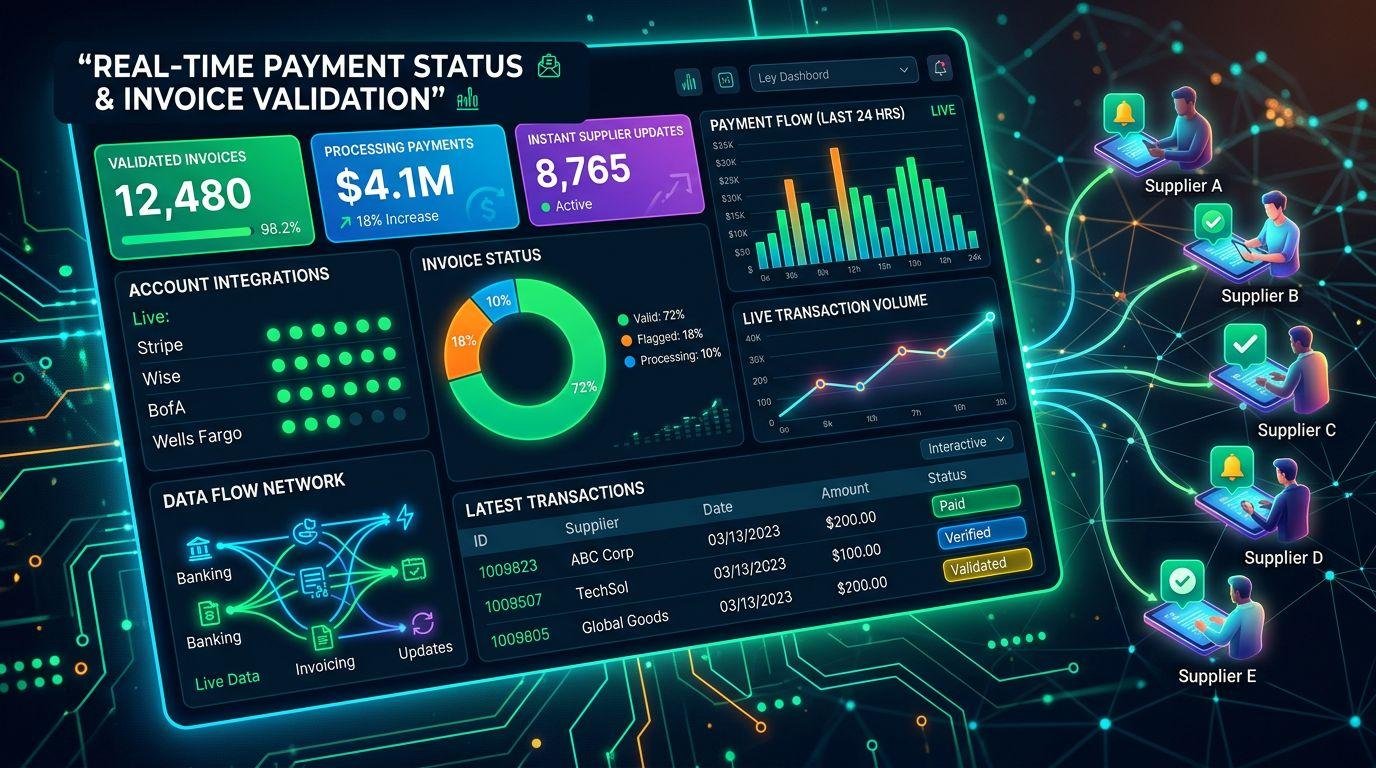
Tradeshift has expanded AskAda for Sellers from a support assistant into an agent that can check payment, invoice and validation status for suppliers in real time, the company says, in a move it presents as part of a broader shift towards agentic AI across its platform.
The change is aimed at one of the most persistent questions in trade finance: “Where is my payment?”. For suppliers, an overdue or unexplained invoice can quickly become a cash-flow problem, yet the ...
Continue Reading This Article
Enjoy this article as well as all of our content, including reports, news, tips and more.
By registering or signing into your SRM Today account, you agree to SRM Today's Terms of Use and consent to the processing of your personal information as described in our Privacy Policy.
answer has often required a manual support request, a search across buyer and seller records, and a wait for someone to respond. Tradeshift says the new version of AskAda removes that back-and-forth by letting suppliers ask directly and receive an answer in seconds, without raising a ticket.
According to Tradeshift, AskAda for Sellers now handles live queries about invoice and payment status on the platform, alongside checks on whether a document has been accepted, rejected or failed validation. It can also answer follow-up questions in the same conversation, such as references to earlier invoices or requests to explain why a specific document could not be processed. Product guidance and general how-to questions remain within the assistant’s original remit, drawing on Tradeshift’s knowledge base and support resources.
The company has been building towards this point for some time. It says AskAda, named after Ada Lovelace, has been part of its AI strategy since 2017. The seller version first appeared as a beta in December 2024, initially limited to product information and documentation. It was then extended to paid seller subscribers in spring 2025 before being made available to all active seller accounts later that year, with multilingual support added and a Babelway version launched earlier in the summer.
What is different now is that AskAda is no longer confined to explaining how Tradeshift works. It can also use the user’s live account data, which means a supplier can ask about a specific invoice and receive an answer grounded in the current state of the platform rather than a generic help article. Tradeshift says that marks the transition from a product guide to an AI agent.
Behind the interface, the company describes an agentic architecture in which an orchestrator determines the intent of the query and chooses the relevant tool or workflow. If the question relates to a supplier’s own data, AskAda retrieves the appropriate invoice, payment, order or network information through the Tradeshift MCP Server and converts it into a response. If the question is about platform usage, it falls back on product knowledge instead.
That distinction matters because the system is designed to do more than answer isolated prompts. Tradeshift says the agent can combine multiple lookups to resolve more complex requests, maintain context across follow-up questions and use open, standards-based tools that are being rolled out more widely across the platform. The same underlying approach also powers the company’s AP Auditor agent for buyers.
Security is central to the pitch. Tradeshift says seller documents, questions and answers are not used to train or fine-tune AI models. The model itself does not have standing access to an account; instead, each query retrieves only the information needed to answer that specific question. Access is governed by existing platform permissions, meaning AskAda can only see the data the logged-in user is already entitled to view.
The company also says the assistant is read-only, cannot alter records and stores conversation context only for the active session. It adds that every lookup is logged and that safeguards against prompt injection have been built into the system. In Tradeshift’s telling, the platform, not the model, remains the gatekeeper for company data.
For buyers and accounts payable teams, the appeal is as much operational as technological. If suppliers can check invoice or payment status themselves, Tradeshift argues, support teams face fewer routine queries and can spend more time on exceptions and higher-value tasks. The company also frames the change as a way to improve supplier relationships by making communication faster and more transparent.
AskAda for Sellers sits alongside Tradeshift’s Payment Predictor for Sellers, which estimates when a payment is likely to arrive. Tradeshift says the two tools are complementary: one explains the current state of an invoice or payment, while the other gives suppliers a forecast they can use for planning. That pairing is meant to give sellers both immediate visibility and a sense of what is coming next.
The release also fits into a wider product push. Tradeshift says it has recently rebuilt its invoice coding engine with Ada 2.0, launched AI Document Intelligence, introduced the AP Expert Auditor and expanded access through the Tradeshift MCP Server. In its latest release materials, the company describes those changes as part of a broader effort to extend agentic AI across reporting, auditing, document handling and self-service support.
According to Tradeshift, the common thread is an AI system that works against live platform data, inherits the permissions of the user and leaves an audit trail behind it. AskAda for Sellers is intended to show how that approach works from the supplier side of the network: not as a generic chatbot, but as a secure assistant that can answer the question suppliers ask most often, and do so without waiting for human intervention.
Source: Noah Wire Services