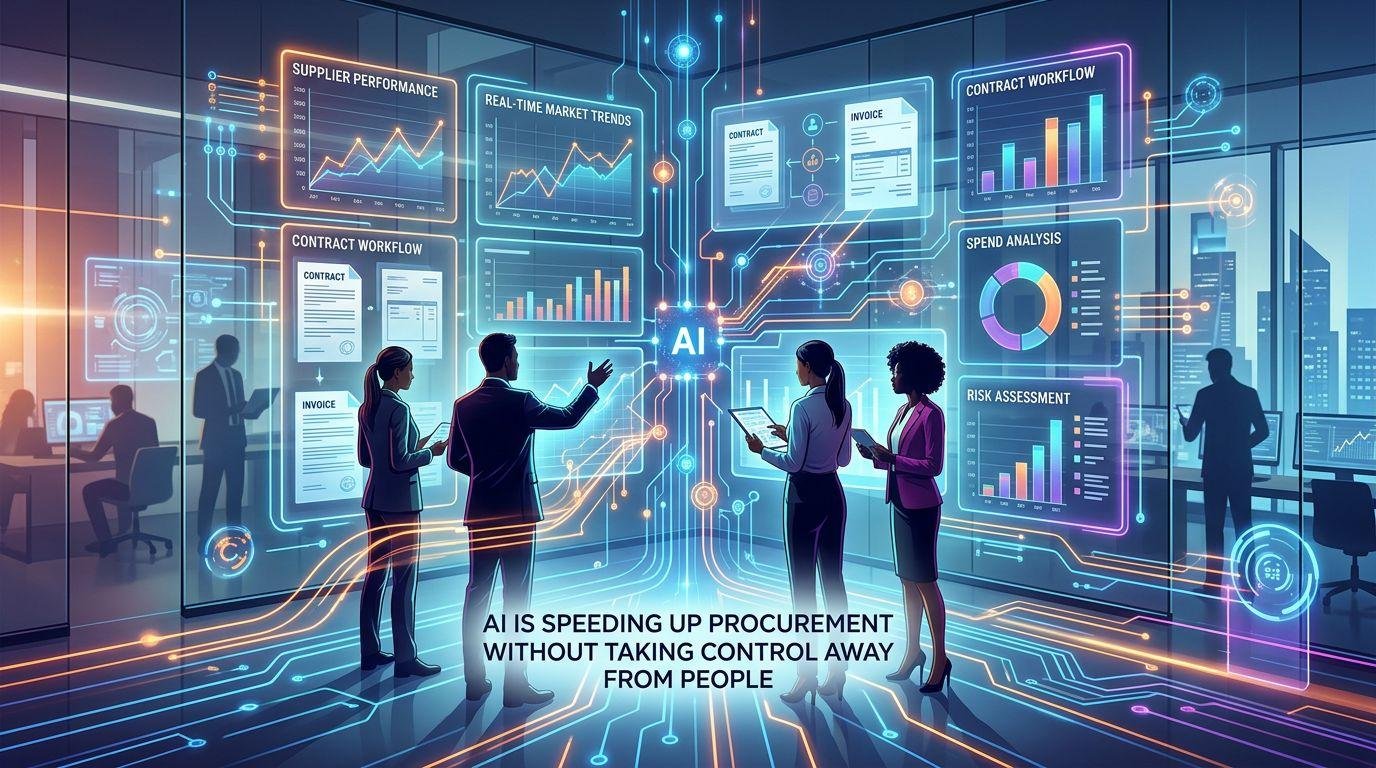
Artificial intelligence is moving from a novelty in procurement to a practical layer of support across sourcing, contracting and invoice handling. In 2026, the most visible gains are not coming from fully autonomous buying, but from systems that help teams classify spend, identify suppliers, extract key clauses from contracts and spot anomalies in invoices. Several industry guides suggest that procurement leaders are now treating AI less as a headline-grabbing experiment and more as a...
Continue Reading This Article
Enjoy this article as well as all of our content, including reports, news, tips and more.
By registering or signing into your SRM Today account, you agree to SRM Today's Terms of Use and consent to the processing of your personal information as described in our Privacy Policy.
tool that can remove repetitive work from workflows while leaving final accountability with people.
That distinction matters. AI can now search supplier landscapes more quickly than a human team, sift through large volumes of historical purchasing information, draft sourcing documents and summarise supplier responses. It can also highlight pricing trends, delivery risks and contract deviations that might otherwise be missed. But the strongest procurement use cases are still those that support judgement rather than replace it. Autonomous negotiation, fully automated RFx creation and hands-off supplier selection remain far more limited in practice than some marketing claims suggest.
The clearest value often appears in the early and middle stages of sourcing. AI can improve spend analysis by grouping transactions, flagging fragmented purchasing and revealing unusual price variation. It can help procurement teams build a more accurate view of market conditions by combining internal data with outside information on supply, regulation, geography and supplier performance. In supplier discovery, it can scan approved data sources for potential candidates that match technical, operational and geographic requirements, then present a shortlist for human review. For category managers, that means less time spent trawling directories and more time on strategy, negotiation and risk management.
Document-heavy tasks are another area where AI is already proving useful. Generative tools can draft request-for-proposal content from templates and prior events, identify missing information and organise supplier answers into a consistent format for evaluation. Natural language models can also review contracts, pull out obligations and renewal dates, and surface deviations from standard terms. In some organisations, invoice processing is becoming one of the most valuable AI applications because it can read multi-page documents, match them to purchase orders and flag mismatches for review instead of allowing them to pass unchecked.
Yet the technology’s usefulness depends on how it is governed. Procurement teams that are expanding AI from pilots into live workflows are increasingly being forced to answer familiar questions in a new setting: Who can trust an automated recommendation? At what point must a human step in? What evidence supports the system’s suggestion? Those questions are especially important when a model identifies the lowest-cost supplier but also flags elevated risk. In that situation, the right response is not to accept or reject the output blindly, but to examine the underlying evidence, request further documentation, compare alternatives and decide whether the risk is acceptable in context.
This is why many organisations are moving towards a human-led model of AI-enabled sourcing. In that model, the machine handles data gathering, pattern recognition and first-pass drafting, while people retain control over business judgement, supplier relationships and final approval. The practical division of labour is increasingly clear across the sourcing lifecycle. AI can analyse spend, draft sourcing documents, sort suppliers into categories, compare bids and monitor risk signals. Humans validate the requirements, define the evaluation criteria, interpret trade-offs and make the decisions that carry financial, operational or legal consequences.
The risks are equally clear. Poor data quality can distort results. Historical purchasing patterns can embed bias into supplier scoring. Confidential commercial information can be exposed if staff use unapproved tools. And if procurement teams cannot audit prompts, outputs and approvals, they may struggle to explain how a decision was made. That is why governance is becoming part of the sourcing conversation itself. Organisations are beginning to build controls around approval thresholds, data access, model oversight and logging, while also training users to challenge unsupported claims rather than treating AI outputs as authoritative.
Procurement technology vendors are responding by positioning AI inside broader workflow platforms rather than as stand-alone add-ons. The emphasis is increasingly on connected systems that bring sourcing, purchasing, approvals, invoices and budgets into one environment, so the organisation can see what it buys, from whom and at what price. That integrated approach is particularly useful where AI is being used to speed up quote handling, invoice matching, contract review and spend questions, because it reduces the gap between an automated suggestion and the business record behind it.
The broader trend in 2026 is not the automation of procurement judgement, but the compression of routine work around it. AI is best understood as an accelerator for research, analysis and document handling, not a substitute for commercial leadership. For procurement teams that can pair reliable data with clear governance and well-defined human review points, the technology offers a genuine opportunity to make sourcing faster, more consistent and more strategic. For those that treat it as a black box, the risks may outweigh the benefits.
Source: Noah Wire Services