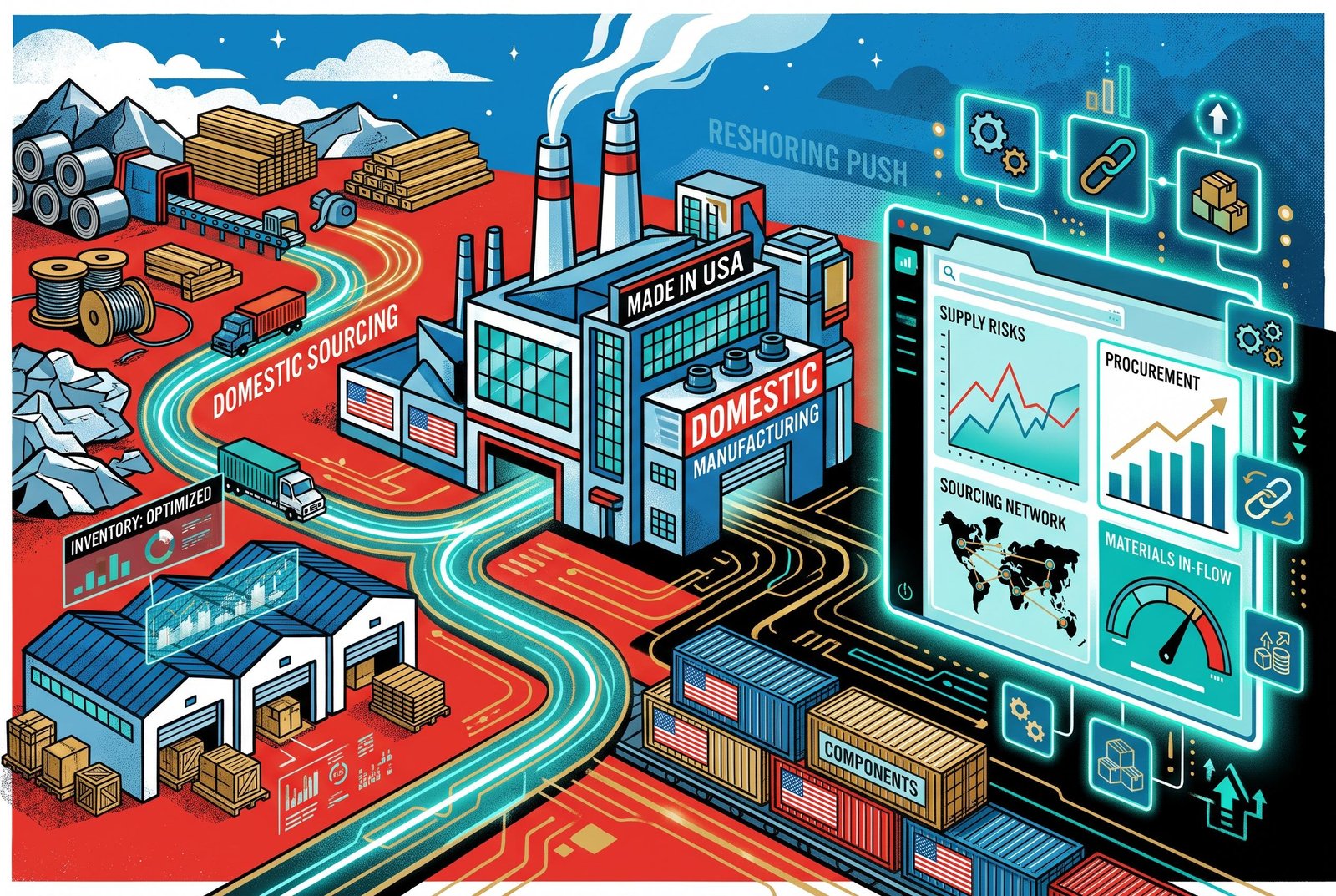
Donald Trump’s drive to bring more manufacturing back to the United States has helped revive a familiar political promise: make it at home, sell it at home, and reduce dependence on distant suppliers. But as manufacturers and software startups are discovering, the hardest part is not the slogan. It is the system around it.
A new survey from the Reshoring Initiative and Regions Recruiting suggests the appetite for domestic production is real. It found that 36 per cent of origi...
Continue Reading This Article
Enjoy this article as well as all of our content, including reports, news, tips and more.
By registering or signing into your SRM Today account, you agree to SRM Today's Terms of Use and consent to the processing of your personal information as described in our Privacy Policy.
nal equipment manufacturers had either already moved production back to the US or were in the process of doing so, up from 29 per cent a year earlier. The same survey also found that 63 per cent planned capital investment in the US over 2026 or 2027. Yet the research also pointed to the obstacles that continue to frustrate that shift, including policy uncertainty, price pressure from imports and shortages of skilled technicians.
That tension between intent and execution is creating room for a new generation of intermediaries. Rather than building factories themselves, these companies are trying to solve the less visible but essential problems of sourcing, quoting, logistics and procurement.
One of the clearest examples is Bloom, a Detroit-based startup that recently raised $3.6 million in seed funding to build an AI-powered marketplace for American manufacturing. The company connects businesses looking to make products with suppliers that can produce components, assemble finished goods or handle delivery. Bloom was founded in 2023 by Justin Kosmides after he attempted to launch an electric bike business and found that shifting production closer to home was far harder than expected.
Speaking about the experience, Mr Kosmides has described the absence of a coherent support structure as a major barrier for smaller companies. Large US manufacturers can still handle cars, aircraft and other high-volume industries, but businesses making limited runs often struggle to find a factory willing to take them on. Bloom says it has already made more than 2,000 matches between suppliers and more than 140 hardware companies, using a network of more than 500 US service providers. Its clients range from major firms such as Toyota to tiny startups with only a handful of employees.
The appeal of this kind of platform is speed as much as access. In manufacturing, a useful introduction can still depend on personal networks and word of mouth. Bloom argues that moving those relationships online can cut weeks or months from a sourcing process. For a Detroit fastener maker used to runs of several million units, the needs of a startup ordering only a few hundred or a few thousand components are a very different proposition. The challenge is not just finding a factory, but finding one that is willing and able to work at the right scale.
Bloom is not alone in spotting opportunity in the supply-chain bottleneck. Cofactr, another startup focused on hardware operations, acquired sourcing platform Cogbase in 2025, gaining access to a database of more than 450,000 suppliers. The company says the combined offering is meant to help hardware firms identify suppliers, streamline procurement and build more resilient supply chains. Another New York startup, Didero, raised $30 million in February to develop AI agents that can handle procurement work, from supplier communication to tracking orders and processing information.
Together, these businesses reflect a wider rethinking of what “reshoring” actually requires. Bringing production back is not just a matter of constructing plants in the US. It also depends on being able to discover suppliers, manage orders, secure parts and keep costs under control.
That is especially obvious in sectors such as automotive components, where international supply chains remain deeply embedded. Isaac Bunick, founder and chief executive of Motormia, an AI platform for car enthusiasts seeking aftermarket parts and modification plans, says his users are increasingly turning away from overseas components because of tariff pressure and uncertainty about delivery times. For owners of European cars in particular, the right part may come from a specialised factory abroad, and delays at customs can leave a project stalled.
Mr Bunick says the issue is not always whether a component can be made in America. It is whether a company can make it in America while also absorbing the legal, insurance and liability costs that come with domestic production. If a suspension kit made in Italy costs €2,500 to manufacture, he estimates the same item could rise to between €3,500 and €4,500 if moved to the US. That kind of increase can quickly push a product out of reach for customers.
He also points to the knock-on effects of tariffs on existing inventory. In one case, he says, a manufacturer had thousands of engine components on backorder, priced before fresh aluminium duties were introduced. Importing them now would force American distributors to absorb costs they had not planned for, potentially adding hundreds of thousands of dollars to a single shipment. Faced with that uncertainty, some firms are instead holding stock overseas and waiting for conditions to improve.
The broader picture is that the US is unlikely to become manufacturing self-sufficient any time soon, however strong the political case for doing so. Even companies trying to source domestically often rely on imported machinery, materials or subcomponents. As Mr Kosmides has acknowledged, rebuilding industrial capacity is not a quick fix. It will take years, and perhaps longer, to reverse the decades of offshoring that reshaped the country’s manufacturing base.
For now, the reshoring movement is less a completed transformation than a work in progress. The factories may be the visible symbol of the shift, but the real test lies in the connective tissue around them: the suppliers, software, logistics and human relationships that make production possible in the first place.
Source: Noah Wire Services