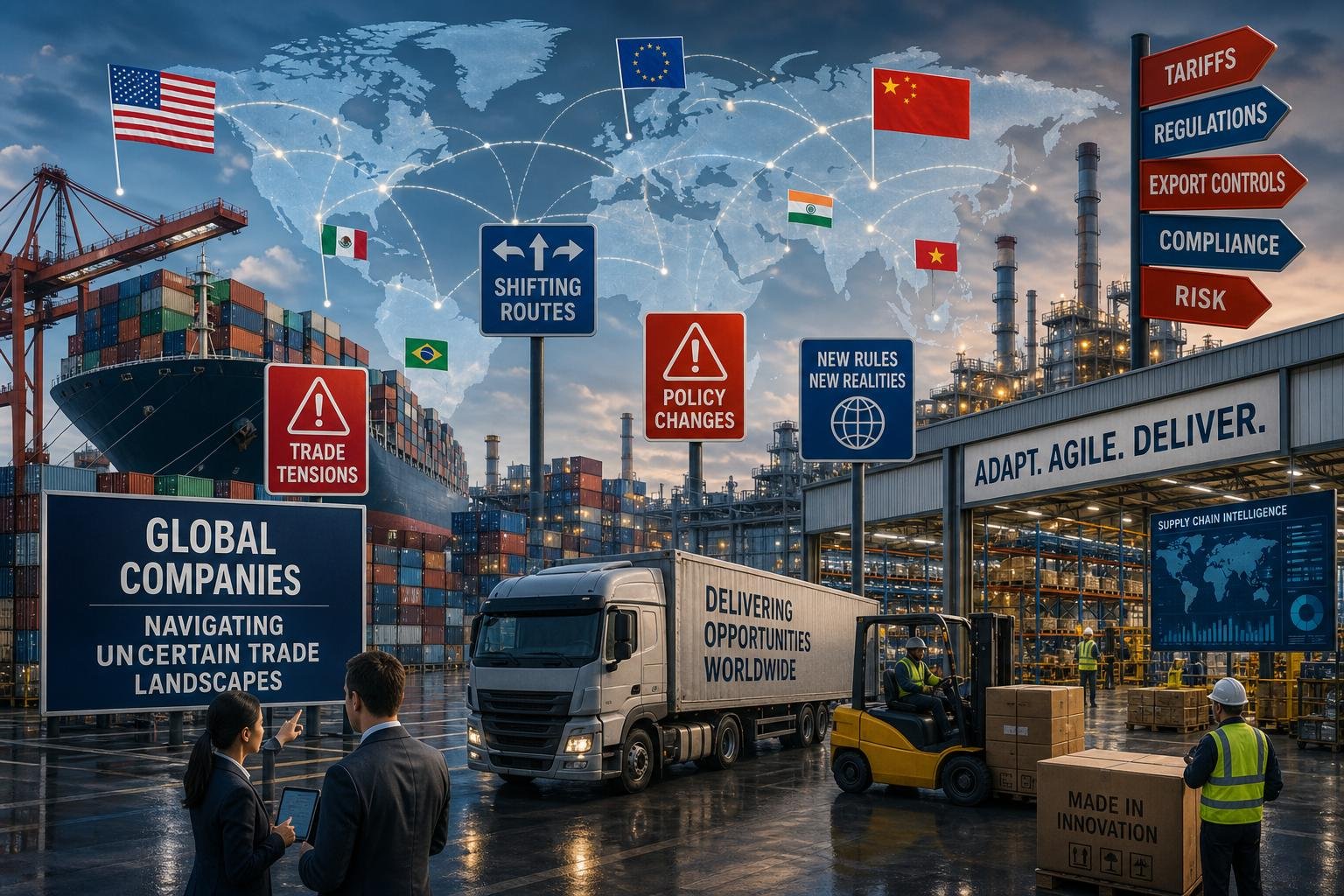
Tariff volatility is forcing companies to rethink sourcing in ways that go well beyond comparing supplier list prices.
Across procurement teams, the new benchmark is becoming tariff-adjusted landed cost: a rolling estimate that folds in duties, freight, compliance, insurance and inventory exposure, then tests those costs against several possible trade-policy outcomes. That shift reflects a broader reality in which the duty line is no longer fixed. According to the OECD, U.S. ef...
Continue Reading This Article
Enjoy this article as well as all of our content, including reports, news, tips and more.
By registering or signing into your SRM Today account, you agree to SRM Today's Terms of Use and consent to the processing of your personal information as described in our Privacy Policy.
fective tariff rates rose to around 9% in 2025, the highest level since the 1930s, while the Penn Wharton Budget Model said China faced effective tariffs of nearly 40% by June 2025 and steel, aluminium and vehicles were among the most heavily taxed categories.
The pressure is not just theoretical. USAFacts said the U.S. collected roughly $287 billion in customs duties and related fees in 2025, a 192% jump from the previous year. Yale’s Budget Lab has argued that many of the tariffs introduced in 2025 sit in a range where further increases can damage welfare even if they still raise revenue, underscoring how unstable the policy environment has become for import-dependent manufacturers.
That instability is changing how firms rank suppliers. Instead of relying on a single-cost snapshot, more companies are building scenario models that weigh the probability of tariff changes over the next 12 to 24 months. A sourcing decision that looks cheap under today’s rules can quickly become expensive if duties move higher on a key lane, or if a retaliatory measure alters the economics of an export market.
For firms with the right data, the approach can speed response. Companies that had already mapped escalation paths were better able to shift volumes when the U.S. introduced sharply higher duties on selected categories in 2025. Those relying on static spreadsheets were often left scrambling, forced to renegotiate prices or absorb service compromises to keep products moving.
But the larger challenge is organisational, not analytical. Tariff modelling depends on accurate HS-code classification, reliable country-of-origin data, and visibility into freight and compliance costs that often sit in separate systems. Procurement, finance, logistics and trade compliance frequently work from different assumptions, which makes a single view of landed cost hard to maintain.
That gap matters because supply chain conditions are not easing. GEP’s Global Supply Chain Volatility Index fell to -0.51 in March 2025, its lowest reading in nearly five years, indicating abundant spare capacity but also weak demand and caution across global trade lanes. In that environment, tariffs can become the deciding factor in whether companies diversify suppliers, move production or stick with a familiar source.
Large multinationals are increasingly able to embed tariff logic into network-planning tools and procurement engines. Smaller manufacturers, by contrast, face higher friction and less room to absorb shocks, which can make even modest duty changes painful. For them, a disciplined scenario model, updated regularly and reviewed before major awards, can still outperform a backward-looking cost comparison.
What emerges is a quieter but profound shift in sourcing strategy. As tariff risk becomes part of the cost calculation, companies are favouring geographic spread, stronger compliance capability and contracts that allow for rerouting or volume changes. In effect, tariff-adjusted landed cost is becoming less a finance exercise than the organising principle of the modern supply network.
Source: Noah Wire Services