


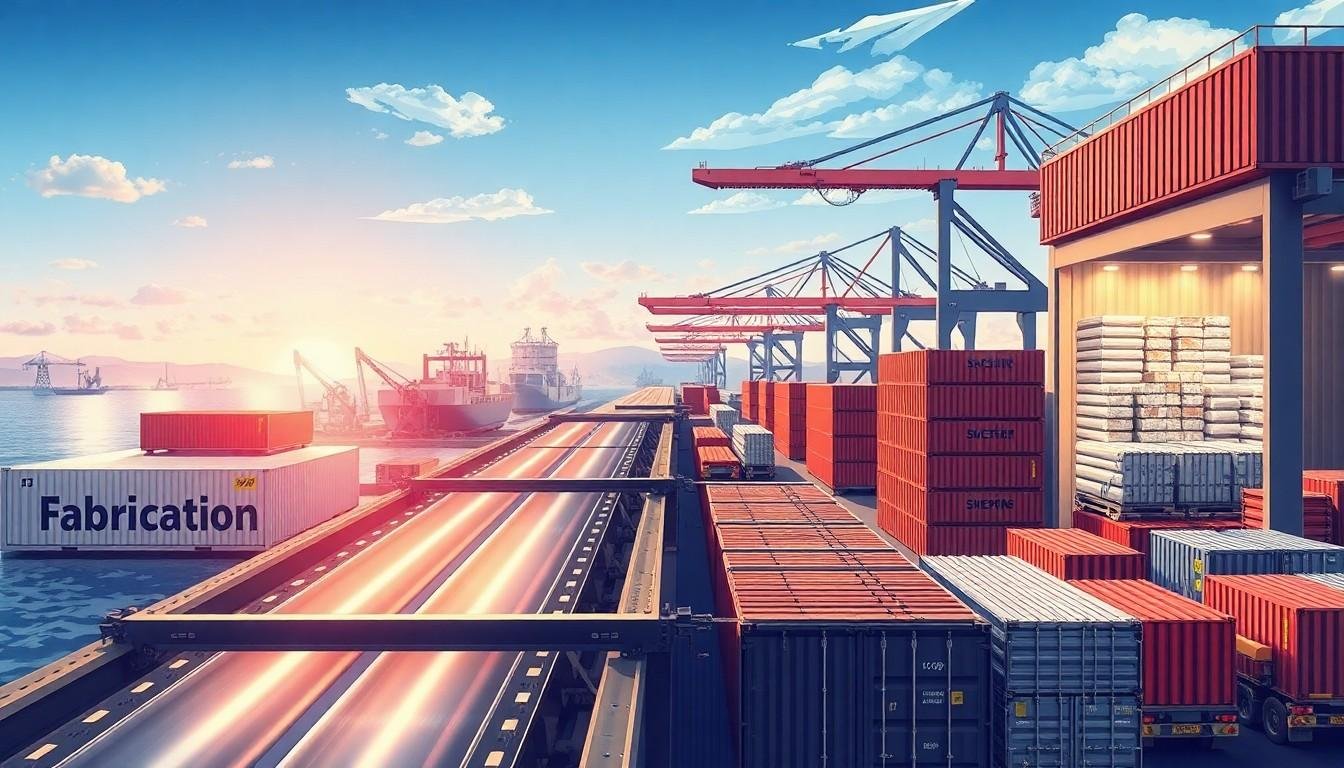
For US procurement teams weighing fabricated aluminium components for a new programme, the decisive questions are usually practical rather than technical. Can the supplier hit the delivery window? Will tolerances hold across repeated runs? What happens if a shipment arrives with defects or a finish problem? Those are the issues that determine whether a sourcing decision becomes an efficient supply arrangement or an ongoing disruption.
Aluminium remains a mainstay in constructio...
Continue Reading This Article
Enjoy this article as well as all of our content, including reports, news, tips and more.

By registering or signing into your SRM Today account, you agree to SRM Today's Terms of Use and consent to the processing of your personal information as described in our Privacy Policy.
That is why supplier selection matters so much. A dependable fabricator is not simply a shop with the right machines; it is a partner able to maintain consistency, communicate clearly and manage changes without creating downstream problems.
Fabrication services usually start with raw sheet, tube, bar or extrusion and end with a component ready for assembly or direct use. In practice, the scope can range from a simple bracket or frame to a more complex enclosure, sub-assembly or load-bearing structure. A supplier working on light commercial parts may rely on a different mix of processes from one producing precision components for industrial customers, but the underlying requirement is the same: accuracy, repeatability and control.
The main operations often include cutting, machining, bending, rolling, welding, deburring and assembly. Some providers also manage packaging and finishing in-house, which can reduce handling errors and shorten the time between fabrication and shipment. Firms such as Tower Fabrication, for example, promote an integrated model covering extrusion, machining, assembly and packaging, arguing that bringing more steps under one roof improves coordination and delivery performance.
Finishing deserves more attention than it often receives at the sourcing stage. Anodising, powder coating and other surface treatments are not merely cosmetic. They help protect against corrosion, improve wear resistance and, in some applications, support compliance with environmental or safety requirements. Eagle Aluminum, which offers cutting, drilling, forming and finishing services, highlights anodised and powder-coated options as part of a broader light metal fabrication offering. For buyers, the lesson is straightforward: a part that is dimensionally correct but poorly finished can still fail in service.
This is also why offshore sourcing from India has become a serious option for many US buyers. Over the past two decades, India has built a substantial base of precision engineering and contract manufacturing capability, supported by investment in CNC machinery, laser cutting and export-oriented production. Companies such as CPEC Global position themselves as ISO-certified suppliers of precision machined components, sub-assemblies and aluminium parts for international customers, while AltEdge markets custom manufacturing from India through a network of audited facilities covering castings, forgings, machined parts, fabrications and surface coatings.
The attraction is obvious: lower labour costs, expanding technical capacity and a wider pool of manufacturers able to support overseas customers. But the case for offshore sourcing should never rest on unit price alone. Freight, duties, inspection costs, inventory carrying expense and the cost of added lead time all need to be included in the calculation. For simpler, high-volume parts, the savings can be meaningful. For tightly specified assemblies or items requiring complex finishing, the advantage may narrow once the full landed cost is properly modelled.
Lead time is another point where optimism can be expensive. Offshore fabrication adds production time, shipping time and often more complex planning around customs and inbound inspection. Buyers running lean inventories may need larger safety stocks to avoid stockouts, particularly if they are depending on a supplier with limited export experience. A stated lead time is useful, but a track record of on-time international shipments is more persuasive.
Supplier evaluation should therefore go beyond catalogues and certificates. ISO 9001 remains an important baseline because it signals a documented quality management framework, but it does not guarantee flawless parts. The real question is whether the supplier can apply its procedures consistently, run production at the required standard and respond quickly when something changes.
That means asking for samples, production records and evidence of repeatability. Where possible, it also means auditing the factory or using a qualified intermediary to verify process control. Bharat Offshore Services, which focuses on fabrication, project management and welding engineering, emphasises non-destructive testing and safety in its work; that kind of capability matters when the component’s integrity is critical rather than merely cosmetic.
Communication is equally important. A supplier that answers technical questions slowly, gives vague explanations or presents conflicting information between sales and production teams is sending a useful warning signal. The best arrangements usually involve direct contact with someone who understands the shop floor, not just the commercial side. That becomes especially valuable when tolerances are tight or specification changes are likely.
Once a supplier is chosen, the contract should make the operating rules explicit. Rejected goods, rework, freight responsibility and response times all need to be defined before the first order ships. If a non-conforming shipment arrives, the buyer should already know how the dispute will be handled, who pays for replacement parts and what evidence is required to prove conformance failure.
Specification changes need the same level of clarity. Real-world procurement rarely stands still; drawings are revised, customer requirements shift and engineering teams update dimensions or finishes. A mature supplier will have a process for handling those changes without losing control of work in progress. A weaker one may continue producing to an outdated version and create avoidable scrap or delay.
Several mistakes appear again and again in aluminium sourcing. Buyers rely too heavily on quoted price and underestimate the real landed cost. They approve a supplier after one strong sample but do not verify whether production runs remain consistent. They neglect to specify finishing standards in enough detail. They carry too little inventory to absorb shipping variation. And they treat supplier approval as a one-off event rather than an ongoing discipline.
That last point is particularly important. The strongest procurement programmes do not assume quality will stay constant on its own. They monitor performance, track delivery reliability and review non-conformances over time. That is how buyers spot drift early enough to correct it before it affects production.
Sourcing fabricated aluminium from India or any other offshore location can be a sensible and cost-effective strategy, but only if it is built on realistic expectations. The supplier’s equipment matters. So does certification. But process control, communication, finishing capability and logistics resilience matter just as much.
For teams that approach the decision in that order, aluminium fabrication becomes a manageable supply-chain relationship rather than a gamble. The result is fewer disruptions, more predictable cost and a better chance of scaling smoothly when demand grows.
Source: Noah Wire Services
Subscribe to Industry Updates

