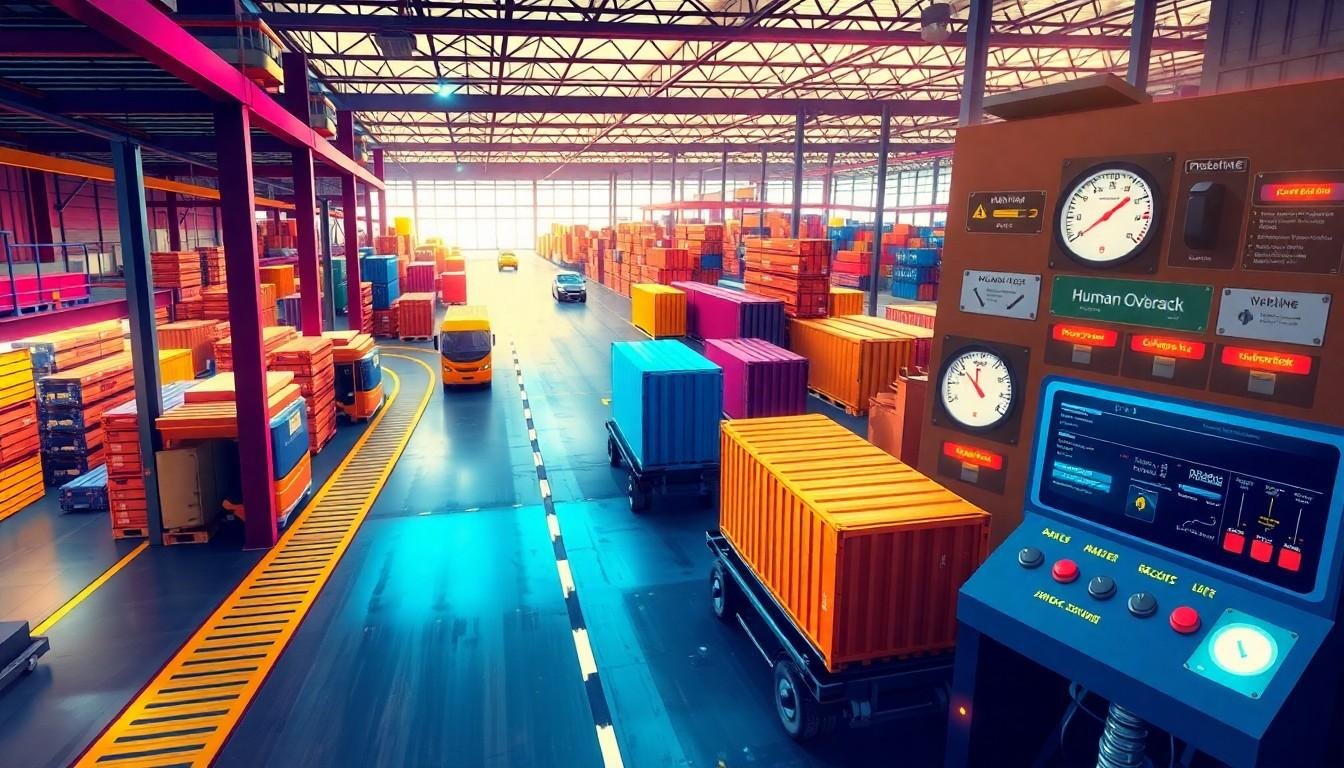
Silicon Valley’s enthusiasm for leaner teams, tighter automation and fewer layers of human oversight is now influencing more than the technology sector. For supply-chain executives, that should be cause for caution. What looks efficient in a stable environment can become fragile when disruption hits, especially if companies strip out the people who quietly absorb shocks, question outputs and keep systems working when the unexpected arrives.
The concern is not abstract. A Stan...
Continue Reading This Article
Enjoy this article as well as all of our content, including reports, news, tips and more.
By registering or signing into your SRM Today account, you agree to SRM Today's Terms of Use and consent to the processing of your personal information as described in our Privacy Policy.
ford Digital Economy Lab study found that workers aged 22 to 25 in occupations most exposed to AI suffered a 16 per cent relative fall in employment after company-level shocks were controlled for. Other Stanford updates suggest the pattern is continuing, with younger workers in heavily AI-exposed roles seeing the sharpest declines. In practice, that means the first casualty of automation is often the entry point into a profession.
That matters in logistics and manufacturing because modern supply chains run on software as much as on physical infrastructure. Control towers, digital twins, routing platforms and smart warehouses all depend on people who can spot when the machine is wrong, not just when it is fast. If firms automate junior tasks too aggressively, they may save money in the short term while eroding the training ground that produces future planners, operators and system owners.
Recent commentary from the technology sector underlines the point. TechRadar has argued that the most effective use of AI in supply chains is not standalone chatbots, but agentic systems embedded in core workflows, with human oversight preserved for high-impact decisions. The same analysis warned that badly integrated tools can create operational risk if they are siloed from the broader business and lack context, traceability and governance.
There is also a workforce angle. Another TechRadar report said AI and related technologies are already reshaping roles by taking over repetitive work such as data entry, inventory checks and basic freight coordination, while creating new positions that require analytical judgement and human-machine collaboration. These include jobs such as robot fleet managers, predictive logistics operators and resilience architects. The World Economic Forum has previously argued that automation could still result in a net gain in employment overall, but only if workers are reskilled quickly enough to move into those emerging roles.
The challenge is that demand is moving faster than supply. Gartner, according to ITPro, said interest in AI skills across supply-chain roles rose by 387 per cent between the first quarter of 2023 and the first quarter of 2026, outpacing the available talent pool and lengthening recruitment times. The consultancy advised chief supply-chain officers to look beyond external hiring and build capability internally, particularly by making better use of entry-level staff as a pipeline for future expertise.
That is where the Silicon Valley model can become dangerous if copied without thought. A young planner who merely approves an algorithm’s recommendation will learn far less than one who has to build a plan, defend it and repair it when it fails. The industry may end up with efficient systems but too few people who understand why those systems work, or how to intervene when they do not.
Research on algorithmic management points to another risk: highly optimised, software-led systems can reduce autonomy and trust even as they improve measured productivity. In routine conditions, that may seem acceptable. During a crisis, it can slow decision-making precisely when companies need local judgement most. The pandemic, port congestion and repeated disruption in maritime routes have all shown that resilience depends on human discretion, not just central visibility.
The broader lesson is that talent strategy now belongs at the centre of resilience planning. After Covid, many firms talked about dual sourcing, buffer stock and network redundancy. Fewer gave the same attention to redundancy in know-how: whether enough staff understand a critical platform, whether younger employees are learning the work rather than merely supervising software, and whether key suppliers can still support complex systems after restructuring or layoffs.
AI is not the issue. The question is whether companies use it to build supply chains that are only leaner, or genuinely stronger.
Source: Noah Wire Services