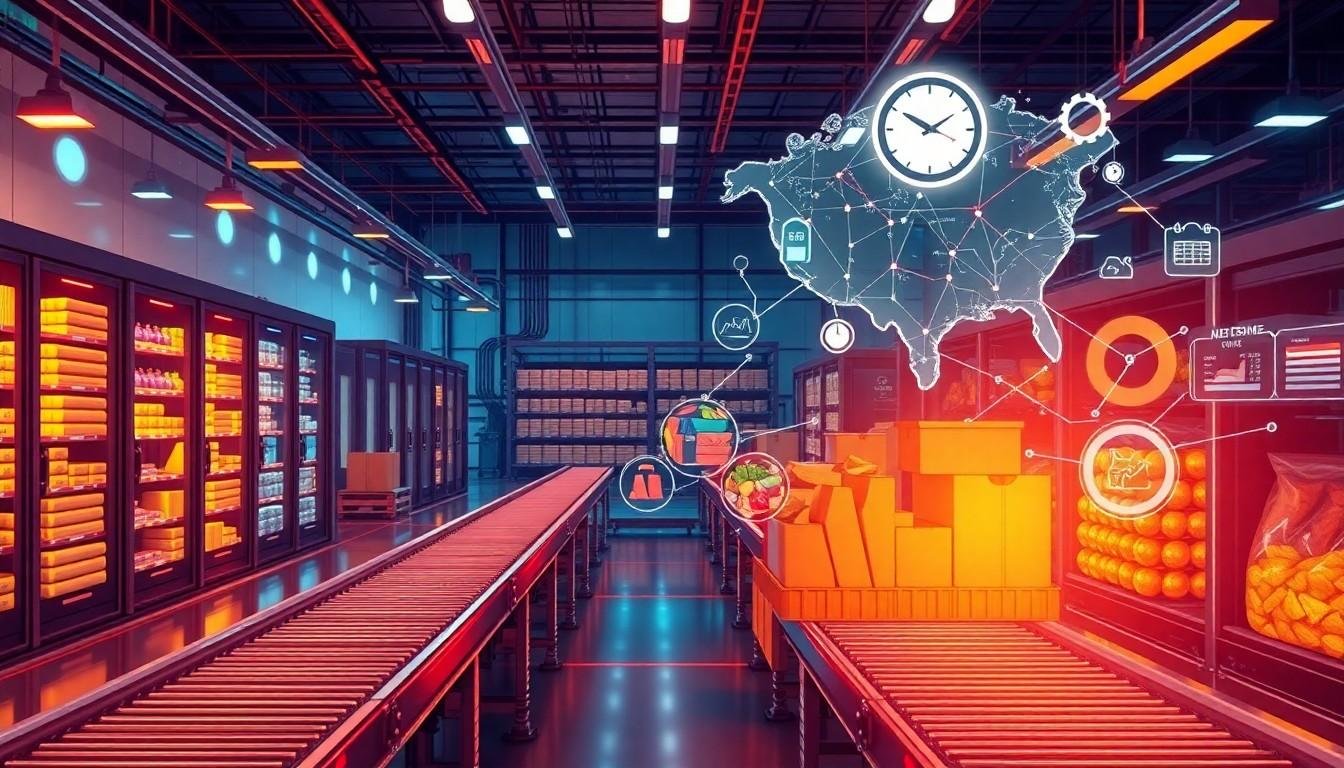
Food and beverage businesses are being forced to run harder just to stand still. Inflation, labour shortages, fragmented supply chains and tighter margins have made operational efficiency less of a back-office concern and more of a survival strategy. In that environment, the move towards smarter, integrated workflows is gathering pace, not as a fashionable upgrade but as a practical response to pressure across the sector.
The shift is especially visible in manufacturing, where ...
Continue Reading This Article
Enjoy this article as well as all of our content, including reports, news, tips and more.
By registering or signing into your SRM Today account, you agree to SRM Today's Terms of Use and consent to the processing of your personal information as described in our Privacy Policy.
companies are trying to make existing assets work better rather than pouring money into expansion. A 2026 outlook cited by Food Industry Executive found that only 28% of food and beverage manufacturers planned to increase investment, with many instead concentrating on optimisation and compliance. The same report said 88% were handling compliance internally or with software, yet only 11% had streamlined and automated those processes. AI adoption remained limited, with 65% of manufacturers not using it at all, largely because of data-security concerns and gaps in digital infrastructure.
That hesitation sits alongside a clear appetite for change. Another Food Industry Executive report published in June said 83% of food and beverage manufacturers planned to increase AI spending in 2025, even though only 16% had scaled more than half of their AI initiatives across all sites. The obstacles were familiar: integration problems, poor data readiness and fragmented manual records that make it difficult to turn pilots into measurable profit-and-loss gains. Gartner has forecast that many AI projects will be abandoned because organisations do not yet have AI-ready data.
For operators, the case for change is straightforward. Smarter workflows can reduce repetitive administration, sharpen inventory control, improve forecasting and limit waste. They can also speed up service, tighten quality checks and give management better visibility over what is happening across kitchens, plants, warehouses and sales channels. In a sector where small inefficiencies quickly become expensive, even modest gains can matter.
The evolution is not limited to automation in the narrow sense. Food Industry Executive has described the move from paper-based Lean methods towards Digital Lean, where connected-worker platforms and live data replace manual logs and sporadic audits. That approach allows teams to diagnose equipment issues faster, validate quality in real time and distribute work instructions digitally, reducing dependence on what individual employees happen to know. The result is less firefighting and more consistent execution.
Artificial intelligence is increasingly being positioned as the layer that ties these systems together. Industry suppliers say AI can help manufacturers translate production signals, quality events and equipment conditions into coordinated action, improving throughput while reducing downtime and variability. Decisyon says its AI-powered execution tools can deliver measurable gains in overall equipment effectiveness, downtime reduction and annual savings per plant, although such claims are vendor-led and will vary by site and implementation. The broader point remains that intelligence is moving closer to the frontline of operations.
That also applies to supply chains, where resilience has become a competitive differentiator. With real-time data linked across suppliers, warehouses and points of sale, businesses can react earlier to shortages, reroute shipments and adjust stock levels before disruption spreads. Predictive analytics, internet-connected sensors and cloud platforms are increasingly being used to make those decisions faster and with less guesswork.
Yet the transition is rarely smooth. Many F&B businesses still depend on legacy systems, and upgrading them can be expensive and disruptive. Staff resistance, limited technical expertise and the challenge of integrating new tools with old processes all slow progress. The most successful implementations tend to start small, prove value in one area and then expand, rather than trying to transform everything at once.
The direction of travel is clear. As the industry becomes more data-led, the businesses most likely to prosper will be those that treat workflows not as fixed routines but as systems that can be measured, improved and adapted. In food and beverage, that shift is no longer just about efficiency. It is about resilience, compliance and the ability to compete in a market that leaves little room for wasted time or wasted product.
Source: Noah Wire Services