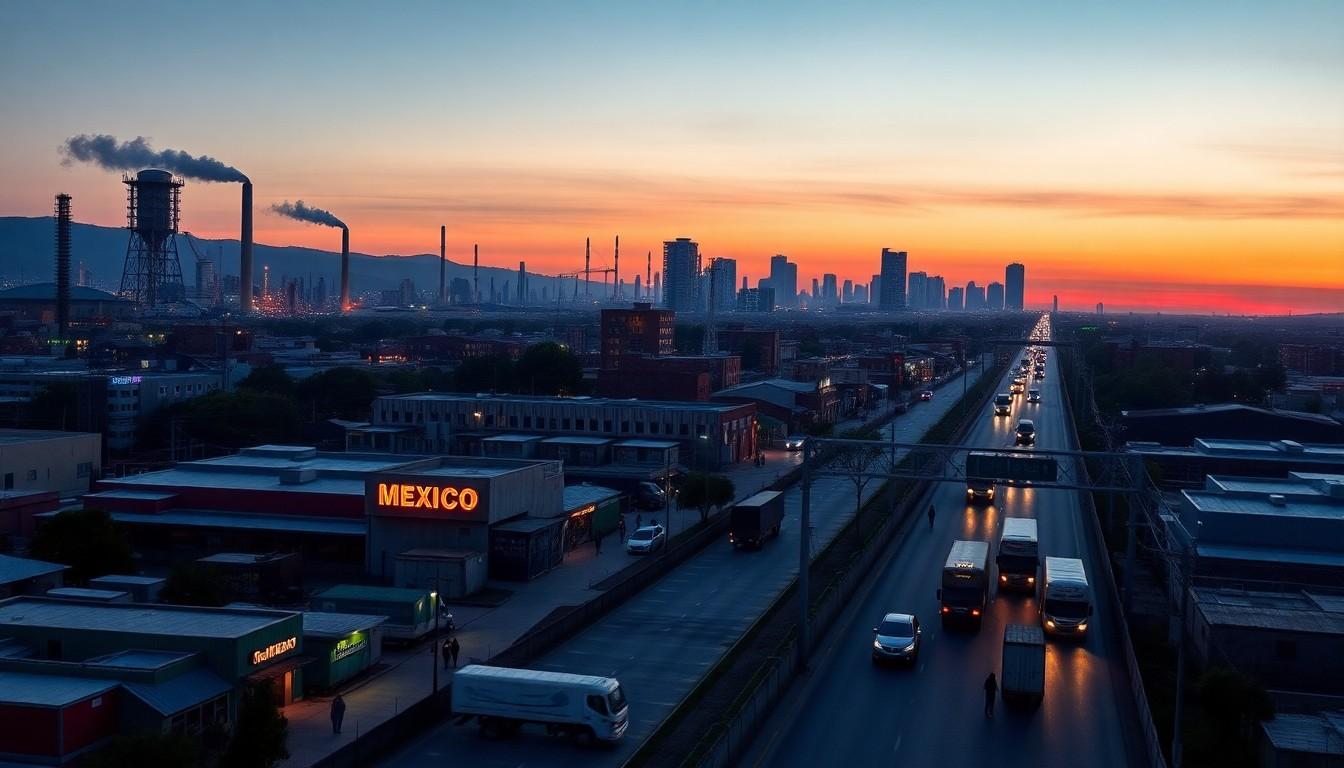
North America’s most serious setback is not one it suffered on a battlefield, nor one brought on by a recession or a banking collapse. It is the collapse of a conviction: that globalisation alone would deliver prosperity, technological leadership and geopolitical stability. For more than three decades, the economic integration of the United States, Canada and Mexico was held up as a model for the world. First under NAFTA and later under the USMCA, open trade, dispersed production an...
Continue Reading This Article
Enjoy this article as well as all of our content, including reports, news, tips and more.
By registering or signing into your SRM Today account, you agree to SRM Today's Terms of Use and consent to the processing of your personal information as described in our Privacy Policy.
d global value chains were presented as the natural route to growth.
That confidence is now under strain. Donald Trump’s tariff agenda, the technology confrontation with China, export curbs on semiconductors, the race for artificial intelligence, industrial policy shifts and tensions in the Middle East all point to a broader break with the post-war economic order shaped by the United States. As Herman Mark Schwartz of the University of Virginia has argued, the issue is no longer simply whether America remains the leading power. The more relevant question is what kind of leadership it wants to exercise, and under what rules the global economy will operate in the decades ahead.
For more than 70 years, American influence rested on four foundations: the dollar’s role as the world’s reserve currency, the technological strength of its universities and companies, Wall Street’s reach in global finance and the institutional power it wielded over trade and investment rules. That system helped Washington organise much of the world economy. But China’s rise has altered the balance. The rivalry between the two powers is no longer just about commerce. It is about control of the strategic industries that will define the 21st century: semiconductors, AI, advanced telecommunications, batteries, clean energy and high-end manufacturing.
China has shown that industrial leadership can be built through deliberate, long-term policy. Huawei, for example, has reportedly devoted about a fifth of its revenues to research and development, while the country has established strong positions in electric vehicles, clean technologies and advanced manufacturing. Yet the current moment does not point to a straightforward swap in which China simply replaces the United States. More likely, it signals a prolonged strategic contest between the two. That is where North America’s central challenge lies.
The pandemic exposed the dangers of overdependence on distant suppliers for strategic goods. Concentrated production in Asia, shortages of industrial inputs and the fragility of critical sectors forced governments to rethink assumptions that had dominated economic policy for years. Nearshoring emerged as part of the answer, but not necessarily as a complete solution. The key issue is not merely where factories are located. It is who controls technology, who generates innovation and who captures the value created by new supply chains.
Research from Brookings says the USMCA has deepened North American economic integration, particularly in manufacturing trade between the United States and Mexico, while also encouraging investment flows that are less reliant on far-flung supply chains. A separate Brookings analysis notes that nearshoring has been accelerated by the U.S.-China trade war and by Washington’s wider effort to reduce supply-chain risk. The trend has historical roots as well: work from the Baker Institute traces the shifting of U.S. production to Mexico over roughly 60 years, showing that the process predates the current debate but has been intensified by trade agreements and changing economic policy.
For Mexico, the transition is both an opportunity and a test. Its integration with the United States has created a formidable export platform, but much of it still depends on assembly work with limited domestic technology content. The USMCA review due in the coming years is likely to force that issue into the open. The Economic Commission for Latin America and the Caribbean says Mexico’s role as a nearshoring platform can support industrial upgrading, but only if it is backed by active industrial policy and stronger local capabilities.
The lesson from South Korea, Taiwan and China is that durable development depends on more than attracting foreign capital. It requires domestic capacity, local suppliers, home-grown technology and the reinvestment of profits into productive activity. That is why the strategic debate in Mexico can no longer be reduced to a choice between free trade and protectionism, or between Washington and Beijing.
The more important question is whether Mexico can use the current reordering of the global economy to build a modern industrial policy around semiconductors, artificial intelligence, electric mobility, clean energy and advanced manufacturing. CSIS has argued that Mexico should adopt a mindset of complementarity as the United States pushes for reshoring and supply-chain de-risking. In that view, Mexico is not simply a beneficiary of American reindustrialisation, but a partner that can strengthen North American resilience if it uses its advantages wisely.
Digital trade will also matter in the next phase. CSIS has said the 2026 USMCA review should reinforce, not reopen, the agreement’s digital trade provisions, reflecting the growing importance of cross-border services and data flows in the regional economy. That reinforces a broader point: the North American project is no longer just about goods moving across borders. It is about technology, standards, data and the ability to compete in sectors where value is created by knowledge rather than labour alone.
The world emerging from this disruption will be more competitive, more technological and more geopolitical than the one that defined the past few decades. Countries that build their own productive capabilities will be better placed to prosper. Historic shifts do not occur only when one power declines and another rises. They happen when middle powers understand the scale of the change and act accordingly.
Mexico is now facing one of those moments. The USMCA review, nearshoring and the wider restructuring of the world economy have opened a window that may not appear again soon. The real question is not whether North America can recover a lost leadership role. It is whether Mexico will use this transition to become a central actor in the new economy, or remain a manufacturing base inside supply chains designed elsewhere.
Source: Noah Wire Services