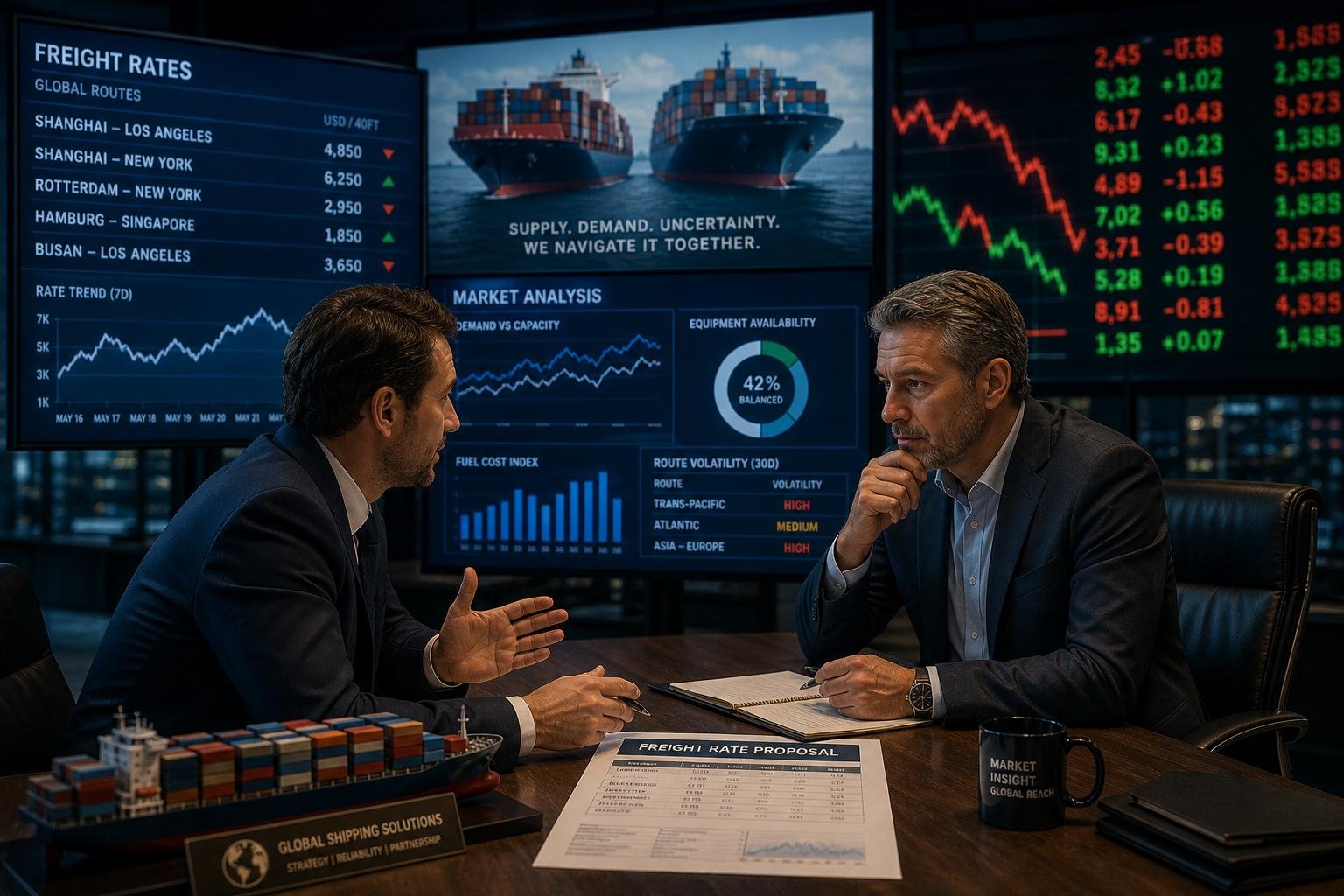
Freight rate negotiation in 2026 is becoming less about squeezing carriers for a lower number and more about managing uncertainty with evidence.
For shippers, the market is no longer behaving like the deep trough of the freight downturn, when excess capacity gave buyers far more leverage. Instead, pricing is being shaped by a mix of uneven capacity, changing trade flows, fuel swings, labour pressure, weather disruption and carrier network changes. Recent market signals underlin...
Continue Reading This Article
Enjoy this article as well as all of our content, including reports, news, tips and more.
By registering or signing into your SRM Today account, you agree to SRM Today's Terms of Use and consent to the processing of your personal information as described in our Privacy Policy.
e that point: Cass said freight spending rose 3.5% year on year in April 2026, DAT reported higher spot truckload rates in March, and Drewry’s World Container Index climbed 12% in mid-May.
That does not mean all freight will become uniformly more expensive. In fact, several market outlooks suggest 2026 may be defined by sharp swings rather than a straight-line increase. S&P Global’s ocean freight outlook points to softer underlying trade growth and expanding vessel capacity, but says volatility remains because of port congestion, geopolitical risk and compliance costs. Ryder, meanwhile, says freight volumes are still subdued overall, even as regional capacity tightens and spot market volatility rises.
The practical implication is that rate negotiation has to start well before an RFP lands in a carrier’s inbox.
Too many shippers still treat procurement as a once-a-year exercise: gather lane data, invite bids, compare prices and award business. But carriers do not price freight on distance alone. They weigh network balance, shipment regularity, dwell time, loading requirements, equipment availability, payment history, claims risk and the complexity of the lane itself. Where a shipper cannot clearly explain those variables, uncertainty gets priced into the quote.
That is why the most effective negotiations begin with cleaner data. Companies need to know which lanes are stable, where accessorials are creeping up, which locations are causing delays, and which carriers are consistently outperforming the base rate. Without that visibility, the exercise becomes a price comparison rather than a commercial discussion about value and service.
Shippers also need to be wary of judging success by linehaul alone. A seemingly low rate can quickly become expensive if it brings poor tender acceptance, frequent service failures, excessive accessorials, weak peak-period capacity or claims problems. The cheapest headline rate is not always the cheapest freight.
A stronger view of shipping cost includes tender behaviour, invoice accuracy, fuel formulae, accessorial patterns, contract compliance, claims performance and the actual gap between promised and delivered service. Ryder says carrier exits and consolidation are already reshaping routing guides and reliability, which means quarterly reviews and more frequent network updates may be needed rather than an annual refresh.
The picture is also becoming more regional and mode-specific. Truckload, less-than-truckload, parcel, ocean, intermodal and air are each being pushed by different forces, and even within truckload, dry van, refrigerated and flatbed markets can diverge sharply. RCS Freight Services says capacity is likely to stay uneven, with pockets of tightness during seasonal surges and disruptions, alongside softer pricing in lanes with spare supply.
That fragmentation makes broad-brush negotiation targets less useful. Some lanes may still support savings, while others may require stronger commitments to protect service. In some cases, the answer may not be a better rate at all, but a different routing guide, a revised mode mix or a redesigned network.
Data quality is where many negotiations are won or lost. If shipment records are incomplete or poorly coded, shippers may not know where they are actually overspending. They may miss unnecessary spot buys, incorrect accessorials, recurring detention, off-guide routing or lanes that consistently exceed contracted rates. Freight audit and payment data can be especially valuable here, not just as a back-office control but as the evidence base for procurement, logistics and finance.
Contract terms matter just as much. Fuel surcharges, minimum charges, dimensional rules, detention language, payment terms, liability provisions and escalation clauses can all change the real cost of moving freight. A good base rate can be undone by weak terms or poor compliance if the contract is not monitored properly after signature.
There is also a stronger case in 2026 for collaboration rather than confrontation. Carriers want freight that fits their networks; shippers want service that is reliable and affordable. The best outcome often comes from better alignment: more consistent tender patterns, better forecasting, reduced dwell time and clearer volume commitments for lanes where performance is strong.
Some market voices are also pointing to a window of leverage. DocShipper says short-term deals can be attractive after Chinese New Year, while the second quarter remains a key period for annual contract talks. Cubic argues that overcapacity in ocean shipping could give shippers room to push for lower rates and better terms. Yet Yahoo Finance reported that Traffix expects double-digit rate increases to persist through 2026, citing carrier exits, regulatory pressure and firmer volumes. Taken together, those views suggest the market is unlikely to move in one direction for long.
That is why the most successful shippers are likely to be the ones who combine timing, data and discipline. They will know their freight profile, watch contract performance closely, update routing guides more often, and use audit data to spot where money is leaking out of the network.
In 2026, the winning negotiation strategy is not pressure for its own sake. It is preparation, visibility and control.
Source: Noah Wire Services