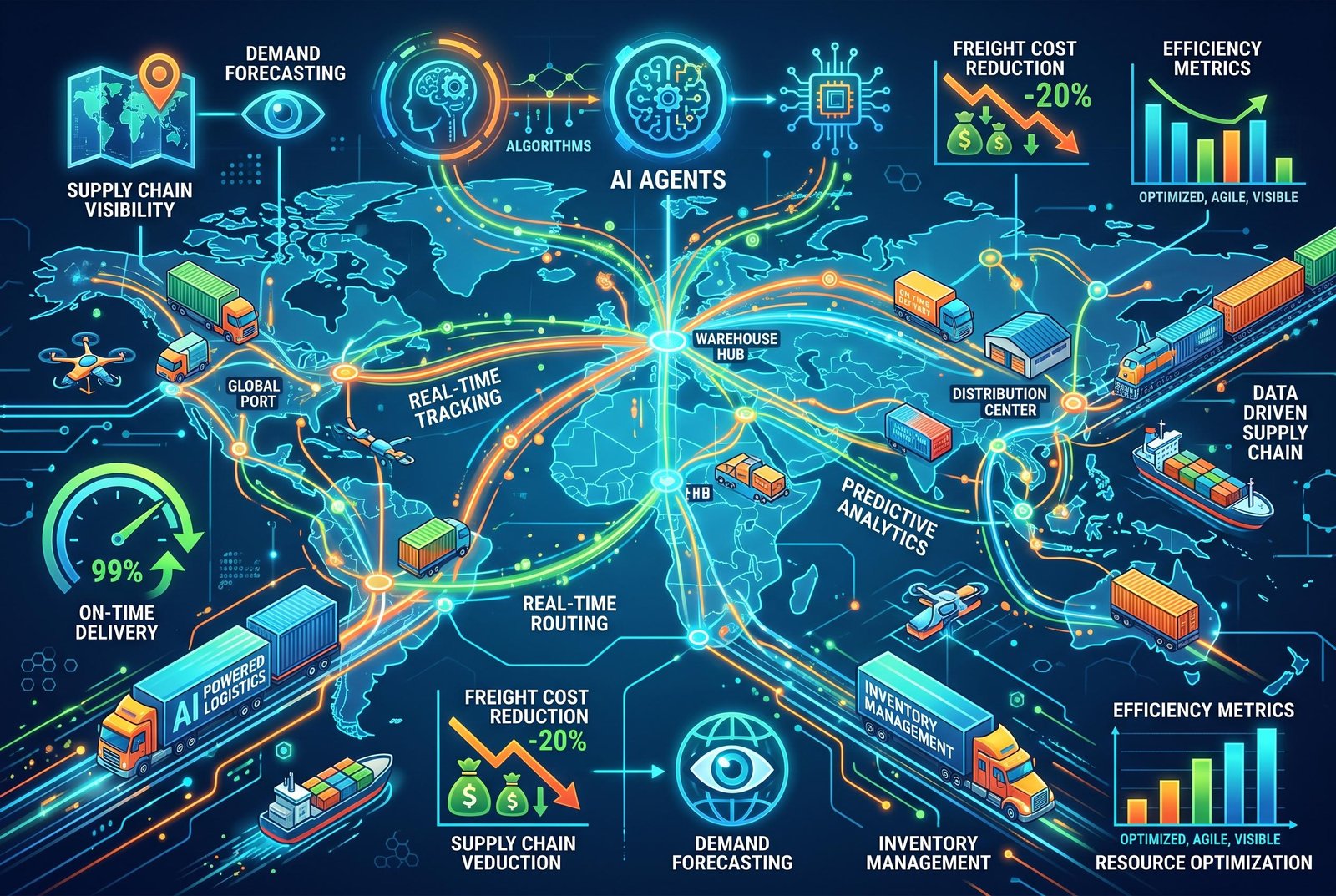
FourKites has unveiled a new commercial model it is calling Outcome-as-a-Service for Supply Chain, positioning its software around specific business results rather than the features of individual tools.
The Chicago-based company said the shift reflects a broader change in enterprise technology, as businesses increasingly judge suppliers on whether they can deliver measurable operational gains rather than simply provide software licences. Under the new approach, FourKites said e...
Continue Reading This Article
Enjoy this article as well as all of our content, including reports, news, tips and more.
By registering or signing into your SRM Today account, you agree to SRM Today's Terms of Use and consent to the processing of your personal information as described in our Privacy Policy.
ngagements will begin with a target metric such as on-time-in-full performance, expedited freight spend or cost to serve, before the company maps out the agents, workflows and data needed to influence that measure.
Founder and chief executive Mathew Elenjickal said in the announcement that the company’s original real-time visibility platform was built to identify problems, but that the new offer is intended to solve them. “We founded real-time visibility to show customers where the problem was. Outcome-as-a-Service is how we solve it for them,” he said. He added that supply chain leaders are typically assessed on business outcomes rather than technology adoption.
The company is also tying the new model to an updated mission, pledging to use AI agents to complete one billion hours of operational work for customers over the next decade. FourKites said that, to support the plan, it has rebuilt internal processes around artificial intelligence and accelerated its software release cadence to daily rather than fortnightly updates.
At the centre of the pitch is FourKites’ claim that its network data gives its AI agents an edge over systems trained only on a customer’s internal information. The firm said its network graph spans more than 1,600 brands, 500,000 carriers and 3.6 million facilities across 176 countries. It argued that this external context , including carrier performance, port conditions and receiving-dock constraints , is critical if software is to do more than flag issues and instead act on a customer’s behalf.
That message is in step with a broader industry conversation around agentic AI and outcome-based contracts. Industry commentary has suggested that models sometimes described as Outcome-as-a-Service, or OaAS, could eventually challenge conventional software sales by shifting accountability for results towards vendors. The appeal is clearest in sectors such as logistics, healthcare and financial services, where workflows are complex and fragmented.
FourKites has been building towards this model for years. Founded in 2014, it originally focused on transportation visibility before expanding into what it now describes as autonomous operational execution. Its website now frames the business around a catalogue of more than 70 outcomes, grouped across areas such as supply resilience, customer fulfilment and global movement, rather than around traditional product modules.
The company has also introduced a digital workforce of named AI agents, each assigned to different supply chain tasks. According to FourKites, these agents are meant to handle work such as carrier operations, supplier management, facility operations, compliance and workflow development.
The launch comes as enterprise software groups increasingly reposition their products around automation and measurable returns on investment. For FourKites, the bet is that customers will be more willing to buy a promised result than a set of tools , provided the company can persuade them that its network, data and AI systems are reliable enough to deliver it.
Source: Noah Wire Services