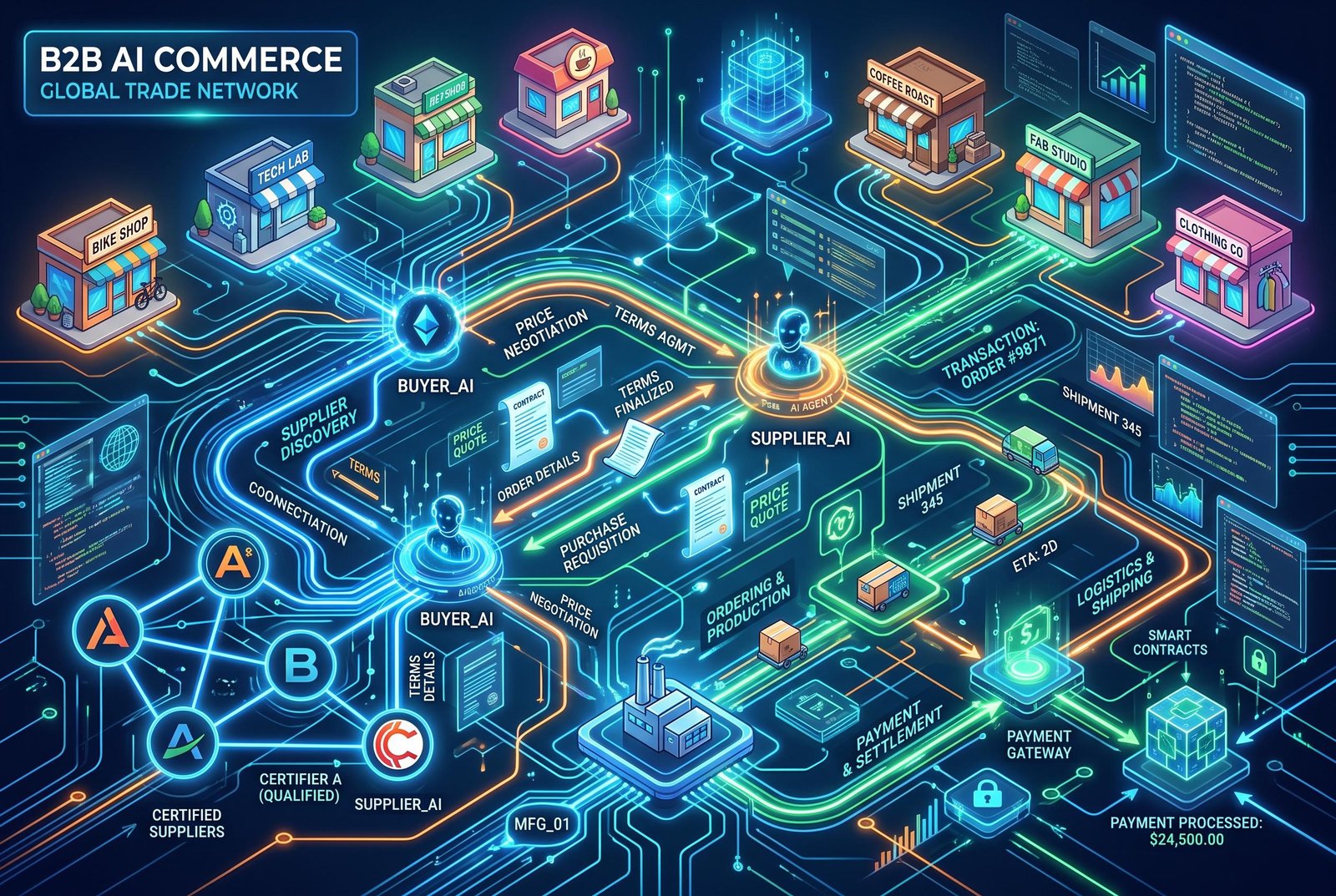
Alibaba.com’s president, Kuo Zhang, believes the next major shift in digital trade is already under way: artificial intelligence is moving from answering questions to carrying out work. In an interview with AI Magazine, he described this transition as the rise of “agentic commerce”, a model in which AI agents do not merely assist users but begin to execute commercial tasks on their behalf.
That change, Zhang argued, is likely to arrive first in business-to-busines...
Continue Reading This Article
Enjoy this article as well as all of our content, including reports, news, tips and more.
By registering or signing into your SRM Today account, you agree to SRM Today's Terms of Use and consent to the processing of your personal information as described in our Privacy Policy.
s trade rather than consumer retail. In B2C commerce, he suggested, people often browse for enjoyment, whereas agents are deployed to save time and reduce friction. B2B purchasing is a different proposition altogether. From the first spark of an idea to supplier discovery, negotiation, production planning and payment, the process can involve around 30 separate steps, creating a strong case for automation.
Zhang, who has previously held senior roles at Microsoft, IBM, Taobao and Tmall, and has led Alibaba.com since 2017, said the most effective agent systems combine three elements: a model, the software framework that manages tools and safeguards, and the operational context drawn from conversations and platform data. If any one of those is missing, he argued, the system fails. The point, he suggested, is not simply to generate answers, but to complete actions.
That idea sits behind Alibaba.com’s growing push into its Accio platform, which the company positions as an AI workspace for small and medium-sized businesses. According to Alibaba, the latest version of Accio Work can help users with research, sourcing, supplier assessment and broader e-commerce operations, while also acting as a coordinated digital team for businesses that lack large in-house resources.
The company says that, in a benchmark covering 107 e-commerce tasks, Accio completed work at more than 50% lower estimated cost than OpenAI’s Codex and Anthropic’s Claude Code, while maintaining comparable completion quality. Alibaba argues that this kind of comparison matters more than model hype, because smaller businesses care less about abstract capability claims than about whether an AI system is affordable enough to use at scale.
Zhang has used that argument to make a broader point about how AI should be judged. Frontier model developers often showcase wins on benchmarks, he said, but those tests do not always reflect the practical demands of a trader, seller or sourcing team working in real time. For SMEs, he contended, value lies in tools that solve business problems at a manageable cost.
Alibaba International has also unveiled Accio Work as a no-code enterprise AI agent intended to deploy specialist agents for longer-term operational tasks from day one. In a separate company announcement, Alibaba said the platform is designed to support a wide range of business needs across global SMEs, and later claimed it had already powered more than 230,000 online stores worldwide.
The company is not trying to build the whole stack alone. Zhang said Alibaba.com is working with around 500 partners across the ecosystem, including payment providers such as Fiserv and JPMorgan, as well as banks, logistics firms including DHL and Maersk, and market-intelligence services such as Helium 10. The aim, he suggested, is to connect the many pieces of global trade into a single environment in which agents can search, compare, negotiate and ultimately transact.
That vision extends beyond simple automation. Zhang expects B2B commerce to evolve into A2A, or agent-to-agent, trade, in which supply and demand are matched not by people manually reviewing endless lists of options, but by autonomous systems connecting with one another directly. In his view, that could reshape how buyers discover suppliers and how sellers reach demand, especially when products require detailed specifications, compliance information and faster coordination.
He also drew a distinction between the way AI is discussed in the West and the way it may be adopted in practice. The technology itself is global, he said, but business value is local. Each enterprise faces its own constraints, ambitions and market conditions, and the most useful AI systems will be those that help solve those specific problems rather than pursue abstraction for its own sake.
Alibaba’s broader bet is that commerce, and particularly cross-border sourcing, is one of the most fertile areas for this shift. Zhang pointed to software development as the first major AI breakthrough, noting its rapid uptake among engineers. He believes the next wave will be agents handling real-world operations in real time, with e-commerce and international trade among the best-positioned sectors to lead the way.
For now, the pitch is clear. Alibaba.com is presenting agentic AI not as a distant concept, but as a practical operating layer for trade: one that can help small businesses research markets, define products, manage suppliers and move faster through the long, often cumbersome chain of B2B commerce.
Source: Noah Wire Services