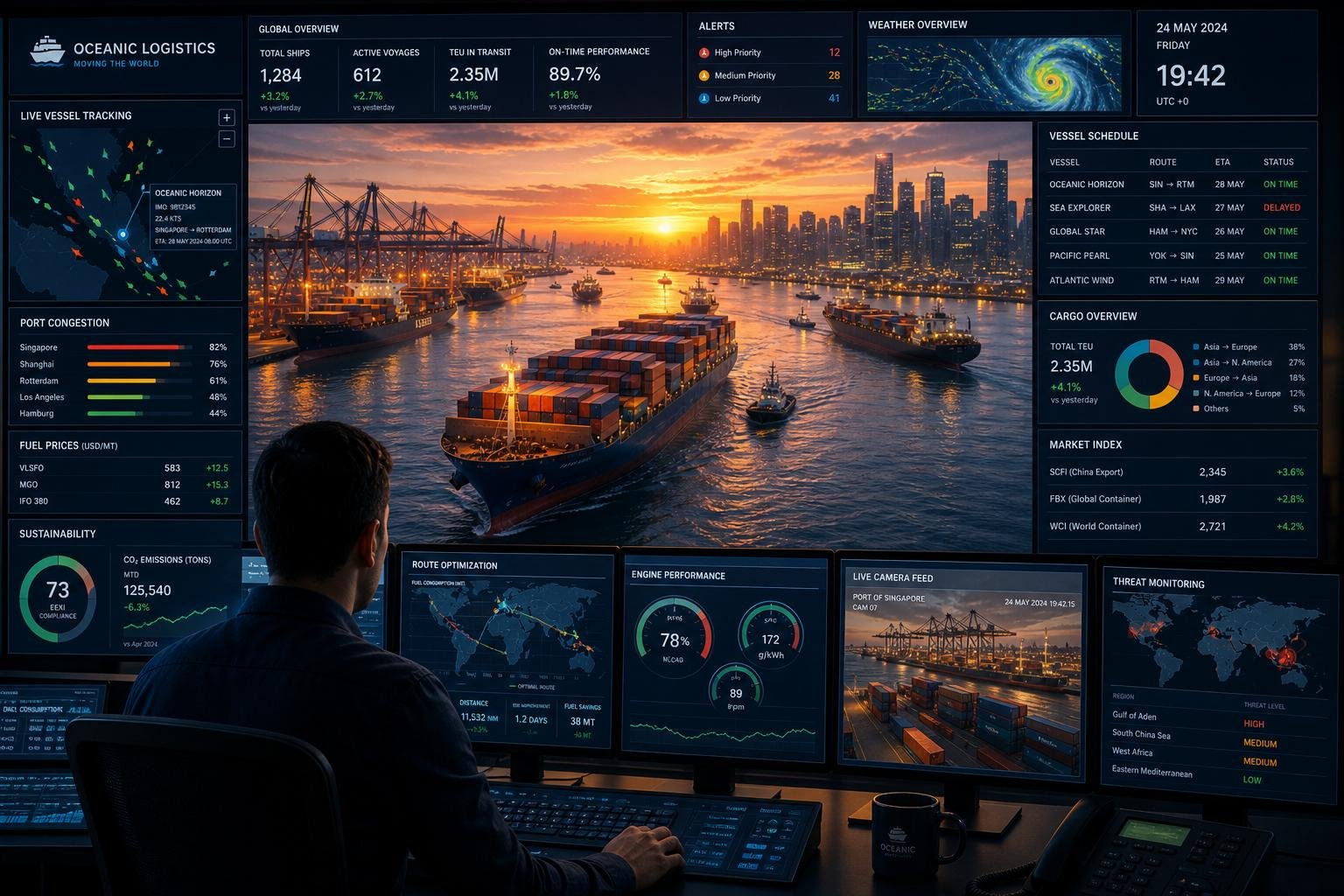
Container shipping is being dragged into the light by data. What was once a market shaped by private negotiations, uneven information and personal relationships is gradually becoming one that can be measured, compared and challenged in real time.
Xeneta has built its ocean freight platform around that shift. The company says its aim is to help shippers “stop negotiating in the dark”, and the broader logic is hard to dispute. In a sector where rates, capacity and ser...
Continue Reading This Article
Enjoy this article as well as all of our content, including reports, news, tips and more.
By registering or signing into your SRM Today account, you agree to SRM Today's Terms of Use and consent to the processing of your personal information as described in our Privacy Policy.
vice quality have long been difficult to verify, live benchmarking is changing both procurement and carrier behaviour. What used to rely on intuition or anecdote is increasingly being replaced by lane-by-lane rate comparisons, performance tracking and signals on capacity pressure.
The appeal of that transparency has grown as shipping has become less predictable. Geopolitical tensions, tariff swings and route disruptions have repeatedly forced companies to rethink supply chains at short notice. For procurement teams, that has made freight budgeting and contract talks more difficult, but also more important. Evidence now carries more weight than ever, especially when a surcharge, a rate hike or a reliability claim has to be justified internally.
Schedule reliability illustrates the point. Sea-Intelligence’s data show global reliability has remained stubbornly uneven, even if it has improved from the lows of recent years. In December 2024, it stood at 53.8%, with the full year largely confined to a 50% to 55% range. By August 2025, reliability had risen to 65.3%, and in September 2025 it was 65.2%, before climbing to 62.4% in January 2026, the highest monthly figure across the 2021 to 2026 period. Even so, late vessel arrivals still carried average delays of more than five days in January, underlining how far the industry remains from truly dependable schedules.
That matters because reliability is no longer just a complaint. It is becoming a procurement variable. Shippers can now compare carriers not only on price, but on consistency, delay patterns and broader service performance. That makes it easier to question commercial claims and to put a clearer risk premium on weak routes or unreliable services.
Xeneta’s platform is built around that idea of usable intelligence. The company says it aggregates real-time data from a wide network of shippers and freight forwarders, covering price, capacity, reliability and emissions. In practice, that means procurement teams can benchmark contract and spot rates against market reality, identify outliers and move faster in tenders. It also gives them a firmer basis for negotiating with carriers, particularly when the market is volatile and pricing power can swing quickly.
The implications go beyond large global shippers. For exporters and importers, especially in markets where freight decision-making is still fragmented, transparency can reduce dependence on informal networks and narrow market knowledge. It can also make carrier selection more disciplined by combining price with service quality and operational resilience.
Sea-Intelligence’s latest numbers suggest the improvement in schedule reliability is real, but fragile. Delays remain substantial, and the broader picture still points to an industry that is more measurable than before, yet far from stable. That is precisely why data has become so influential. It does not remove disruption, but it helps expose where disruption is most costly and where carriers are asking for more than the market justifies.
For shipping, that may be the deeper change. Transparency is no longer a nice-to-have. It is becoming part of the operating model.
Source: Noah Wire Services