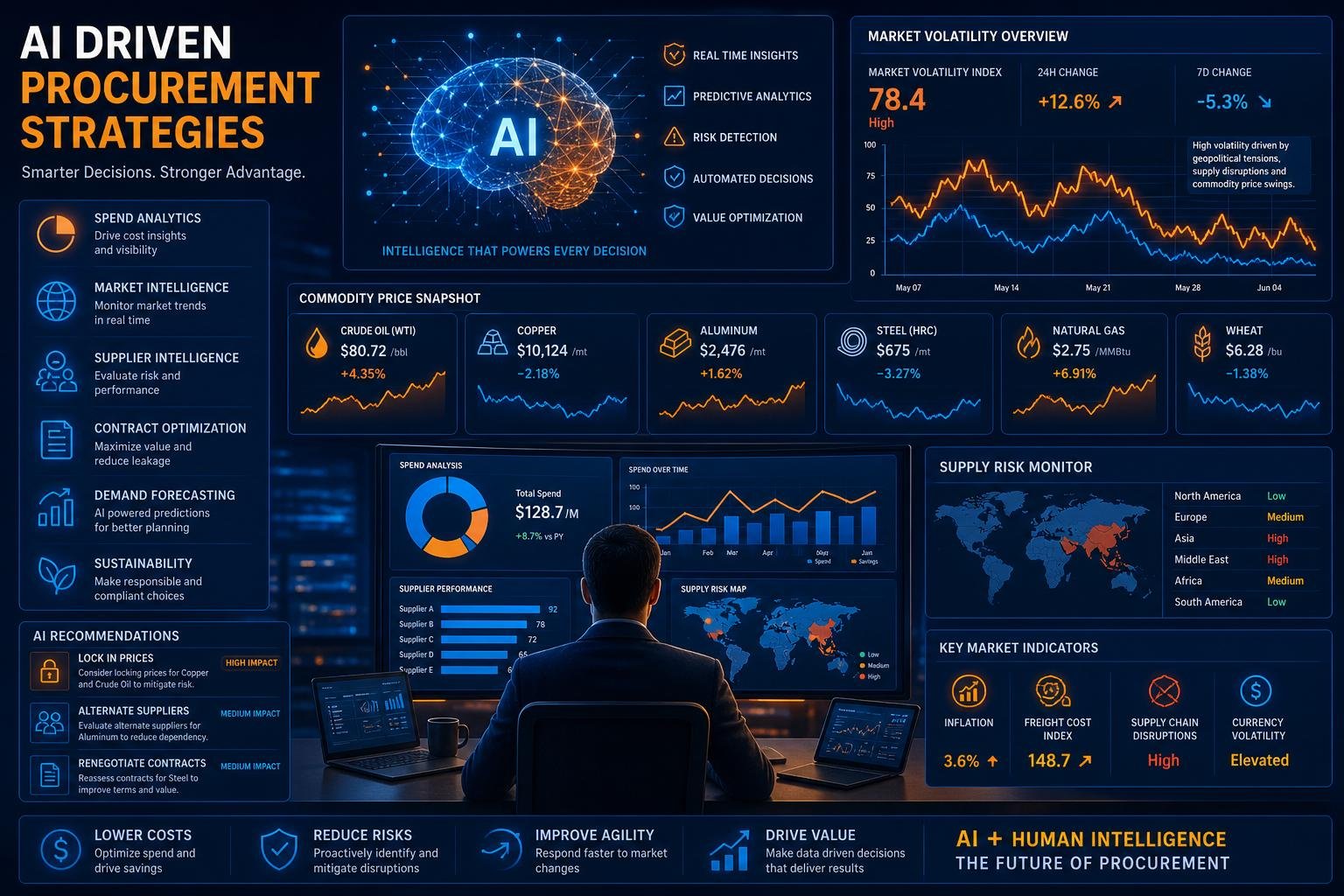
Commodity volatility is forcing retail and consumer goods procurement teams to think more like strategists and less like price negotiators. In a market shaped by erratic input costs, supplier disruption and shifting commercial pressures, the function is increasingly being asked to protect margin, preserve supply and influence downstream pricing decisions before problems become visible on the shop floor.
According to HCLTech, that is the environment in which AI in procurement is...
Continue Reading This Article
Enjoy this article as well as all of our content, including reports, news, tips and more.
By registering or signing into your SRM Today account, you agree to SRM Today's Terms of Use and consent to the processing of your personal information as described in our Privacy Policy.
being judged. The company says the technology’s value lies not in accelerating buying for its own sake, but in helping teams make better decisions when conditions are uncertain. Kristina Rogers, HCLTech’s chief growth officer and global head of retail, CPG and luxury, said: “The case for AI in procurement is not that it buys faster. It is that it buys smarter when market conditions stop being predictable.”
That framing reflects a broader shift in the market. Gartner’s 2025 and 2026 procurement research points to a more demanding phase for generative AI in procurement, with uneven returns exposing the difference between organisations that have modernised their operating model and those that have simply added new tools on top of old processes.
The practical challenge is that procurement is now being pulled into a wider set of decisions than before. Alongside commodity swings, teams must weigh supplier risk, sustainability commitments and newer pricing structures that can change how value is captured across the business. HCLTech argues that this raises the importance of supplier visibility, market intelligence and scenario planning, which are becoming core capabilities rather than optional extras.
The company’s Smart Buy proposition is designed around that shift, positioning AI as a decision-support layer for sourcing, supplier evaluation and buying strategy. That approach mirrors a wider trend across retail and CPG technology, where vendors are increasingly building systems that turn raw operational data into faster, more targeted action. Platforms such as Swiftly, Opener, Foreko, Vision Group and Engini are all pushing AI deeper into retail workflows, from demand forecasting and replenishment to buyer targeting and execution. The common thread is not automation alone, but the attempt to connect data, judgement and action more tightly.
HCLTech says that the operating model around procurement matters as much as the technology itself. Better buying decisions, it argues, depend on cleaner data flows, sharper visibility and processes that can respond quickly when markets move. In that sense, the issue is not simply whether AI can analyse more information, but whether the organisation can act on it with enough speed and discipline.
That is especially important as procurement’s remit expands. Beyond sourcing and approvals, it is increasingly tied to enterprise resilience and value creation. Buying decisions now have implications for continuity, customer pricing and overall commercial performance, which means the stakes are higher when market conditions turn.
Rogers said the most effective teams will be those that spot changes earliest and respond with confidence. “The smartest procurement teams will not be the ones that automate the most steps. They will be the ones that see market movement earliest and act on it with confidence,” she said.
For retail and CPG leaders, the implication is clear: procurement is becoming a strategic control point. The organisations that combine AI with stronger planning, better visibility and more adaptive processes are likely to be better placed to handle volatility, protect profitability and turn sourcing into a more active source of competitive advantage.
Source: Noah Wire Services