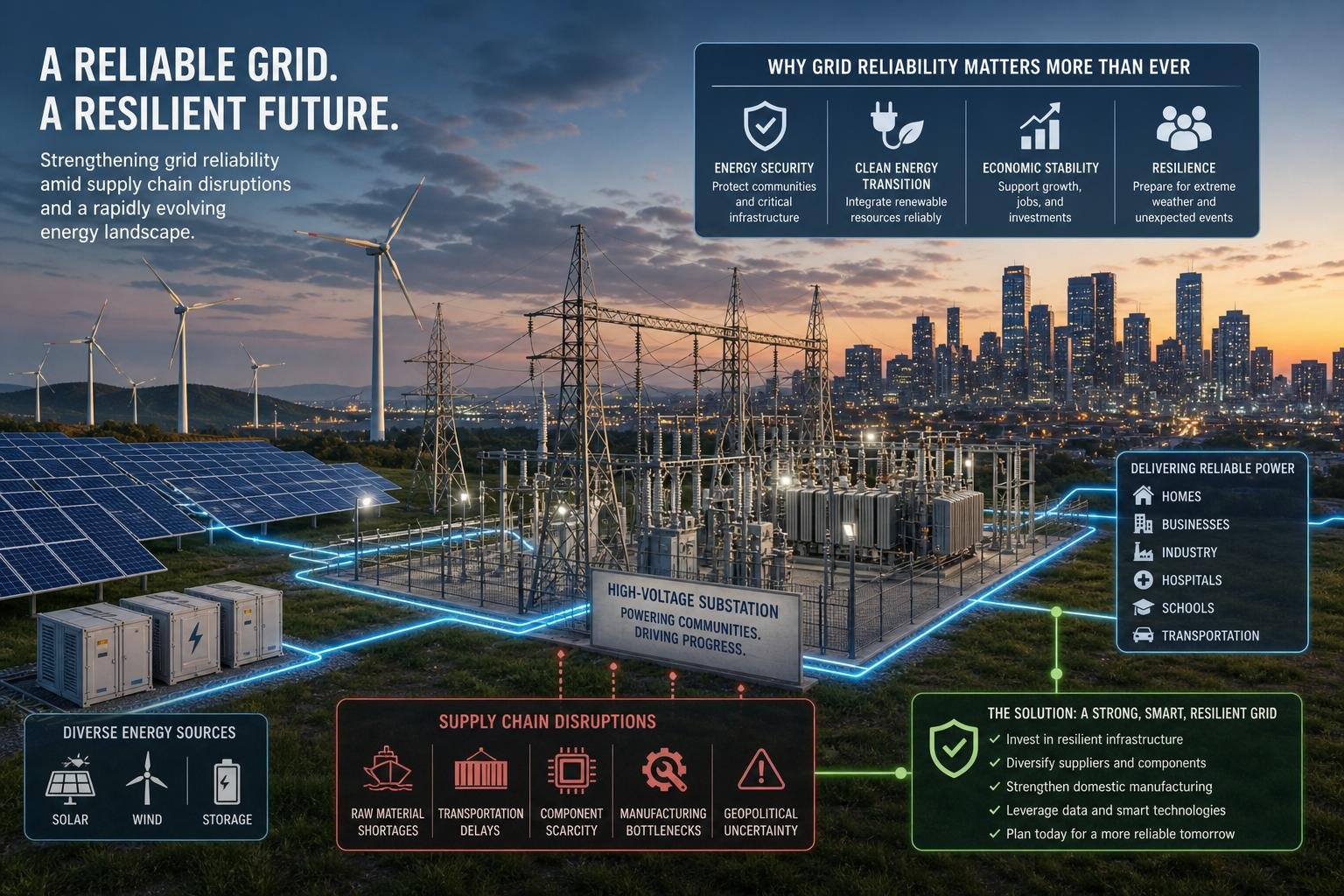
Grid reliability still hinges on careful engineering and disciplined planning, but for utilities and developers the bottleneck is increasingly more basic: the hardware is not arriving on time.
Danielle Pirrone, president and chief operating officer of ULE Group, argues that procurement has become a direct reliability issue because projects can now slip long after design work is complete. Crews may be mobilised, schedules may be fixed and permitting may be in place, yet a transf...
Continue Reading This Article
Enjoy this article as well as all of our content, including reports, news, tips and more.
By registering or signing into your SRM Today account, you agree to SRM Today's Terms of Use and consent to the processing of your personal information as described in our Privacy Policy.
ormer, switchgear package or even a smaller component can still be missing when construction is ready to begin.
That problem is not confined to a single type of project. Utilities are simultaneously replacing ageing assets, preparing for load growth and responding to new demand from data centres. Developers bringing generation online can also trigger utility-side upgrades that depend on the same constrained categories of equipment. The result is a market in which long lead times for medium-voltage gear and transformers continue to affect delivery schedules far more than many owners expected just a few years ago.
Industry commentary suggests the situation has deteriorated sharply since before the pandemic. A recent article on data centre supply chains said lead times for power transformers have expanded from less than a year to as much as five years, while generator deliveries that once took months can now stretch into a two-year planning horizon. McKinsey has likewise said utilities are operating in a procurement environment where lead times for critical materials and parts have at least doubled, with U.S. manufacturers of transformers, meters and related equipment unable to meet all demand.
What makes the challenge more disruptive is that the delay is often discovered late. Interconnection setbacks are usually discussed in terms of studies or permits, but Pirrone notes that projects can also stall after engineering is finished simply because equipment was not ordered early enough. In some cases, she says, the missing item is not the largest piece of gear at all, but a smaller part that was overlooked or delayed. Once field work is under way, such gaps are much harder to recover from.
That has changed the way projects are sequenced. Before the pandemic, equipment ordering was often pushed further down the delivery chain. As supply constraints worsened, developers and contractors began moving procurement decisions earlier to avoid being trapped by long waits later. The logic is straightforward: if a project team waits until engineering is complete, it may already be too late to protect the schedule.
The financial consequences can be significant. Late arrivals leave crews idle, force work to be resequenced and can trigger expensive expedited shipping. By the time a project reaches the back end of construction, redesign is rarely realistic because the scope has usually been approved or permitted. For utilities trying to deliver reliability improvements without overspending, that makes predictability nearly as important as headline price.
Pirrone’s wider point is that purchasing decisions should be judged on more than the initial invoice. A cheaper option can quickly become more expensive if it introduces schedule risk that later translates into labour costs, delay penalties or field inefficiencies. Lead time and labour exposure, she argues, need to be weighed alongside purchase price because they are part of the same commercial decision.
That lesson is encouraging a broader shift in how projects are managed. Procurement is increasingly being brought into the process earlier, alongside engineering and construction rather than after them. Standardisation can help, because repeatable specifications make forecasting easier and allow orders to be placed sooner. Some firms are also widening the supplier base, qualifying alternative manufacturers that can meet the same technical requirements and sometimes offer shorter waits than legacy vendors.
The wider market backdrop is not making the task easier. Demand for grid equipment is being driven by utility upgrades, data centre build-outs, electrification and transmission expansion at the same time, while domestic manufacturing capacity remains tight. That combination means old assumptions about ready availability no longer hold.
The practical implication is clear enough. Reliability programmes, interconnection schedules and capital budgets are all more vulnerable when procurement is treated as a late-stage administrative step. They are more resilient when equipment strategy is considered early, while there is still room to adjust the plan and protect the schedule.
In that sense, procurement is no longer peripheral to grid reliability work. It is part of the reliability solution itself.
Source: Noah Wire Services