


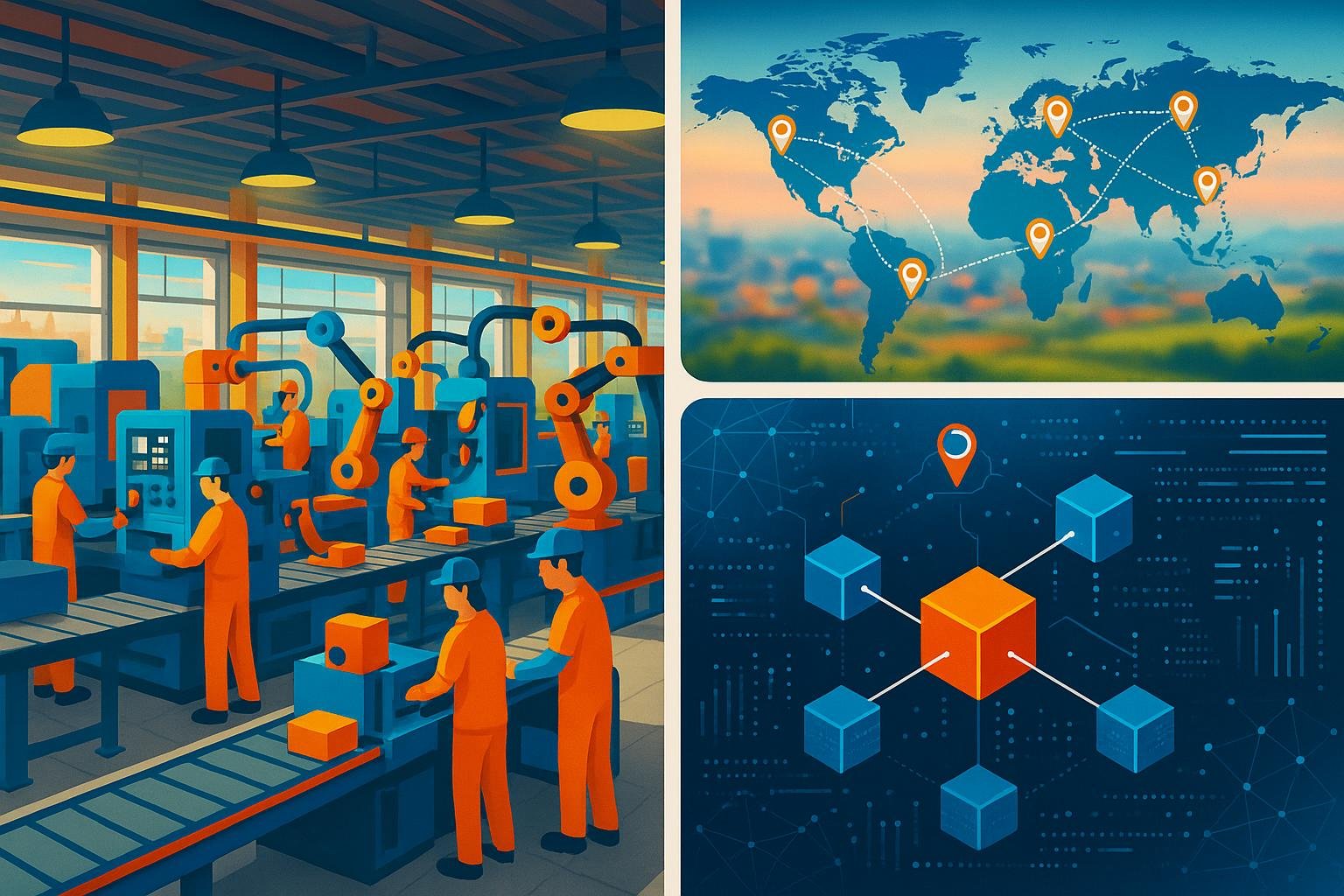
Manufacturers have spent decades trying to keep control of products through paper files, disconnected systems and supplier reports that rarely line up neatly. That approach is under increasing strain. As supply chains stretch across continents and regulators demand better proof of safety, provenance and compliance, traceability has become a boardroom issue rather than a clerical one.
This is the space in which blockchain has gained traction. Better known for its role in cryptoc...
Continue Reading This Article
Enjoy this article as well as all of our content, including reports, news, tips and more.

By registering or signing into your SRM Today account, you agree to SRM Today's Terms of Use and consent to the processing of your personal information as described in our Privacy Policy.
In practice, the appeal is straightforward. Manufacturers need a clearer picture of where materials came from, how they were handled, who certified them and where they ended up. That matters for recalls, quality control, anti-counterfeit measures, sustainability claims and regulatory defence. When a defect appears, or a customer questions a provenance claim, a ledger that links each step in the product journey can make the difference between a swift response and a costly scramble.
Traceability itself is not new. Automotive, pharmaceutical, food and aerospace firms have long relied on batch codes, serial numbers and chain-of-custody records. But those systems often break down when production becomes multi-tiered and geographically dispersed. Information can be delayed, duplicated or lost between suppliers, freight operators, factories and warehouses. Data may sit in incompatible software, while paper records and email attachments leave room for error or manipulation.
Blockchain offers a different logic. Rather than relying on one company’s internal database, it distributes approved records across a network of participants. Each event is time-stamped and linked to the previous one, creating a sequence that is much harder to tamper with after the fact. That makes it easier to establish a shared version of what happened, when it happened and who handled it.
The manufacturing uses are broad. In consumer electronics, blockchain can help trace batteries, circuit boards, casings and final assembly back through multiple supplier layers. If a battery batch is later found to overheat, the company can identify which products are affected and which shipments share the same risk profile. In automotive production, it can track components, software updates and critical materials. In pharmaceuticals, it can help prove that ingredients stayed within the correct temperature range. In food processing, it can support provenance and cold-chain integrity. In aerospace and heavy industry, it can verify certification and the origin of specialist parts.
The technology is also gaining attention because it can support accountability in multi-party production networks. Modern manufacturing is rarely confined to one firm. A finished product may pass through design houses, component suppliers, logistics providers, inspectors and contract manufacturers before reaching the customer. When something fails, the question of responsibility can become blurred. A shared ledger does not eliminate disputes, but it does narrow the evidential gap by making each handover visible.
That is particularly useful in industries where compliance is non-negotiable. Pharmaceuticals, food, defence, aerospace and automotive sectors all depend on precise records. Blockchain can make those records harder to manipulate and easier to verify, especially when combined with sensors, barcodes, RFID tags and digital signatures that tie the physical item to its digital identity. United Barcode Systems has argued that reliable coding and labelling remain essential to making blockchain-based traceability work in practice, rather than in theory.
Counterfeit prevention is another major draw. Fake parts and unauthorised goods can cause safety incidents, machine failure and reputational damage. A blockchain-backed record can make it harder for counterfeit items to enter the chain unnoticed, particularly when physical identifiers are linked to the ledger. If a product appears in the wrong place, or without the right transaction history, the discrepancy becomes easier to spot.
Recalls may be the clearest commercial case for adoption. When a fault is discovered, manufacturers need to know exactly which units are affected, where they were shipped and how far the problem spread. Weak traceability tends to widen recalls unnecessarily, increasing costs and disruption. Stronger traceability can support narrower, more targeted withdrawals and faster root-cause analysis, which matters both financially and reputationally.
Sustainability is pushing the same logic into sharper focus. Companies are under pressure to prove claims about recycled content, emissions, labour standards and ethical sourcing. That is difficult when inputs come from opaque supplier networks. Blockchain can help record certificates, energy readings, material transformations and recycling events, giving sustainability claims a firmer evidential base. It will not make a product greener by itself, but it can make green claims more credible.
Some of the most ambitious applications are emerging in textiles and apparel, where digital product passport initiatives are bringing new attention to fibre origin, manufacturing steps and end-of-life recovery. EcoFabric Trace, a blockchain-based platform aimed at the sector, describes a model in which data from farmers, mills and manufacturers is linked into a single verified record from fibre to finished garment. The broader point is that traceability is no longer only about compliance. It is becoming part of how brands present trust to buyers.
Even so, blockchain is not a cure-all. A ledger can preserve records, but it cannot guarantee that the information entered was true in the first place. If bad data goes in, the system may faithfully protect the bad data. That means blockchain has to sit alongside inspections, governance, sensors and certification checks. It strengthens trust, but does not replace it.
There are also practical obstacles. Many manufacturers still depend on legacy ERP, MES and supply-chain systems that were never designed to talk to a distributed ledger. Integrating those tools can be expensive and technically awkward. Data standards may not match. Smaller suppliers may lack the resources to participate. Networks can also become slow or cumbersome if they try to record too much information at once.
That is why the more successful deployments tend to be targeted. Rather than attempting to digitise every interaction in the factory, companies often start with a high-risk material, a sensitive product line or a compliance-heavy process. Once the value is proven, the network can expand. Industry observers say this phased approach is usually more effective than trying to build a complete system on day one.
The deeper challenge is organisational rather than technical. Blockchain traceability only works if suppliers, auditors, logistics partners, regulators and manufacturers are willing to align on data rules and governance. If participants do not see a benefit for themselves, adoption stalls. For that reason, the strongest business cases tend to be in sectors where the cost of failure is high and the value of proof is obvious.
The direction of travel, however, is clear. As rules tighten and customers become more sceptical, manufacturers are being asked not just to say what their products are, but to show it. Blockchain is one of the tools now being used to make that possible. Its long-term significance may lie less in the technology itself than in the discipline it imposes: shared records, visible handovers and a more auditable chain of responsibility.
In manufacturing, that shift could prove consequential. The industry has always depended on control, but it is increasingly being judged on verifiable control. Blockchain will not solve every supply-chain problem, yet it offers a stronger basis for proving where things came from, how they were handled and who was accountable along the way.
Source: Noah Wire Services
Subscribe to Industry Updates

