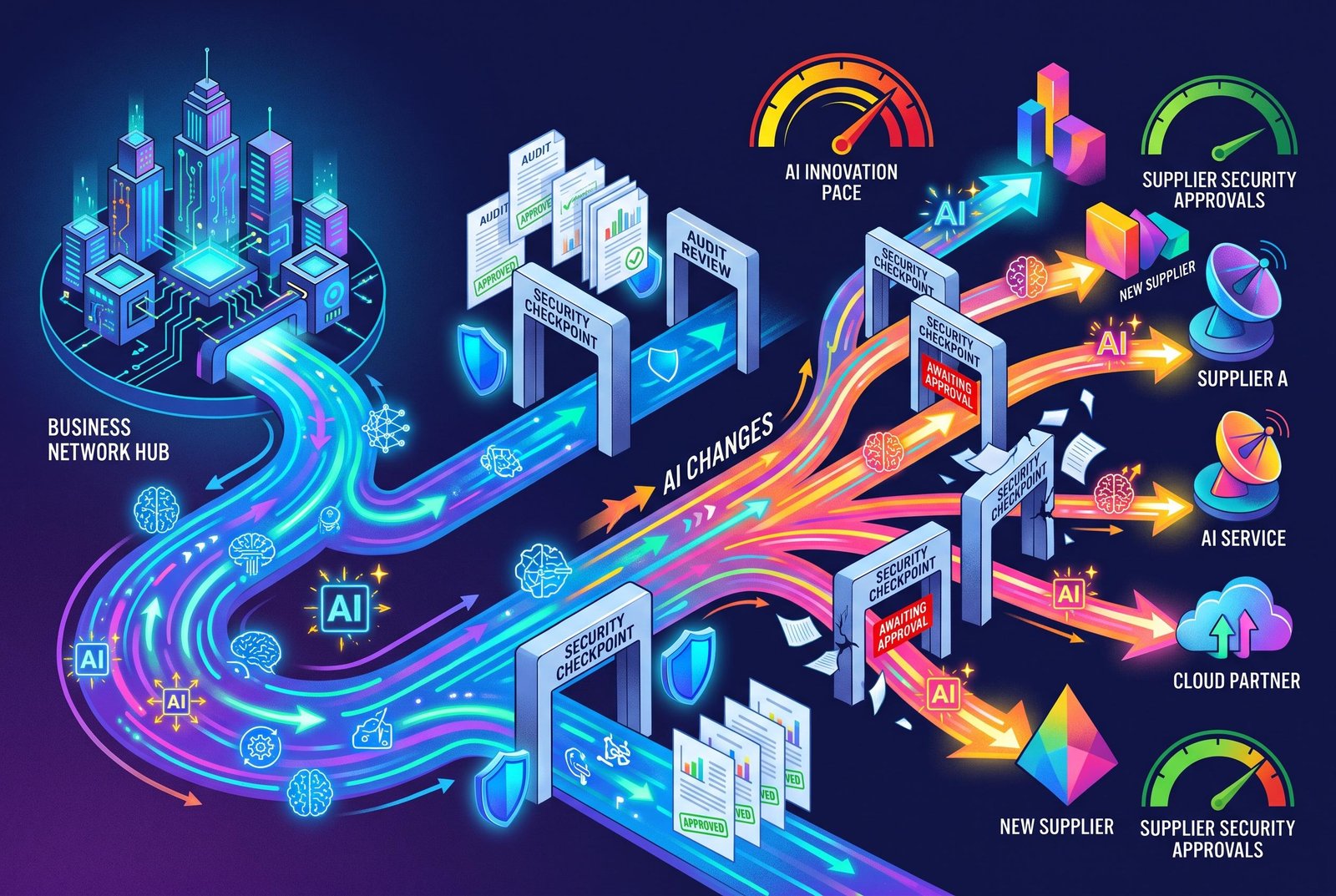
A supplier’s security approval may describe only the service it provided at the time it was assessed. If the vendor later adds an AI feature, changes how data is handled or brings in another technology provider, the organisation’s exposure can shift even though the contract and supplier remain unchanged.
That gap is becoming more significant as businesses adopt AI and rely on increasingly complex technology chains. A company may buy a service from one vendor, while its AI f...
Continue Reading This Article
Enjoy this article as well as all of our content, including reports, news, tips and more.
By registering or signing into your SRM Today account, you agree to SRM Today's Terms of Use and consent to the processing of your personal information as described in our Privacy Policy.
unctions depend on separate model providers, cloud platforms and data processors. Without visibility into those relationships, customers may not know who can access their information, where it is processed or who is responsible if something goes wrong.
The UK Government’s Cyber Security Breaches Survey 2025/2026 points to limited oversight of suppliers. Only 15% of businesses said they formally reviewed the cyber risks posed by immediate suppliers, and just 6% examined the wider supply chain. Among large businesses, the figures were 48% and 24% respectively. The survey also found that 43% of businesses had experienced a cyber security breach or attack in the previous 12 months, with phishing the most commonly reported.
AI use is spreading faster than many organisations’ controls. The survey found that around 31% of businesses were using AI, adopting it or considering it. Among that group, roughly a quarter reported having cyber security practices or processes to manage AI-related risks. The survey cautions that it records attacks organisations identified and reported, meaning some incidents may not appear in the figures.
Traditional supplier reviews, often scheduled according to a vendor’s risk tier, can provide a useful governance structure. But product development does not necessarily follow the review calendar. A material change may occur shortly after an assessment, leaving an organisation dependent on assumptions that no longer reflect the service it is using.
The National Institute of Standards and Technology’s AI Risk Management Framework Playbook recommends documenting plans for managing risks associated with third-party AI systems and monitoring those systems for potential problems. Its suggested actions include keeping records of external components, watching for warning signs such as weak change management, and establishing channels for suppliers to report vulnerabilities, risks or bias. The Playbook is guidance rather than a mandatory checklist, but it reinforces the need to treat external AI resources as an ongoing governance concern.
The central challenge is not to reassess every software update. That would overwhelm most risk teams. Instead, organisations need clear thresholds for reopening an assessment: for example, when an AI component begins processing sensitive information, a new model provider supports a critical service, the purpose of processing changes or an additional subprocessor gains access to protected data. The significance of each change can be judged against the original approval, the supplier’s importance, the sensitivity of the information and the potential consequences of failure.
Data protection obligations add another layer. The Information Commissioner’s Office says organisations should establish the actual roles played by parties handling personal data, rather than relying solely on labels in a contract. Depending on the arrangement, an organisation may be a controller, joint controller or processor, and responsibilities depend on the substance of the processing and the parties’ conduct. AI services can make this analysis less straightforward because providers may make technical decisions about infrastructure, storage or model deployment while still potentially acting as processors.
The ICO’s guidance on controller and processor contracts covers matters including processing instructions, security measures, sub-processors, audits and the end of a contract. Those terms can help clarify responsibilities across a service chain, where a direct supplier depends on other organisations to deliver parts of its offering. The ICO says its relevant guidance is under review following changes made by the Data (Use and Access) Act, so organisations should check for updates.
Contracts and monitoring can help ensure material changes are surfaced. Critical suppliers may be required to notify customers when their AI use, key subprocessors or data-processing arrangements change. External signals such as security alerts and breach notifications are useful, but may not reveal a new model provider working behind an existing feature. Procurement, privacy, legal and security teams therefore need an agreed route for changes to reach the people responsible for supplier-risk decisions.
The National Cyber Security Centre’s 2025 Annual Review also highlights the broader difficulty of supplier assurance, reporting that 14% of UK businesses had reviewed the cyber risk of their immediate suppliers during the preceding year. It points to limits in buyers’ capacity, expertise and tools. For regulated financial organisations in New York, guidance from the state’s Department of Financial Services offers further examples of risk-based oversight, including scrutiny of downstream providers, contractual protections and reassessment. Although that guidance applies to a specific regulatory setting, its emphasis on proportionate controls illustrates how organisations can address supplier dependence without treating every vendor identically.
A practical reassessment should ask whether the technology has changed since approval, whether data now follows a different route, whether another provider has entered the chain and whether the existing control picture still matches the service in use. Approved status remains meaningful only while the conditions behind it remain true. As suppliers add AI capabilities and rely on broader networks of providers, organisations need a reliable way to identify when those conditions have changed, and to act before an incident exposes the gap.
Source: Noah Wire Services