


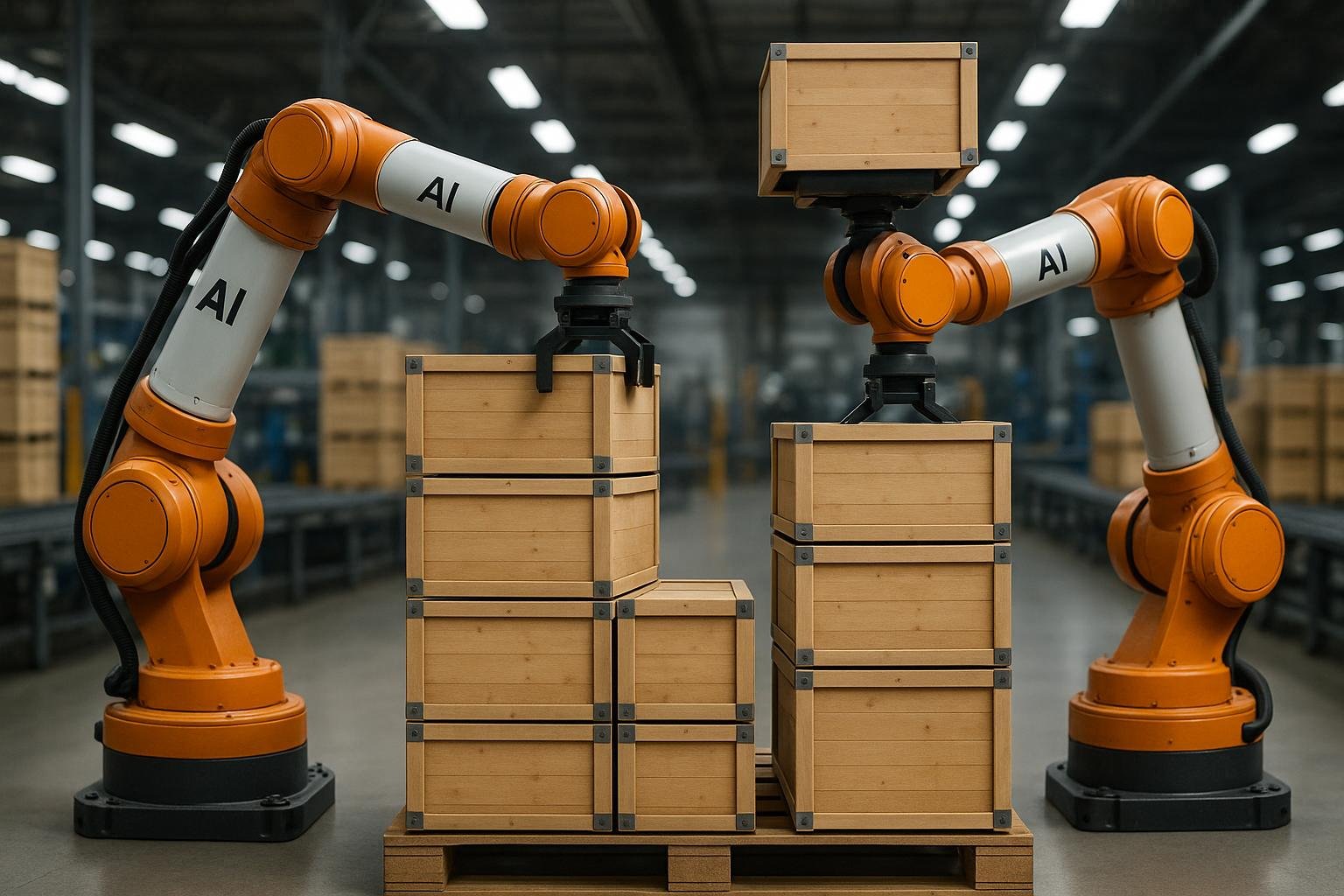
Industry experts reveal that pragmatic, industry-specific AI implementations focused on high-impact, manageable goals are transforming supply chains, enabling smarter decision-making and operational resilience across manufacturing and distribution sectors.

Artificial intelligence (AI) holds great promise for transforming supply chains in manufacturing and distribution, delivering agility and enhanced visibility beyond what legacy systems provide. Yet, despite widespread...
Continue Reading This Article
Enjoy this article as well as all of our content, including reports, news, tips and more.
By registering or signing into your SRM Today account, you agree to SRM Today's Terms of Use and consent to the processing of your personal information as described in our Privacy Policy.
Industry experts emphasize that AI deployments must prioritise incremental transformation focused on concrete business pain points rather than abstract process models. Leading companies typically start by addressing their most critical bottlenecks, such as chronic inventory surpluses caused by poor demand forecasting or excessive manual order interventions. For example, one manufacturer achieved rapid improvements by moving away from spreadsheet-based processes to an automated, real-time visibility system that fine-tuned forecast accuracy and replenishment logic, significantly cutting inventory costs while improving customer fulfillment rates. This incremental, outcomes-driven approach is amplified when supported by managers and executives who sponsor initiatives within their immediate operational contexts, creating momentum through measurable wins.
A key enabler of success is employing AI technologies that augment existing systems rather than attempting disruptive overhauls. Widespread “rip-and-replace” projects in manufacturing often lead to downtime, user resistance, and spiralling costs. Conversely, modern AI platforms work as overlays—intelligent automation that integrates with ERPs, manufacturing execution systems (MES), and legacy applications. Such integration allows the uninterrupted continuation of operations while AI manages procurement signals, sensor analytics, and risk alerts across siloed environments. A leading distributor exemplified this by unlocking actionable insights from fragmented order data without revamping their data architecture, turning planners from reactive problem-solvers into proactive customer-commitment makers within a single fiscal quarter.
Equally vital is the engagement of knowledge workers, whose tacit skills, experience, and judgment underpin day-to-day operations. AI should complement these human assets by codifying best practices, unearthing root causes, and capturing the operational decisions honed over years. Deployments driven from the ground up leverage this “tribal knowledge,” enabling machines to learn embedded business rules beyond explicit data. One distributor’s allocation system, for instance, integrated regional price elasticity, channel impact, and service commitments—dimensions that traditional spreadsheets overlooked—to create a collaborative AI-human network enhancing decision-making rather than replacing analysts.
Success further depends on AI solutions born from a deep understanding of manufacturing and distribution’s distinct needs. Generic platforms often necessitate extensive IT effort to map unique product IDs and retrofit data fields, draining resources with limited value creation. Instead, industry-specific designs embed optimization around compliance protocols, inventory segmentation, transportation modelling, and sector-specific demand irregularities. A multi-market distributor that transitioned to a domain-oriented architecture drastically improved their Sales & Operations Planning process, boosting throughput and gross margins by addressing the actual complexity of cost-to-serve and regional constraints—something off-the-shelf tools failed to capture.
Research reinforces these practical insights. A Gartner survey found that top-performing supply chain organisations adopt AI and machine learning at more than twice the rate of their peers, focusing on productivity gains through integrated investments in digital tools, resources, and talent. High performers move beyond pilot stages to full adoption, unlocking superior decision-making and value extraction. Similarly, an NTT DATA report reveals that 95% of manufacturing leaders across 34 countries already use generative AI to enhance efficiency, especially in supply chain and inventory management, with rapid progress expected as Internet of Things (IoT) data enrich AI models, making them dynamically responsive to real-world conditions.
Moreover, McKinsey highlights AI’s significant value in distribution operations, specifically in planning, warehousing, and transportation. The consultancy recommends a clear, structured roadmap prioritising immediate business value and ensuring AI initiatives are self-funding and self-sustaining. Companies making such strategic investments gain resilience and competitive advantage through improved inventory control, lower logistics costs, and procurement efficiencies.
Real-life exemplars confirm AI’s transformative impact. Retail giants Amazon and Walmart have deployed AI-driven systems that accelerate inventory cycles and optimise delivery routes, yielding efficiency gains and environmental benefits. Additionally, AI-driven supplier evaluation platforms, such as those used by Siemens and Veridion, help assess supplier financial health, compliance, and capacity dynamically, supporting more robust supplier relationship management.
In essence, AI’s true potential in manufacturing and distribution supply chains is realised when deployments are pragmatic, scalable, and deeply integrated into existing operations and human expertise. They must solve specific, high-impact challenges incrementally, respect core transactional systems, and foster collaboration between AI and knowledge workers. Solutions tailored to the industry’s unique processes and characteristics are indispensable. Organisations that embrace these principles move AI beyond technological hype to become foundational drivers of resilience, operational speed, and margin enhancement.
Manufacturers and distributors who ground their AI strategies in these frameworks position themselves not merely to keep up but to lead the next generation of supply chain excellence, setting new benchmarks in agility, efficiency, and innovation.
Michael Romeri, CEO of A2go.ai, encapsulates the view that AI in supply chains thrives where technology, expertise, and industry insight converge, enabling companies to sense, decide, and act in real time—empowering every stakeholder from plant managers to planners to focus on what truly matters.
Source: Noah Wire Services
Subscribe to Industry Updates

