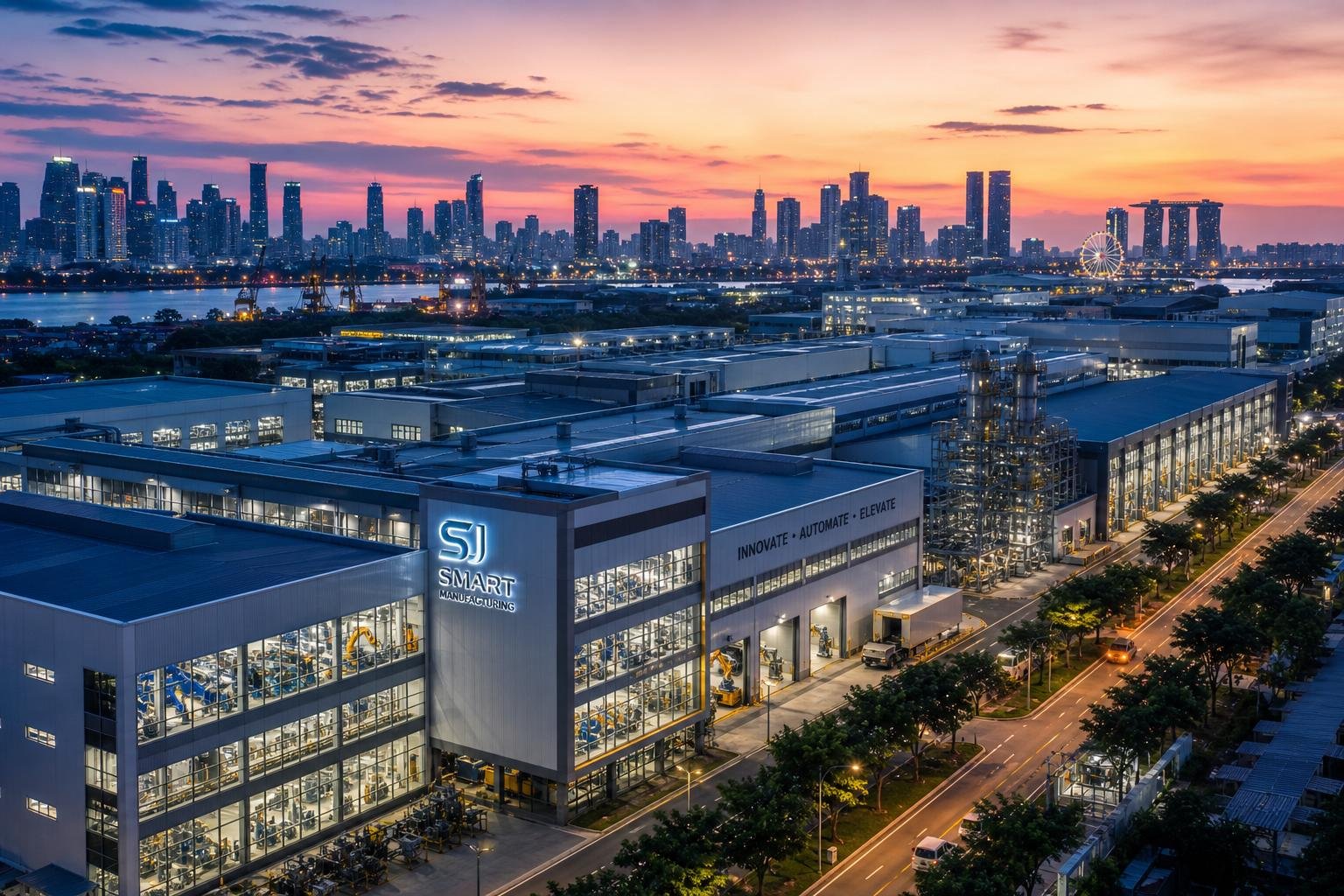
Singapore’s factories are increasingly becoming living test beds for the next generation of manufacturing, with six sites now recognised by the World Economic Forum as among the world’s most advanced production facilities. That is the highest concentration of such plants in South-east Asia, a sign of how the city-state has positioned itself as a regional hub for smart manufacturing, data-led operations and industrial innovation.
The latest addition came in September 2025, w...
Continue Reading This Article
Enjoy this article as well as all of our content, including reports, news, tips and more.
By registering or signing into your SRM Today account, you agree to SRM Today's Terms of Use and consent to the processing of your personal information as described in our Privacy Policy.
hen GlobalFoundries’ 300mm semiconductor plant in Singapore joined the WEF’s Global Lighthouse Network, which spotlights factories that have moved Fourth Industrial Revolution technologies from small pilots into full-scale use. The network has expanded rapidly since its launch in 2018, reaching 201 sites across 30 countries and 35 subsectors after the WEF added 12 new members in its September 2025 intake.
According to the WEF, these facilities are distinguished not just by their use of artificial intelligence, robotics and analytics, but by the way they apply those tools across entire operations to lift output, shorten lead times, improve sustainability and develop workers. Recent additions, it says, are delivering returns faster than earlier pioneers, while also posting sizeable gains in labour productivity and speed.
Singapore’s six lighthouse sites span pharmaceuticals, beverage production, printhead manufacturing and semiconductors. They include Agilent Technologies, Coca-Cola, HP, Infineon, Micron and GlobalFoundries, each using digital systems in slightly different ways but with a common objective: to make production more flexible, more resilient and less resource-intensive.
At Agilent, the Singapore site became the first laboratory technology facility in the world to win Lighthouse status in 2022. The plant has used digital twins, machine learning and AI to manage complex, high-specification instrument production. More than 150 industrial internet of things stations now feed Agilent-designed algorithms for predictive testing, while robots handle demanding tasks and AI-assisted inspection improves quality control. The company says the changes have lifted productivity by 60 per cent and output by 80 per cent.
Coca-Cola’s Tuas concentrate plant, added in 2024, has taken a similarly data-heavy approach. AI forecasting and scheduling tools help the site deal with changing demand and product complexity, while robotics and digital systems support packaging and more intricate production runs. The company says the plant has increased throughput by 28 per cent, raised labour productivity by 70 per cent and cut inventory shortages sharply.
HP’s Singapore operation, which received Lighthouse recognition in 2021, shows how a traditionally labour-intensive line can be redesigned around automation and digital control. Its Falcon production line for printheads and cartridges uses robots, autonomous vehicles, machine vision and plant-wide sensor networks, with additive manufacturing able to produce replacement parts in-house. HP says the result has been lower costs, higher productivity and stronger quality.
In semiconductors, where speed, yield and precision are critical, Singapore has become especially prominent. Infineon’s back-end plant has automated production scheduling and material transfer, and the site is now being pushed further towards autonomous manufacturing. Micron’s Singapore facility, meanwhile, became one of the country’s earliest lighthouse sites in 2020 and later also won Sustainability Lighthouse status, making it the first front-end semiconductor fab globally to hold both distinctions. Micron says its use of big-data systems, AI and smart utilities helped raise output substantially while cutting resource consumption per unit produced.
GlobalFoundries’ recognition in 2025 reinforced that trend. The company says more than 60 transformation projects have been scaled at the Singapore fab since 2020, using machine learning for maintenance, workflow optimisation and quality control. It says those efforts have improved labour productivity and reduced the time needed to prototype new products.
The broader appeal of Singapore for advanced manufacturers goes beyond individual factories. The government has spent years building an ecosystem that combines industrial land, skilled labour, research partnerships and policy support. Roughly 35 per cent of tertiary graduates each year come from STEM disciplines, while companies can tap schemes such as SkillsFuture and Career Conversion Programmes to retrain staff. Industrial estates are also designed around logistics and specialised manufacturing needs, with clusters such as Wafer Fab Park, Tuas Biomedical Park and the Jurong Innovation District giving companies space to co-locate production, research and training.
For firms, that mix matters. The WEF’s lighthouse model is intended to show that digital manufacturing works best when companies can scale ideas across sites rather than leaving them as isolated experiments. Singapore’s cluster of recognised factories suggests it has become one of the clearest places where that shift is already happening.
Source: Noah Wire Services